. 2016 Mar 11;8(3):77.
doi: 10.3390/v8030077.

Characterization of Viral Communities of Biting Midges and Identification of Novel Thogotovirus Species and Rhabdovirus Genus

Affiliations

Characterization of Viral Communities of Biting Midges and Identification of Novel Thogotovirus Species and Rhabdovirus Genus

Sarah Temmam et al. Viruses. .

Abstract

More than two thirds of emerging viruses are of zoonotic origin, and among them RNA viruses represent the majority. Ceratopogonidae (genus Culicoides) are well-known vectors of several viruses responsible for epizooties (bluetongue, epizootic haemorrhagic disease, etc.). They are also vectors of the only known virus infecting humans: the Oropouche virus. Female midges usually feed on a variety of hosts, leading to possible transmission of emerging viruses from animals to humans. In this context, we report here the analysis of RNA viral communities of Senegalese biting midges using next-generation sequencing techniques as a preliminary step toward the identification of potential viral biohazards. Sequencing of the RNA virome of three pools of Culicoides revealed the presence of a significant diversity of viruses infecting plants, insects and mammals. Several novel viruses were detected, including a novel Thogotovirus species, related but genetically distant from previously described tick-borne thogotoviruses. Novel rhabdoviruses were also detected, possibly constituting a novel Rhabdoviridae genus, and putatively restricted to insects. Sequences related to the major viruses transmitted by Culicoides, i.e., African horse sickness, bluetongue and epizootic haemorrhagic disease viruses were also detected. This study highlights the interest in monitoring the emergence and circulation of zoonoses and epizooties using their arthropod vectors.

Keywords: biting midges; epizooties; rhabdovirus; thogotovirus; viral metagenomics; zoonoses.


Figures
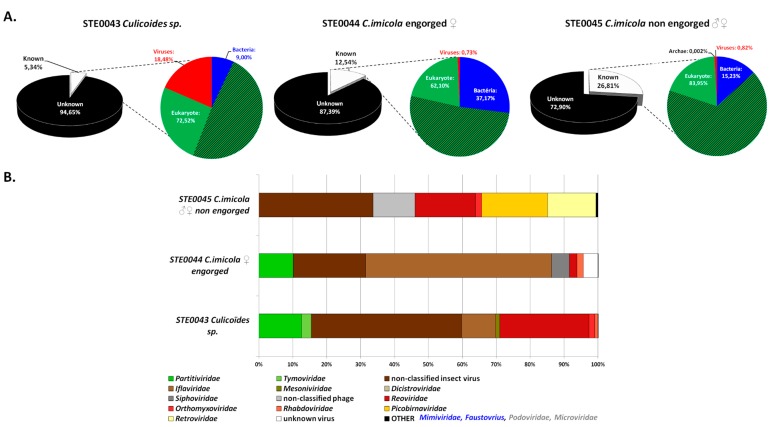
Figure 1
Figure 1
Taxonomic assignment of reads (A) BlastN search against the National Center for Biotechnology Information (NCBI) nucleotide database (dashes correspond to the arthropod-borne proportion of eukaryotic reads) (B) Relative abundance of viral families in biting midge metagenomes according to their target hosts (Green: plant viruses, Brown: insect viruses, Grey: bacteriophages, Red: arboviruses, Yellow: mammalian viruses, Blue: amoeba-infecting giant viruses).
Figure 2
Figure 2
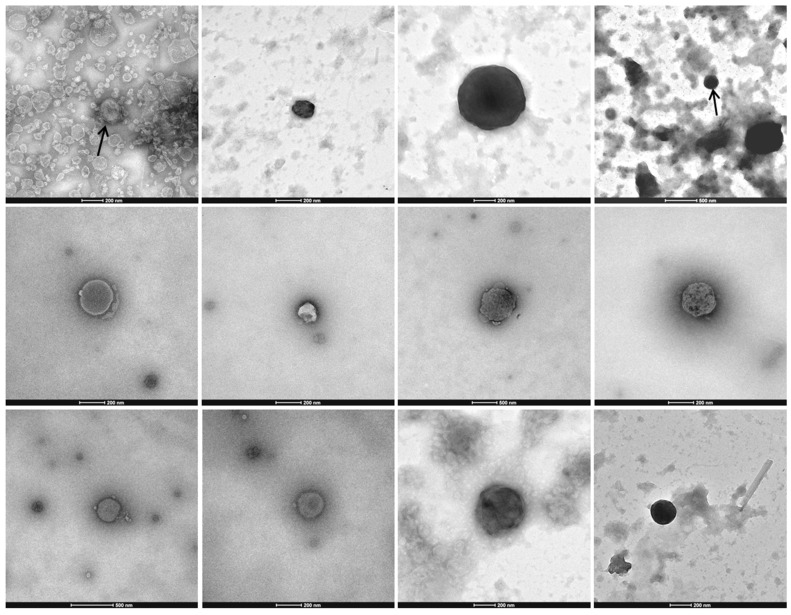
Repertory of transmission electron microscopy images of Culicoides sp. viral communities.
Figure 3
Figure 3
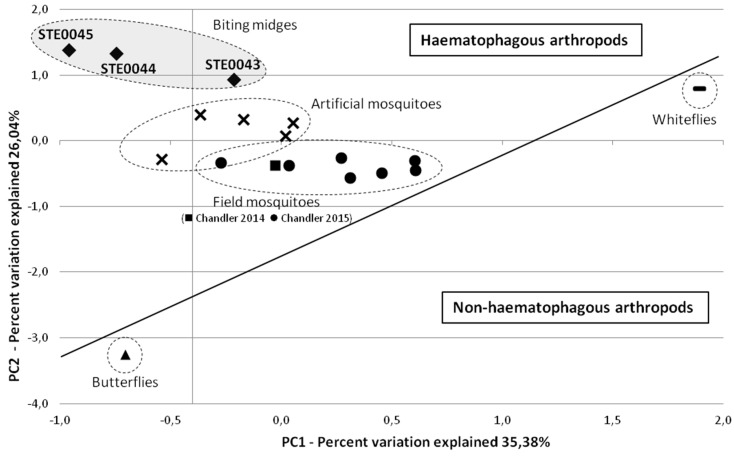
Comparison between viromes of biting midges with available arthropod RNA metagenomes based on a taxonomic classification of reads. Principal component analysis (PCA) was used to compare data in MG-RAST server [21] with a maximum E-value of 10−5, a minimum identity of 60%, and a minimum alignment length of 15 amino-acids for protein and 15 bp for RNA databases. Data were normalised to values between 0 and 1 and distances were measured using the Bray-Curtis distance matrix.
Figure 4
Figure 4
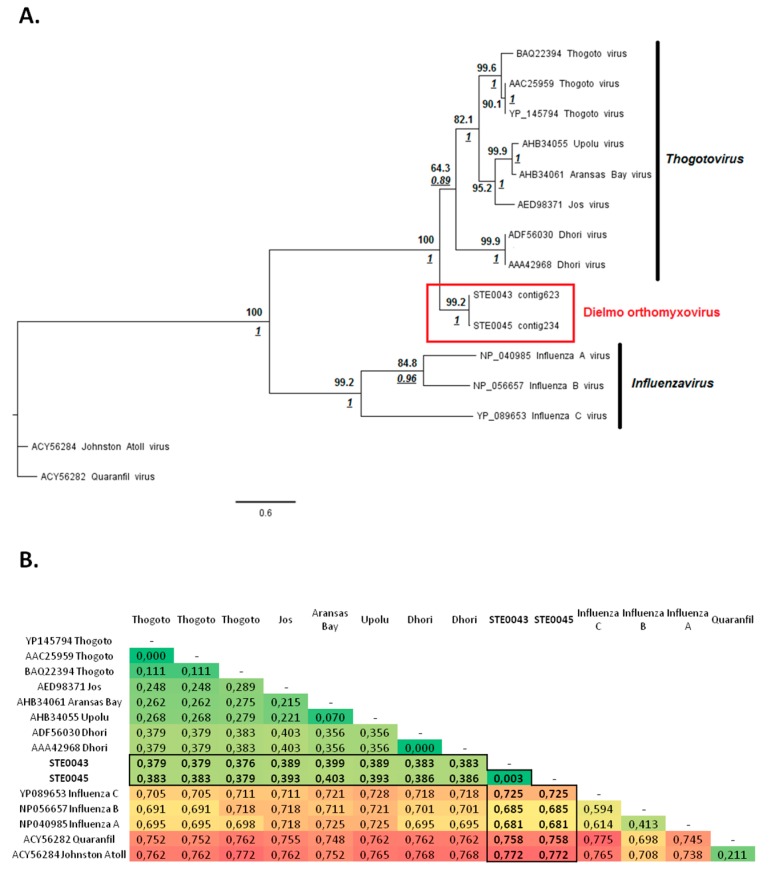
Phylogenetic analyses of Dielmo orthomyxovirus compared to other Thogotovirus viruses. (A) Phylogenetic analysis of a fragment of 358 amino-acids of PB1. ML analysis was used to fix tree topology. ML analysis was performed on 1000 iterations and bootstrap values are represented in bold. Bayesian posterior probabilities are underlined and represented in italics where nodes coincided with ML. Substitutions models for ML and Bayesian analyses were determined as LG+I+G and rtREV+I+G, respectively. Scale bar indicates the number of amino-acid substitutions per site; (B) Matrix of genetic distances observed between PB1 amino-acid sequences of Dielmo orthomyxovirus and other representative thogotoviruses. Diversity was calculated by the pairwise-distance algorithm implemented through MEGA [23].
Figure 5
Figure 5
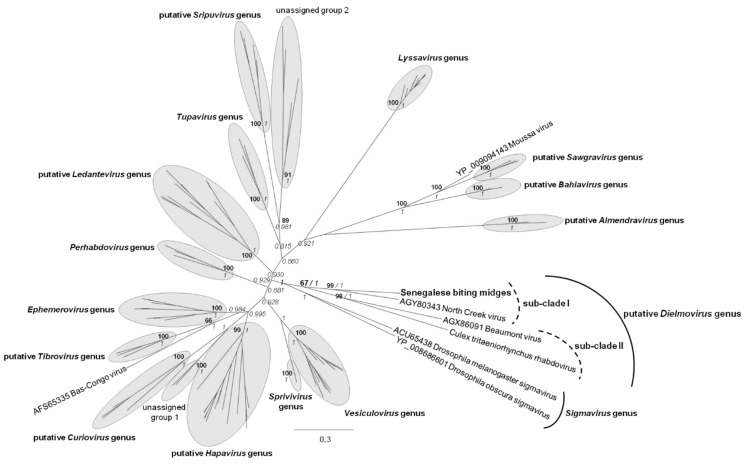
Phylogenetic analysis of Dielmovirus genus compared to other Rhabdoviridae. Phylogenetic analysis of a fragment of 463 amino-acids of the RNA-dependant RNA polymerase. Bayesian inference (BI) analysis was used to fix tree topology. BI analysis was performed on 1,000,000 iterations and nodes with a posterior probability above 0.80 are represented. ML analysis was performed on 1000 iterations and nodes above 65 are represented, when nodes coincided with BI. Recognised or a putative genera are defined as described in [27]. Substitutions models for ML and Bayesian analyses were determined as LG+I+G and rtREV+I+G, respectively. Scale bar indicates the number of amino-acid substitutions per site. Cytorhabdoviruses, Novirhabdoviruses and Nucleorhabdoviruses were excluded from the analysis because sequences were too divergent.
Figure 6
Figure 6
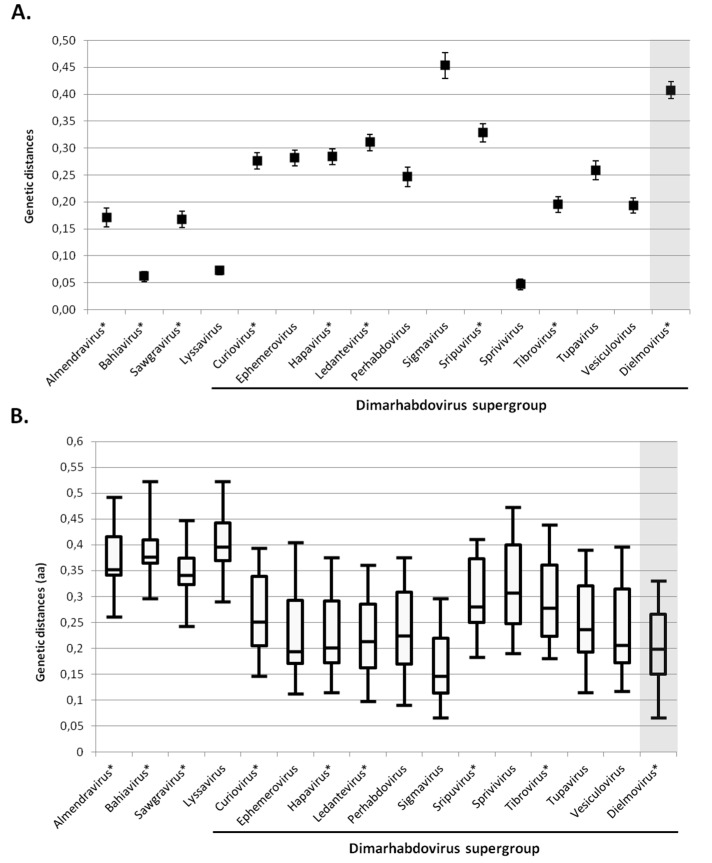
Genetic distances of Dielmovirus genus compared to other Rhabdoviridae. (A) Mean distances within recognised and putative Rhabdoviridae genera (putative genera, as reported in [27], are indicated by a *). Diversity was calculated by the pairwise-distance algorithm implemented through MEGA6 [23], and 1000 bootstrap replications; (B) Distribution of distances between recognised and putative Rhabdoviridae genera (putative genera are indicated by a *). Diversity was calculated by the pairwise-distance algorithm implemented through MEGA6 [23]
Figure 7
Figure 7
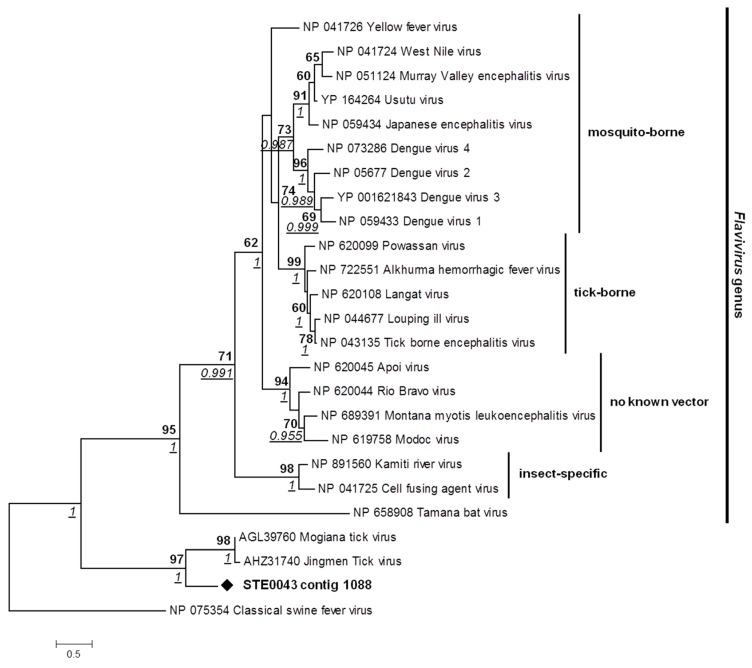
Phylogenetic analysis of Jingmen Tick-like virus. Phylogenetic analysis of a fragment of 319 amino-acids of the NS5 segment. ML analysis was used to fix tree topology. ML analysis was performed on 1000 iterations. Bootstrap values above 60 and posterior probabilities above 0.5 are indicated. Bayesian posterior probabilities are underlined and represented in italics where nodes coincided with ML. Substitution models for ML and Bayesian analyses were determined as LG+G and rtREV+ G, respectively. Scale bar indicates the number of amino-acid substitutions per site.

References

    1. Woolhouse M., Scott F., Hudson Z., Howey R., Chase-Topping M. Human viruses: discovery and emergence. Philos. Trans. R. Soc. Lond. B Biol. Sci. 2012;367:2864–2871. doi: 10.1098/rstb.2011.0354. - DOI - PMC - PubMed
    1. Cutler S.J., Fooks A.R., van der Poel W.H. Public health threat of new, reemerging, and neglected zoonoses in the industrialized world. Emerg. Infect. Dis. 2010;16:1–7. doi: 10.3201/eid1601.081467. - DOI - PMC - PubMed
    1. Temmam S., Davoust B., Berenger J.M., Raoult D., Desnues C. Viral metagenomics on animals as a tool for the detection of zoonoses prior to human infection? Int. J. Mol. Sci. 2014;15:10377–10397. doi: 10.3390/ijms150610377. - DOI - PMC - PubMed
    1. Bishop-Lilly K.A., Turell M.J., Willner K.M., Butani A., Nolan N.M., Lentz S.M., Akmal A., Mateczun A., Brahmbhatt T.N., Sozhammannan S., et al. Arbovirus detection in insect vectors by rapid, high-throughput pyrosequencing. PLoS Negl. Trop. Dis. 2010;4 doi: 10.1371/journal.pntd.0000878. - DOI - PMC - PubMed
    1. Dinsdale E.A., Edwards R.A., Hall D., Angly F., Breitbart M., Brulc J.M., Furlan M., Desnues C., Haynes M., Li L., et al. Functional metagenomic profiling of nine biomes. Nature. 2008;452:629–632. doi: 10.1038/nature06810. - DOI - PubMed

Publication types

LinkOut - more resources