. 2016 Mar 10;8(3):68.
doi: 10.3390/toxins8030068.

Heart Alterations after Domoic Acid Administration in Rats

Affiliations

Heart Alterations after Domoic Acid Administration in Rats

Andres C Vieira et al. Toxins (Basel). .

Abstract

Domoic acid (DA) is one of the best known marine toxins, causative of important neurotoxic alterations. DA effects are documented both in wildlife and experimental assays, showing that this toxin causes severe injuries principally in the hippocampal area. In the present study we have addressed the long-term toxicological effects (30 days) of DA intraperitoneal administration in rats. Different histological techniques were employed in order to study DA toxicity in heart, an organ which has not been thoroughly studied after DA intoxication to date. The presence of DA was detected by immunohistochemical assays, and cellular alterations were observed both by optical and transmission electron microscopy. Although histological staining methods did not provide any observable tissue damage, transmission electron microscopy showed several injuries: a moderate lysis of myofibrils and loss of mitochondrial conformation. This is the first time the association between heart damage and the presence of the toxin has been observed.

Keywords: cardiotoxicity; domoic acid; electron microscopy; immunohistochemistry; phycotoxin.


Figures
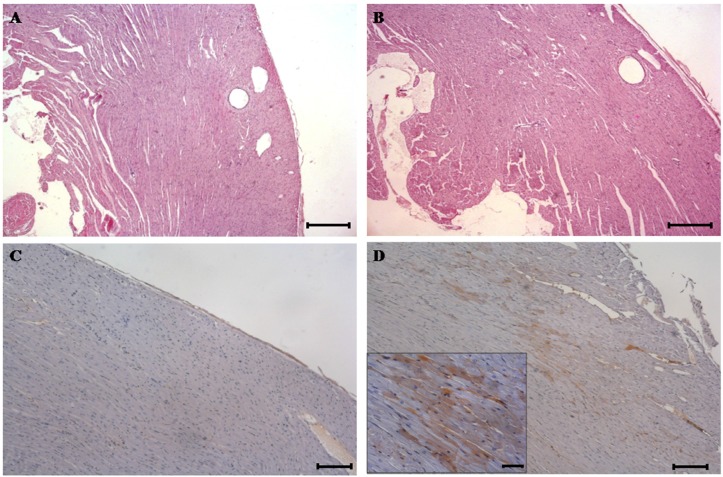
Figure 1
Figure 1
Haematoxylin and eosin (H & E) stained sections of heart tissue from control and domoic acid (DA)-treated rats. (A) H & E-stained sections from control rats. (original magnification, ×40, scale bar = 200 μm); (B) H & E-stained sections of heart tissue from DA-treated rats showing no visible damage (original magnification, ×40, scale bar = 200 μm); (C) DA Immunohistochemistry (IHC) of the heart from control rats. The phycotoxin is absent throughout the tissue. IHC with DA antibody 1:5000 (original magnification, ×100, scale bar = 60 μm); (D) DA IHC of heart from DA-treated rats showing immunoreactivity in myocardium. IHC with DA antibody 1:5000 (original magnification,×100, scale bar = 60 μm). The boxed area shows the positive immunostaining located in the cytoplasm of the cardiomyocytes at higher magnifications (original magnification, ×400, scale bar = 20 μm).
Figure 2
Figure 2
Transmission Electron Microscopy (TEM) of heart samples from control and DA-treated rats. (A) Cardiomyocyte from of a control specimen showing the typical arrangement of myofibrils and mitochondria (M); (B) Ultrastructure of rat cardiac muscle from a DA-treated rat. A moderate lysis of myofibrils (arrows) and degeneration of mitochondria (M) can be observed; (C) Cardiomyocyte from a control specimen showing mitochondria (M) with their usual shape and electron density; (D) Cardiomyocyte from DA treated rat showing degenerated mitochondria (M). These organelles had lost their habitual rounded shape, they were less electron dense than mitochondria of control animals and displayed cristolysis.

References

    1. Hallegraeff G.M. Harmful algal blooms: A global overview. In: Anderson D.M., Cembella A.M., editors. Manual on Harmful Marine Microalgae IOC Manuals and Guides No. 33. UNESCO. International Oceanographic Comission, United Nations Educational, Scientific and Cultural Organization; Paris, France: 1995. pp. 1–22.
    1. Kotaki Y., Koike K., Sato S., Ogata T., Fukuyo Y., Kodama M. Confirmation of domoic acid production of Pseudo-nitzschia multiseries isolated from Ofunato Bay, Japan. Toxicon. 1999;37:677–682. doi: 10.1016/S0041-0101(98)00210-4. - DOI - PubMed
    1. Friedman M.A., Levin B.E. Neurobehavioral effects of harmful algal bloom (HAB) toxins: A critical review. J. Int. Neuropsychol. Soc. 2005;11:331–338. doi: 10.1017/S1355617705050381. - DOI - PubMed
    1. Todd E.C. Emerging diseases associated with seafood toxins and other water-borne agents. Ann. N. Y. Acad. Sci. 1994;74:77–94. doi: 10.1111/j.1749-6632.1994.tb19855.x. - DOI - PubMed
    1. Lefebvre K.A., Robertson A. Domoic acid and human exposure risks: A review. Toxicon. 2010;56:218–230. doi: 10.1016/j.toxicon.2009.05.034. - DOI - PubMed

Publication types

LinkOut - more resources
