Review
. 2016 Jul;73(13):2511-30.
doi: 10.1007/s00018-016-2175-4. Epub 2016 Mar 15.

Modulatory effects of α7 nAChRs on the immune system and its relevance for CNS disorders

Affiliations
Review

Modulatory effects of α7 nAChRs on the immune system and its relevance for CNS disorders

Hans O Kalkman et al. Cell Mol Life Sci. 2016 Jul.

Abstract

The clinical development of selective alpha-7 nicotinic acetylcholine receptor (α7 nAChR) agonists has hitherto been focused on disorders characterized by cognitive deficits (e.g., Alzheimer's disease, schizophrenia). However, α7 nAChRs are also widely expressed by cells of the immune system and by cells with a secondary role in pathogen defense. Activation of α7 nAChRs leads to an anti-inflammatory effect. Since sterile inflammation is a frequently observed phenomenon in both psychiatric disorders (e.g., schizophrenia, melancholic and bipolar depression) and neurological disorders (e.g., Alzheimer's disease, Parkinson's disease, and multiple sclerosis), α7 nAChR agonists might show beneficial effects in these central nervous system disorders. In the current review, we summarize information on receptor expression, the intracellular signaling pathways they modulate and reasons for receptor dysfunction. Information from tobacco smoking, vagus nerve stimulation, and cholinesterase inhibition is used to evaluate the therapeutic potential of selective α7 nAChR agonists in these inflammation-related disorders.

Keywords: Autism; CREB; Dyskinesia; GSK3; Lithium; Nrf2; Suicide.


Conflict of interest statement

All authors declare that this review was prepared without external support. Hans O. Kalkman has no conflicts of interest. Dominik Feuerbach is an employee of Novartis.

Figures
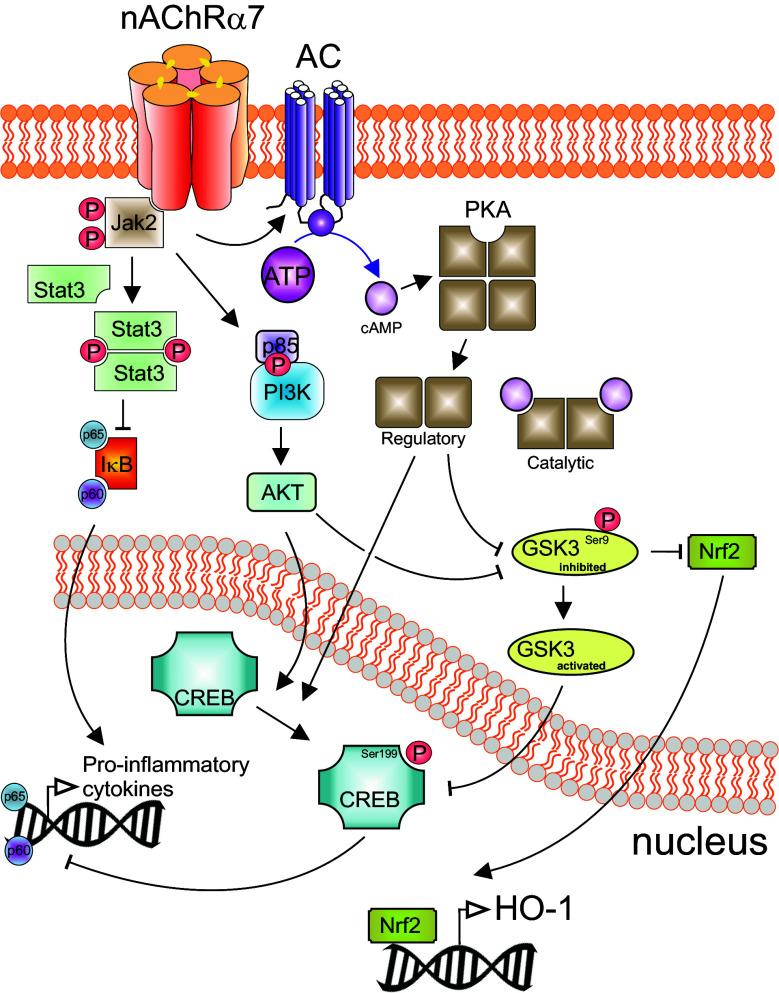
Fig. 1
Fig. 1
Schematic anti-inflammatory signaling pathways activated by nAChR α7. Stimulation of nAChR α7 activates Jak2 leading to inhibition of NFκB and GSK3 but also to CREB activation. A separate signaling cascade involves activation of PKA and AKT enabling the nuclear translocation of Nrf2 (NFE2L2), which drives expression of HMOX1 (HO-1). This pathway elicits potent anti-inflammatory and neuroprotective effects
Fig. 2
Fig. 2
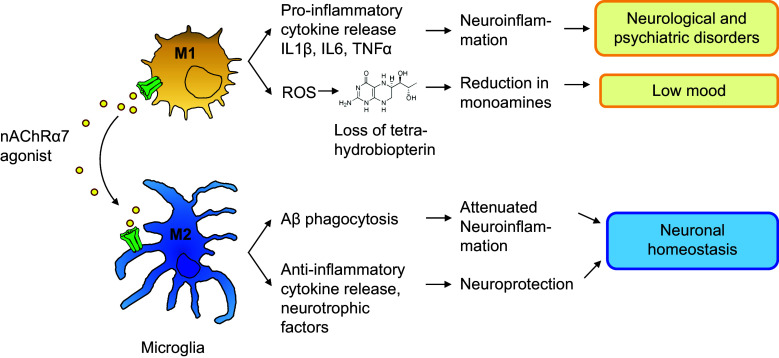
Microglia cells play a role in eradication of invading microorganisms and in removal of debris. During these processes, the cells adapt specialized phenotypes (M1 and M2-like, respectively). During the respiratory burst, labile oxygen products are formed that oxidize microbial proteins and nucleic acids, but also oxidize the essential cofactor for monoamine synthesis, tetrahydrobiopterin. Sterile neuroinflammation is a common observation in neurological and psychiatric disorders. Acetylcholine, acting via α7 nAChRs, promotes M2-polarization. As such, it reduces neuroinflammation, while promoting phagocytosis. M2-polarized microglia cells not only produce neurotrophins and anti-inflammatory cytokines, they also effectively phagocytose and catabolize Aβ. α7 nAChR agonists are expected to improve neurological and psychiatric disorders via inhibition of neuroinflammation, to restore tetrahydrobiopterin levels (improve mood symptoms) and to provide neuroprotection
Fig. 3
Fig. 3
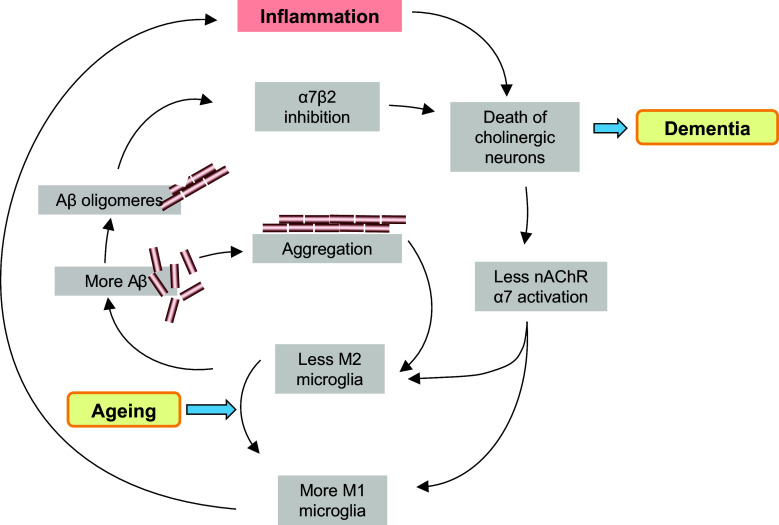
During aging the polarization of microglia gradually shifts towards the M1 phenotype. Diminution of M2 polarization presumably has negative consequences for Aβ catabolism. When extracellular Aβ levels increase, several positive feedback loops are triggered that ultimately lead to the demise of cholinergic neurons. Activation of α7 nAChRs counteracts the loss of the M2 phenotype. α7 nAChR agonists may furthermore compete with Aβ at (mitochondrial?) nicotinic α7β2 receptors. Treatment with α7 nAChR agonists might therefore delay the demise of cholinergic neurons, and thus delay the onset of dementia

References

    1. Marutle A, Zhang X, Court J, Piggott M, Johnson M, Perry R, Perry E, Nordberg A. Laminar distribution of nicotinic receptor subtypes in cortical regions in schizophrenia. J Chem Neuroanat. 2001;22:115–126. doi: 10.1016/S0891-0618(01)00117-X. - DOI - PubMed
    1. Hurst R, Rollema H, Bertrand D. Nicotinic acetylcholine receptors: from basic science to therapeutics. Pharmacol Ther. 2013;137:22–54. doi: 10.1016/j.pharmthera.2012.08.012. - DOI - PubMed
    1. Dineley KT, Pandya AA, Yakel JL. Nicotinic ACh receptors as therapeutic targets in CNS disorders. Trends Pharmacol Sci. 2015;36:96–108. doi: 10.1016/j.tips.2014.12.002. - DOI - PMC - PubMed
    1. John D, Shelukhina I, Yanagawa Y, Deuchars J, Henderson Z. Functional alpha7 nicotinic receptors are expressed on immature granule cells of the postnatal dentate gyrus. Brain Res. 2015;1601:15–30. doi: 10.1016/j.brainres.2014.12.041. - DOI - PMC - PubMed
    1. Shen JX, Yakel JL. Functional alpha7 nicotinic ACh receptors on astrocytes in rat hippocampal CA1 slices. J Mol Neurosci. 2012;48:14–21. doi: 10.1007/s12031-012-9719-3. - DOI - PMC - PubMed

MeSH terms

Substances