Refugee migration and risk of schizophrenia and other non-affective psychoses: cohort study of 1.3 million people in Sweden
- PMID: 26979256
- PMCID: PMC4793153
- DOI: 10.1136/bmj.i1030
Refugee migration and risk of schizophrenia and other non-affective psychoses: cohort study of 1.3 million people in Sweden
Erratum in
-
Refugee migration and risk of schizophrenia and other non-affective psychoses: cohort study of 1.3 million people in Sweden.BMJ. 2016 May 27;353:i2865. doi: 10.1136/bmj.i2865. BMJ. 2016. PMID: 27233674 No abstract available.
Abstract
Objective: To determine whether refugees are at elevated risk of schizophrenia and other non-affective psychotic disorders, relative to non-refugee migrants from similar regions of origin and the Swedish-born population.
Design: Cohort study of people living in Sweden, born after 1 January 1984 and followed from their 14th birthday or arrival in Sweden, if later, until diagnosis of a non-affective psychotic disorder, emigration, death, or 31 December 2011.
Setting: Linked Swedish national register data.
Participants: 1,347,790 people, including people born in Sweden to two Swedish-born parents (1,191,004; 88.4%), refugees (24,123; 1.8%), and non-refugee migrants (132,663; 9.8%) from four major refugee generating regions: the Middle East and north Africa, sub-Saharan Africa, Asia, and Eastern Europe and Russia.
Main outcome measures: Cox regression analysis was used to estimate adjusted hazard ratios for non-affective psychotic disorders by refugee status and region of origin, controlling for age at risk, sex, disposable income, and population density.
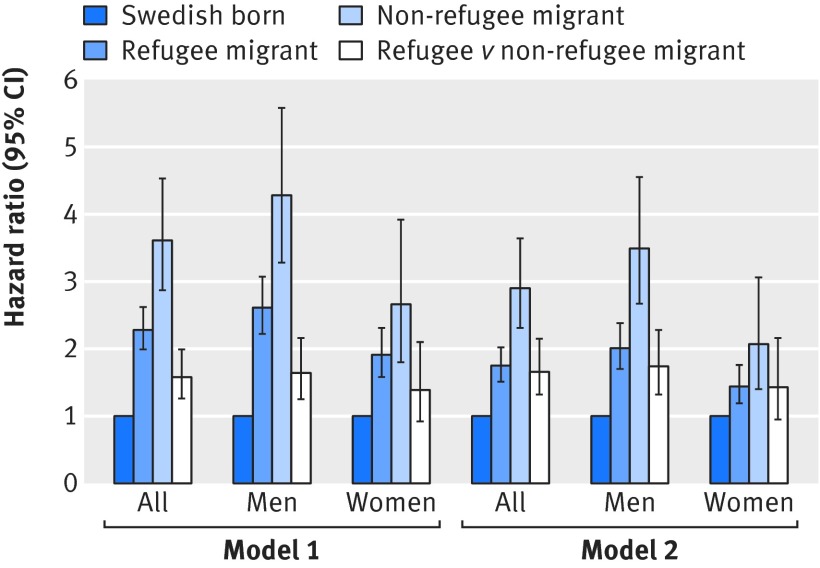
Results: 3704 cases of non-affective psychotic disorder were identified during 8.9 million person years of follow-up. The crude incidence rate was 38.5 (95% confidence interval 37.2 to 39.9) per 100,000 person years in the Swedish-born population, 80.4 (72.7 to 88.9) per 100,000 person years in non-refugee migrants, and 126.4 (103.1 to 154.8) per 100,000 person years in refugees. Refugees were at increased risk of psychosis compared with both the Swedish-born population (adjusted hazard ratio 2.9, 95% confidence interval 2.3 to 3.6) and non-refugee migrants (1.7, 1.3 to 2.1) after adjustment for confounders. The increased rate in refugees compared with non-refugee migrants was more pronounced in men (likelihood ratio test for interaction χ(2) (df=2) z=13.5; P=0.001) and was present for refugees from all regions except sub-Saharan Africa. Both refugees and non-refugee migrants from sub-Saharan Africa had similarly high rates relative to the Swedish-born population.
Conclusions: Refugees face an increased risk of schizophrenia and other non-affective psychotic disorders compared with non-refugee migrants from similar regions of origin and the native-born Swedish population. Clinicians and health service planners in refugee receiving countries should be aware of a raised risk of psychosis in addition to other mental and physical health inequalities experienced by refugees.
Published by the BMJ Publishing Group Limited. For permission to use (where not already granted under a licence) please go to http://group.bmj.com/group/rights-licensing/permissions.
Conflict of interest statement
Competing interests: All authors have completed the ICMJE uniform disclosure form at
Figures
Comment in
-
Non-affective psychosis in refugees.BMJ. 2016 Mar 15;352:i1279. doi: 10.1136/bmj.i1279. BMJ. 2016. PMID: 26980587 No abstract available.
References
Publication types
MeSH terms
Grants and funding
LinkOut - more resources
Full Text Sources
Other Literature Sources
Medical
Miscellaneous