


Editorial
doi: 10.1093/neuonc/now003.
Epub 2016 Mar 14.
MicroRNAs provide a novel pathway toward combinatorial immune checkpoint blockade
Affiliations
- PMID: 26980424
- PMCID: PMC4827049
- DOI: 10.1093/neuonc/now003
Item in Clipboard
Editorial
MicroRNAs provide a novel pathway toward combinatorial immune checkpoint blockade
Neuro Oncol.
2016 May.
No abstract available
Figures
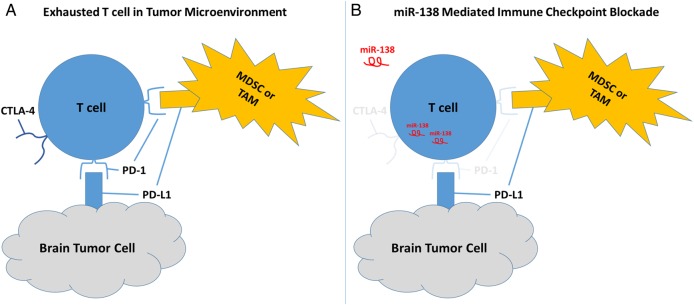
(A) T cells within the tumor microenvironment and tumor draining lymph nodes encounter immune checkpoint inhibition through interactions with tumor cells, myeloid-derived suppressor cells (MDSCs), and tumor-associated macrophages (TAMs). Depicted is the expression of programmed death ligand 1 (PD-L1) on tumor cells and myeloid-lineage suppressor cells engaging the PD-1 receptor on T cells leading to immune suppression. T cells expressing the inhibitory receptor, CTLA-4, also encounter their regulatory ligands expressed on myeloid cells within the tumor microenvironment and lymph nodes. (B) The delivery of miR-138 to T cells inhibits expression of the PD-1 receptor, thus rendering the T cell resistant to inhibition by PD-L1 on the surface of tumor cells, MDSCs, or TAMs. The miR-138 mediated downregulation of the PD-1 receptor may allow for effective maintenance of antitumor immunity in the treated host. MiR-138 delivery was shown to also downregulate expression of CTLA-4 and FoxP3 (not shown), leading to the stimulation of effective antitumor immunity in the GL261 glioma model.
Comment on
-
MiR-138 exerts anti-glioma efficacy by targeting immune checkpoints.Neuro Oncol. 2016 May;18(5):639-48. doi: 10.1093/neuonc/nov292. Epub 2015 Dec 11. Neuro Oncol. 2016. PMID: 26658052 Free PMC article.
References
-
- Ott PA, Hodi FS, Robert C. CTLA-4 and PD-1/PD-L1 blockade: new immunotherapeutic modalities with durable clinical benefit in melanoma patients. Clin Cancer Res. 2013;19(19):5300–5309. - PubMed
Publication types
MeSH terms
Substances
LinkOut - more resources
Full Text Sources
Other Literature Sources
