Randomized Controlled Trial
. 2016 Jan 5:4:124-37.
doi: 10.1016/j.ebiom.2015.12.023. eCollection 2016 Feb.

Oral Phage Therapy of Acute Bacterial Diarrhea With Two Coliphage Preparations: A Randomized Trial in Children From Bangladesh

Affiliations
Randomized Controlled Trial

Oral Phage Therapy of Acute Bacterial Diarrhea With Two Coliphage Preparations: A Randomized Trial in Children From Bangladesh

Shafiqul Alam Sarker et al. EBioMedicine. .

Abstract

Background: Antibiotic resistance is rising in important bacterial pathogens. Phage therapy (PT), the use of bacterial viruses infecting the pathogen in a species-specific way, is a potential alternative.

Method: T4-like coliphages or a commercial Russian coliphage product or placebo was orally given over 4 days to Bangladeshi children hospitalized with acute bacterial diarrhea. Safety of oral phage was assessed clinically and by functional tests; coliphage and Escherichia coli titers and enteropathogens were determined in stool and quantitative diarrhea parameters (stool output, stool frequency) were measured. Stool microbiota was studied by 16S rRNA gene sequencing; the genomes of four fecal Streptococcus isolates were sequenced.

Findings: No adverse events attributable to oral phage application were observed (primary safety outcome). Fecal coliphage was increased in treated over control children, but the titers did not show substantial intestinal phage replication (secondary microbiology outcome). 60% of the children suffered from a microbiologically proven E. coli diarrhea; the most frequent diagnosis was ETEC infections. Bacterial co-pathogens were also detected. Half of the patients contained phage-susceptible E. coli colonies in the stool. E. coli represented less than 5% of fecal bacteria. Stool ETEC titers showed only a short-lived peak and were otherwise close to the replication threshold determined for T4 phage in vitro. An interim analysis after the enrollment of 120 patients showed no amelioration in quantitative diarrhea parameter by PT over standard care (tertiary clinical outcome). Stool microbiota was characterized by an overgrowth with Streptococcus belonging to the Streptococcus gallolyticus and Streptococcus salivarius species groups, their abundance correlated with quantitative diarrhea outcome, but genome sequencing did not identify virulence genes.

Interpretation: Oral coliphages showed a safe gut transit in children, but failed to achieve intestinal amplification and to improve diarrhea outcome, possibly due to insufficient phage coverage and too low E. coli pathogen titers requiring higher oral phage doses. More knowledge is needed on in vivo phage-bacterium interaction and the role of E. coli in childhood diarrhea for successful PT.

Funding: The study was supported by a grant from Nestlé Nutrition and Nestlé Health Science. The trial was registered with Identifier NCT00937274 at ClinicalTrials.gov.

Keywords: Bacteriophages; Bangladesh; Bifidobacterium; Cfu, colony forming unit; Children; Diarrhea; EAEC, enteroaggregative E. coli; EPEC, enteropathogenic E. coli; ETEC, enterotoxigenic E. coli; Escherichia coli; M, ColiProteus phage cocktail from Microgen; ORS, oral rehydration solution; P, placebo; PT, phage therapy; RCT, randomized controlled trial; Streptococcus; T, T4 phage cocktail from NRC; pfu, plaque forming unit; qPCR, quantitative polymerase chain reaction.


Figures
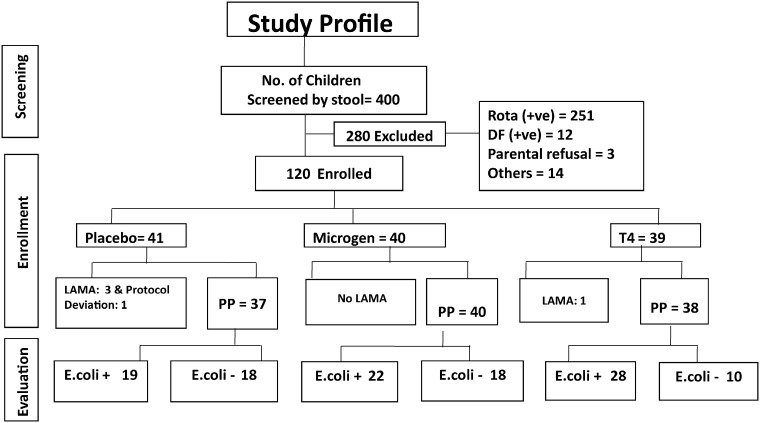
Fig. 1
Fig. 1
Study flow chart. The numbers indicate the children with diarrhea who were screened, enrolled and evaluated. Rota(+ ve), patients with rotavirus positive stool in ELISA; DF(+ ve), patients with V. cholerae positive stool in dark field microscopy; others, patients meeting other exclusion criteria; Microgen, commercial ColiProteus phage cocktail from Microgen, Russia; T4, phage cocktail consisting of T4-like phages from NRC; LAMA, left the study against medical advice; PP, per protocol, E. coli +, patient displaying a pathogenic E. coli in the stool; E. coli-patient without a pathogenic E. coli in the stool.
Fig. 2
Fig. 2
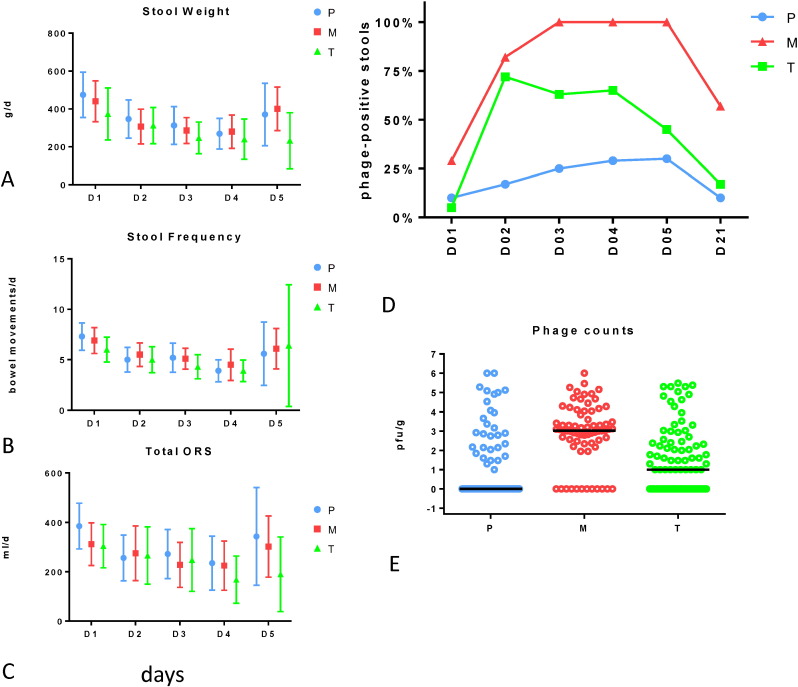
Oral phages reach the intestine in children hospitalized with acute bacterial diarrhea, but show no impact on quantitative clinical diarrhea outcomes. Left: Mean and standard deviation for stool weight (measured without urine contamination) in g/day (A), stool frequency per day (B), and need for oral rehydration solution in ml/day to correct dehydration (C) for the specified day of hospitalization in children enrolled into the three treatment groups identified by the color code. No significant difference was detected between the treatment groups. Right, D: Prevalence of phage positive stools (≥ 10 pfu/g stool on E. coli indicator strain K-12) at the indicated time points (D01–05: days 1 to 5 of hospitalization; D21: re-convalescent visit 21 days after hospital admission) in the three treatment groups; green: NRC T4-like phage cocktail (T), red: Russian Microgen phage cocktail (M), blue: placebo (P). E: Titer distribution and median fecal phage titer in log10 pfu/g stool for the indicated treatment groups.
Fig. 3
Fig. 3
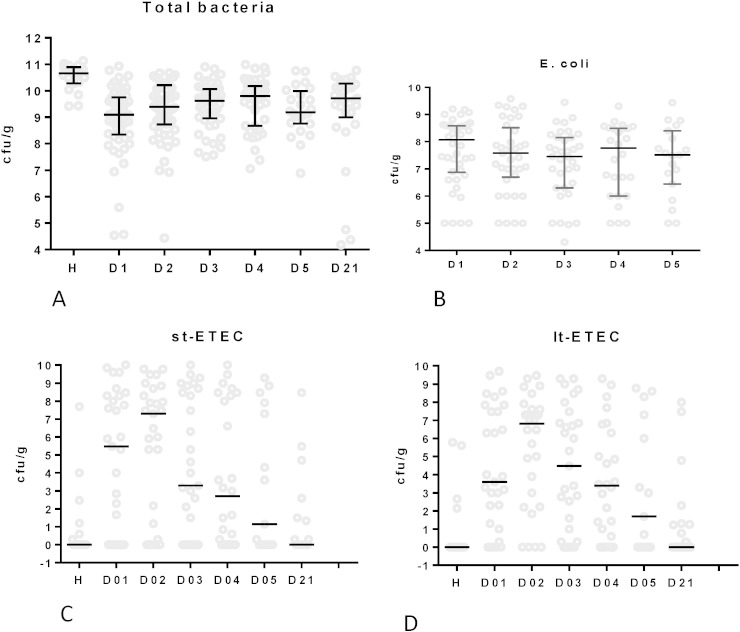
Total bacteria, E. coli and enterotoxigenic E. coli titer development in serial stool samples of hospitalized children during an episode of acute diarrhea. A. Median titer with interquartile range for total stool bacteria determined by real time qPCR with universal bacterial 16S rDNA primers; expressed as log10 cfu/g stool equivalents for healthy local control children (H) and diarrhea patients at the indicated day after hospital admission. Only H is significantly different from the other time points (Dumm's multiple comparisons tests). B. Median with interquartile range of viable E. coli counts on MacConkey agar determined as log10 cfu/g fresh stool (ordinate) for the indicated day of hospitalization of diarrhea patients (no significant difference). C and D. Titer distribution and median titers for heat-stable (st-ETEC, C) and heat-labile (lt-ETEC, D) enterotoxin-carrying bacteria in the stool of diarrhea patients hospitalized with a microbiologically confirmed ETEC infection. Titers determined by real time PCR are for the indicated days of hospitalization and are compared to healthy control children (H). The titers are expressed as log10 median titers in ETEC cfu equivalents.
Fig. 4
Fig. 4
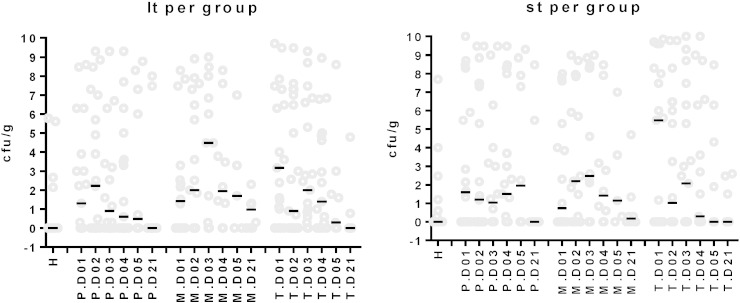
No oral phage treatment effect on fecal ETEC titers. Titer distribution and median titers for heat-labile (lt, left) and heat-stable (st, right) enterotoxin gene-carrying ETEC bacteria in the stool of diarrhea patients treated with placebo (P), Microgen phage (M) or NRC T4 phage (T). Titers were determined by real time PCR for the indicated day of hospitalization (D01 to D05) and the return visit (D21). Titers in healthy control children (H) are given for comparison. The titers are expressed as log10 titers in ETEC cfu equivalents.
Fig. 5
Fig. 5
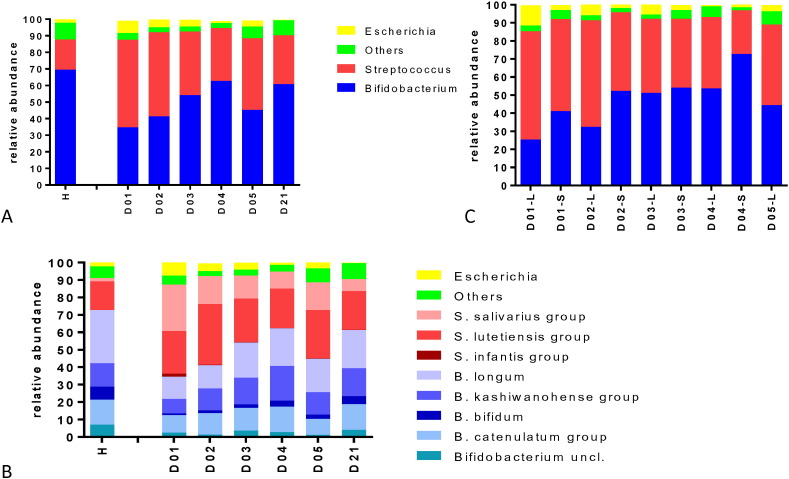
Fecal microbiota analysis by 16S rRNA gene sequencing in serial stool samples from children hospitalized with acute bacterial diarrhea. A. Bacterial community structure profiles for fecal samples from 20 healthy control children (H) and 56 diarrhea patients at the indicated day of hospitalization (D01–D21). The panel gives the mean relative abundance in percent for the bacterial genera identified by the color code at the right. B. Bacterial community structure at species level. Healthy controls (H) and diarrhea patients at the specified day of hospitalization are displayed for relative abundance at species level defined by the color code at the right. S. salivarius and S. vestibularis are members of the S. salivarius group. S. lutetiensis, S. infantarius, S. equinus, S. pasteurianus, S. gallolyticus, S. macedonicus, S. alactolyticus and S. porcorum are members of the S. gallolyticus group. B. catenulatum, B. pseudocatenulatum, B. angulatum, B. ruminantium, B. merycicum, B. adolescentis, B. dentium, and B. stercoris are members of the B. catenulatum group. B. kashiwanohense and B. breve are members of the B. kashiwanohense group. C. Bacterial community structure for 56 diarrhea patients that were hospitalized for 4 day (S—short stay) or 5 days (L—long stay) at the specified day of hospitalization. The panel gives the mean relative abundance in percent for the bacterial genera identified by the same color code as in panel A.
Fig. 6
Fig. 6
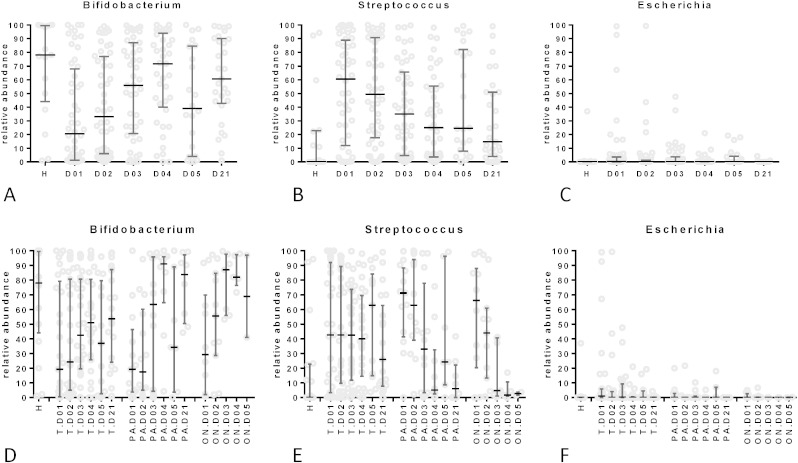
Succession of the three major bacterial genera in the gut microbiota during recovery from diarrhea. Median percentage with interquartile range and distribution for the individual patients with respect to Bifidobacterium (A and D), Streptococcus (B and E) and Escherichia (D and F) contribution to the stool microbiota at the indicated day of hospitalization. In A to C data are presented for all investigated diarrhea patients; in D–F, patients were separated with respect to etiology (ON: other bacterial pathogens than E. coli and no pathogens detected; PA: EPEC and EAEC; T: ETEC infections) compared to healthy local controls (H).
Fig. 7
Fig. 7
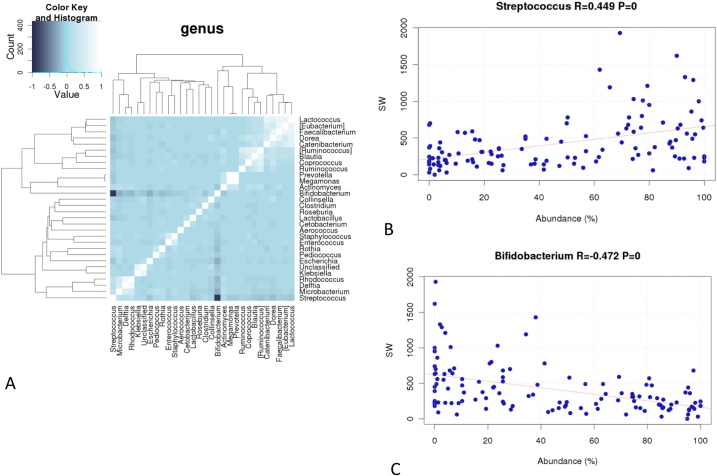
Anti-correlation between Streptococcus and Bifidobacterium abundance in the feces and their association with stool output in diarrhea. Heat map of correlation between the indicated bacterial genera identified in the stool of diarrhea patients (A). The strength for correlation and anti-correlation is given in the color key at the top left. Correlation between percentage of Streptococcus (B) or Bifidobacterium (C) in fecal microbiota (abscissa) and stool weight in g/day (ordinate) for patients hospitalized with ETEC diarrhea. Correlation coefficients and their P value are given at the top of the panels.
Fig. 8
Fig. 8
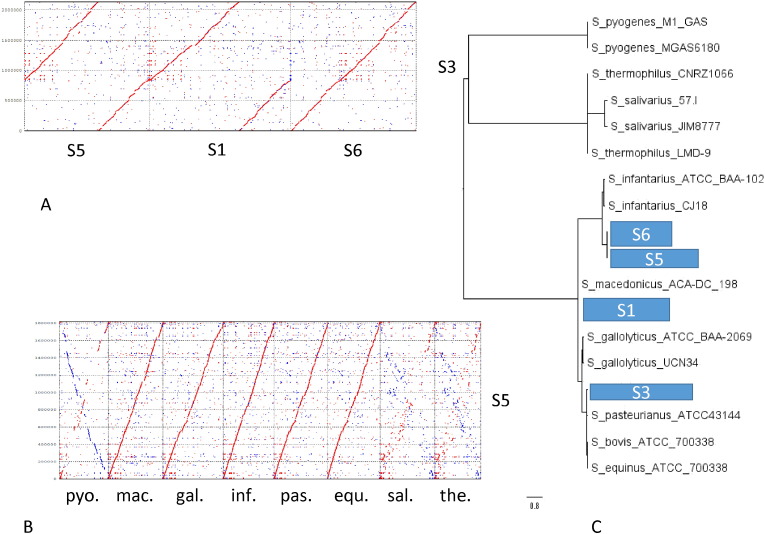
Genome comparisons for the isolated and sequenced fecal streptococci. A: Dotplot alignment of the genome from S. gallolyticus fecal isolate S3 (y-axis) against S. infantarius isolate S5, S. galloyticus isolate S1, and S. infantarius isolate S6 (x-axis) obtained from three different patients and one control (S6) at the DNA sequence level. B: Dotplot alignment of the genome from the fecal S. infantarius isolate S5 (y-axis) against streptococcal strains of the database at the DNA sequence level. The following genomes were chosen for comparison (from left to right on the x-axis): S. pyogenes (human pathogen), S. macedonicus (dairy strain), S. gallolyticus (human pathogen), S. infantarius (dairy strain), S. pasteurianus (human gut commensal), S. equinus (horse gut commensal), S. salivarius (oral commensal), and S. thermophilus (dairy strain) (from left to right). C: Phylogenetic tree analysis based on single nucleotide polymorphisms of the indicated sequenced genomes with the kSNPv2 software (Gardner and Hall, 2013). The position of the four sequenced fecal streptococci is indicated by the boxes S1, 3, 4, and 5 next to representative streptococci marked with their identifier.
Fig. 9
Fig. 9
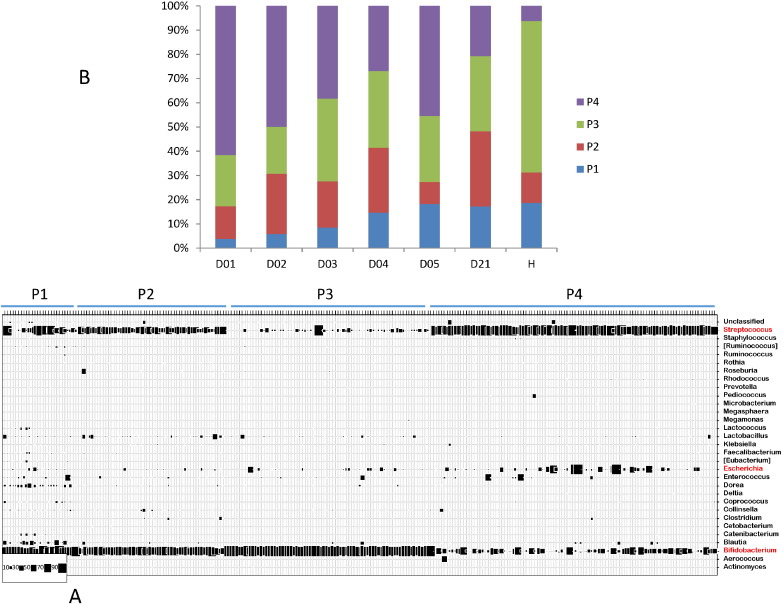
Fecal Community Type analysis in the diarrhea patients and healthy controls. A. A Dirichlet Multinomial Mixture modeling defined four partitions P1 to P4 (“fecal community types”) in the investigated stool samples. Each vertical line of the bubble plot represents one individual stool sample, each horizontal line represents a bacterial genus identified at the right ordinate. The size of the squares indicates the percentage of 16S rRNA gene sequences represented by this genus in the given stool sample (code at the lower left corner). B. The relative percentage of partitions P1 to P4 is given for all 56 investigated diarrhea patients for the indicated day of hospitalization (day D01 to 05) and the return visit (day D21) in comparison with age-matched local healthy controls (H).

References

    1. Ahmed T., Bhuiyan T.R., Zaman K., Sinclair D., Qadri F. Vaccines for preventing enterotoxigenic Escherichia coli (ETEC) diarrhoea. Cochrane Database Syst. Rev. 2013;7 - PMC - PubMed
    1. Albert M.J., Faruque A.S., Faruque S.M., Sack R.B., Mahalanabis D. Case–control study of enteropathogens associated with childhood diarrhea in Dhaka, Bangladesh. J. Clin. Microbiol. 1999;37:3458–3464. - PMC - PubMed
    1. Allen H.K., Looft T., Bayles D.O. Antibiotics in feed induce prophages in swine fecal microbiomes. MBio. 2011;2 - PMC - PubMed
    1. Altschul S.F., Gish W., Miller W. Basic local alignment search tool. J. Mol. Biol. 1990;215:403–410. - PubMed
    1. Barletta F., Ochoa T.J., Mercado E. Quantitative real-time polymerase chain reaction for enteropathogenic Escherichia coli: a tool for investigation of asymptomatic versus symptomatic infections. Clin. Infect. Dis. 2011;53:1223–1229. - PMC - PubMed

Publication types

Associated data