


Genetics of Coronary Artery Disease in Taiwan: A Cardiometabochip Study by the Taichi Consortium
- PMID: 26982883
- PMCID: PMC4794124
- DOI: 10.1371/journal.pone.0138014
Genetics of Coronary Artery Disease in Taiwan: A Cardiometabochip Study by the Taichi Consortium
Abstract
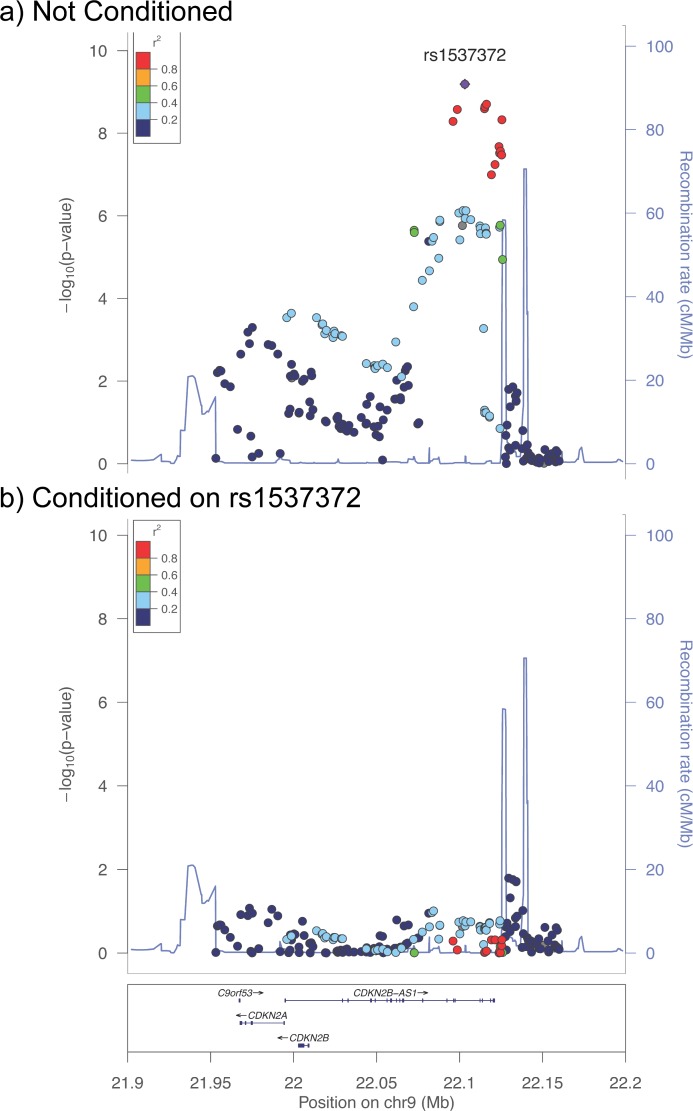
By means of a combination of genome-wide and follow-up studies, recent large-scale association studies of populations of European descent have now identified over 46 loci associated with coronary artery disease (CAD). As part of the TAICHI Consortium, we have collected and genotyped 8556 subjects from Taiwan, comprising 5423 controls and 3133 cases with coronary artery disease, for 9087 CAD SNPs using the CardioMetaboChip. We applied penalized logistic regression to ascertain the top SNPs that contribute together to CAD susceptibility in Taiwan. We observed that the 9p21 locus contributes to CAD at the level of genome-wide significance (rs1537372, with the presence of C, the major allele, the effect estimate is -0.216, standard error 0.033, p value 5.8x10⁻¹⁰). In contrast to a previous report, we propose that the 9p21 locus is a single genetic contribution to CAD in Taiwan because: 1) the penalized logistic regression and the follow-up conditional analysis suggested that rs1537372 accounts for all of the CAD association in 9p21, and 2) the high linkage disequilibrium observed for all associated SNPs in 9p21. We also observed evidence for the following loci at a false discovery rate >5%: SH2B3, ADAMTS7, PHACTR1, GGCX, HTRA1, COL4A1, and LARP6-LRRC49. We also took advantage of the fact that penalized methods are an efficient approach to search for gene-by-gene interactions, and observed that two-way interactions between the PHACTR1 and ADAMTS7 loci and between the SH2B3 and COL4A1 loci contribute to CAD risk. Both the similarities and differences between the significance of these loci when compared with significance of loci in studies of populations of European descent underscore the fact that further genetic association of studies in additional populations will provide clues to identify the genetic architecture of CAD across all populations worldwide.
Conflict of interest statement
Figures
Similar articles
-
Genome-wide association study of coronary and aortic calcification implicates risk loci for coronary artery disease and myocardial infarction.Atherosclerosis. 2013 Jun;228(2):400-5. doi: 10.1016/j.atherosclerosis.2013.02.039. Epub 2013 Mar 13. Atherosclerosis. 2013. PMID: 23561647
-
Effects of the coronary artery disease associated LPA and 9p21 loci on risk of aortic valve stenosis.Int J Cardiol. 2019 Feb 1;276:212-217. doi: 10.1016/j.ijcard.2018.11.094. Epub 2018 Nov 17. Int J Cardiol. 2019. PMID: 30482443 Free PMC article.
-
Large scale association analysis of novel genetic loci for coronary artery disease.Arterioscler Thromb Vasc Biol. 2009 May;29(5):774-80. doi: 10.1161/ATVBAHA.108.181388. Epub 2009 Jan 22. Arterioscler Thromb Vasc Biol. 2009. PMID: 19164808 Free PMC article.
-
Shared genetic susceptibility to ischemic stroke and coronary artery disease: a genome-wide analysis of common variants.Stroke. 2014 Jan;45(1):24-36. doi: 10.1161/STROKEAHA.113.002707. Epub 2013 Nov 21. Stroke. 2014. PMID: 24262325 Free PMC article. Review.
-
Genetics of Coronary Artery Disease.Circ Res. 2016 Feb 19;118(4):564-78. doi: 10.1161/CIRCRESAHA.115.306566. Circ Res. 2016. PMID: 26892958 Review.
Cited by
-
Genetic Factors for Coronary Heart Disease and Their Mechanisms: A Meta-Analysis and Comprehensive Review of Common Variants from Genome-Wide Association Studies.Diagnostics (Basel). 2022 Oct 21;12(10):2561. doi: 10.3390/diagnostics12102561. Diagnostics (Basel). 2022. PMID: 36292250 Free PMC article. Review.
-
Multi-Ancestry Polygenic Risk Score for Coronary Heart Disease Based on an Ancestrally Diverse Genome-Wide Association Study and Population-Specific Optimization.Circ Genom Precis Med. 2024 Jun;17(3):e004272. doi: 10.1161/CIRCGEN.123.004272. Epub 2024 Feb 21. Circ Genom Precis Med. 2024. PMID: 38380516 Free PMC article.
-
Genetic and Pharmacologic Inactivation of ANGPTL3 and Cardiovascular Disease.N Engl J Med. 2017 Jul 20;377(3):211-221. doi: 10.1056/NEJMoa1612790. Epub 2017 May 24. N Engl J Med. 2017. PMID: 28538136 Free PMC article. Clinical Trial.
-
Maternal Larp6 controls oocyte development, chorion formation and elevation.Development. 2020 Feb 26;147(4):dev187385. doi: 10.1242/dev.187385. Development. 2020. PMID: 32054660 Free PMC article.
-
Association between genetic loci linked to HDL-C levels and Indian patients with CAD: a pilot study.Heart Asia. 2017 Jan 4;9(1):9-13. doi: 10.1136/heartasia-2016-010822. eCollection 2017. Heart Asia. 2017. PMID: 28123455 Free PMC article.
References
-
- Schunkert H, Konig IR, Kathiresan S, Reilly MP, Assimes TL, Holm H, et al. Large-scale association analysis identifies 13 new susceptibility loci for coronary artery disease. Nature genetics. 2011;43(4):333–8. Epub 2011/03/08. 10.1038/ng.784 ; PubMed Central PMCID: PMCPmc3119261. - DOI - PMC - PubMed
-
- Makinen VP, Civelek M, Meng Q, Zhang B, Zhu J, Levian C, et al. Integrative genomics reveals novel molecular pathways and gene networks for coronary artery disease. PLoS genetics. 2014;10(7):e1004502 Epub 2014/07/18. 10.1371/journal.pgen.1004502 ; PubMed Central PMCID: PMCPmc4102418. - DOI - PMC - PubMed
-
- Voight BF, Kang HM, Ding J, Palmer CD, Sidore C, Chines PS, et al. The metabochip, a custom genotyping array for genetic studies of metabolic, cardiovascular, and anthropometric traits. PLoS genetics. 2012;8(8):e1002793 Epub 2012/08/10. 10.1371/journal.pgen.1002793 ; PubMed Central PMCID: PMCPmc3410907. - DOI - PMC - PubMed
Publication types
MeSH terms
Grants and funding
LinkOut - more resources
Full Text Sources
Other Literature Sources
Medical
Research Materials
Miscellaneous
