Disorganized attachment and personality functioning in adults: A latent class analysis
- PMID: 26986959
- PMCID: PMC5026862
- DOI: 10.1037/per0000184
Disorganized attachment and personality functioning in adults: A latent class analysis
Abstract
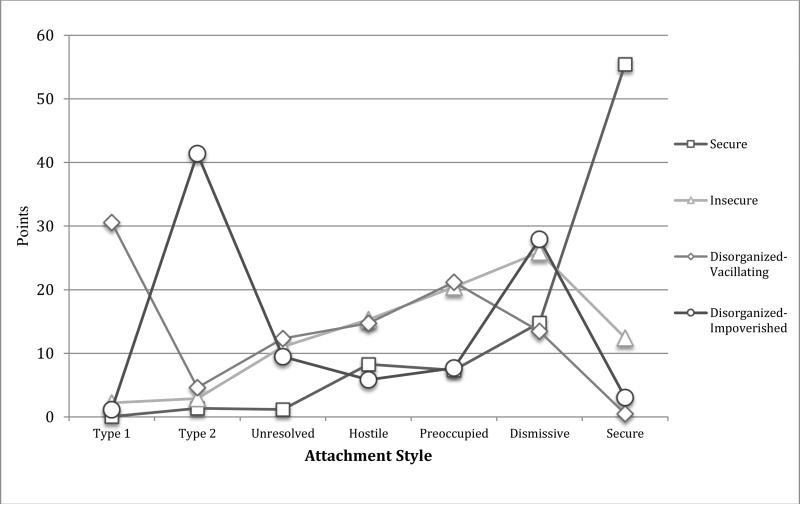
Though researchers have attended to disorganized attachment in infants and children, they have infrequently focused on the character of disorganized attachment in adults. In this study, we aimed to identify clusters of participants based on attachment levels and styles, seeking to better delineate severity and stylistic differences in disorganized attachment than has been previously articulated. We used a new assessment approach focused on a hierarchy of attachment organization, including secure, insecure (dismissive and preoccupied), rigid-controlling (hostile control and compulsive caregiving), and disorganized (contradictory, impoverished, and unresolved) levels of attachment. Clinical evaluators used information from diagnostic and attachment-based interviews to rate participants on each of these aspects of attachment. Latent class analysis (LCA) revealed a 4-class solution, including a secure (n = 33), insecure (n = 110), and 2 disorganized classes. One disorganized class (disorganized-oscillating) was characterized by elevations on contradictory and preoccupied styles (n = 77) and another (disorganized-impoverished) showed elevations on impoverished and dismissive styles (n = 53). The disorganized-oscillating class exhibited elevated personality disorder (PD) severity and general symptom severity, borderline personality disorder (BPD), histrionic, and antisocial dimensional scores, and the most severe identity disturbance compared with the other classes. The impoverished-dismissive class exhibited the highest avoidant and schizoid PD dimensional scores of the classes, and higher PD severity compared with the insecure and secure classes. These results highlight the possibility of identifying distinct classes of attachment organization, differentiated both by aspects of severity and interpersonal style. They also shed light on the manifestation of attachment disorganization in adults. (PsycINFO Database Record
(c) 2017 APA, all rights reserved).
References
-
- Ainsworth MDS, Blehar MC, Waters E, Wall S. Patterns of attachment: A psychological study of the strange situation. Lawrence Erlbaum; Oxford, England: 1978.
-
- Bateman A, Fonagy P. Psychotherapy for borderline personality disorder: Mentalization-based treatment. Oxford University Press; USA: 2004.
-
- Beeney JE, Stepp SD, Hallquist MN, Scott LN, Wright AGC, Ellison WD, Pilkonis PA. Attachment and social cognition in borderline personality disorder: Specificity in relation to antisocial and avoidant personality disorders. Personality Disorders: Theory, Research, and Treatment. 2015;6(3):207–215. doi:10.1037/per0000110. - PMC - PubMed
-
- Beeney J, Stepp SD, Hallquist MN, Scott LN, Wright AGC, Ellison WD, Pilkonis PA. Attachment and Social Cognition in Borderline Personality Disorder: Specificity in Relation to Antisocial and Avoidant Personality Disorders. Personality Disorders: Theory, Research, and Treatment. 2015;6(3) doi:10.1037/per0000110. - PMC - PubMed
-
- Brennan K. a, Shaver PR. Attachment styles and personality disorders: their connections to each other and to parental divorce, parental death, and perceptions of parental caregiving. Journal of Personality. 1998;66(5):835–78. Retrieved from http://www.ncbi.nlm.nih.gov/pubmed/9802235. - PubMed
Publication types
MeSH terms
Grants and funding
LinkOut - more resources
Full Text Sources
Other Literature Sources
Medical
Research Materials