Review
. 2017 Feb 28:387:121-126.
doi: 10.1016/j.canlet.2016.03.015. Epub 2016 Mar 14.

Precision oncology: A new era of cancer clinical trials

Affiliations
Review

Precision oncology: A new era of cancer clinical trials

Lindsay A Renfro et al. Cancer Lett. .

Abstract

Traditionally, site of disease and anatomic staging have been used to define patient populations to be studied in individual cancer clinical trials. In the past decade, however, oncology has become increasingly understood on a cellular and molecular level, with many cancer subtypes being described as a function of biomarkers or tumor genetic mutations. With these changes in the science of oncology have come changes to the way we design and perform clinical trials. Increasingly common are trials tailored to detect enhanced efficacy in a patient subpopulation, e.g. patients with a known biomarker value or whose tumors harbor a specific genetic mutation. Here, we provide an overview of traditional and newer biomarker-based trial designs, and highlight lessons learned through implementation of several ongoing and recently completed trials.

Keywords: Adaptive design; Biomarker-based design; Clinical trial; Oncology.


Conflict of interest statement

STATEMENT The authors have no conflicts of interest to disclose

Figures
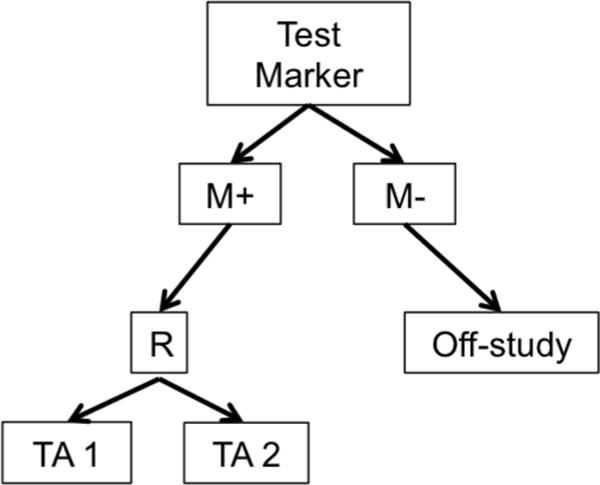
Figure 1
Figure 1. Design Schematics
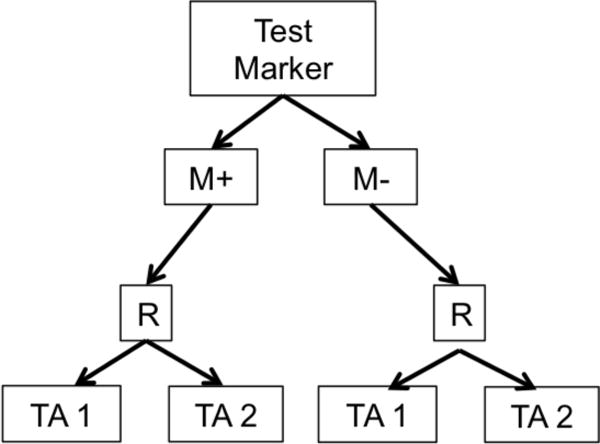
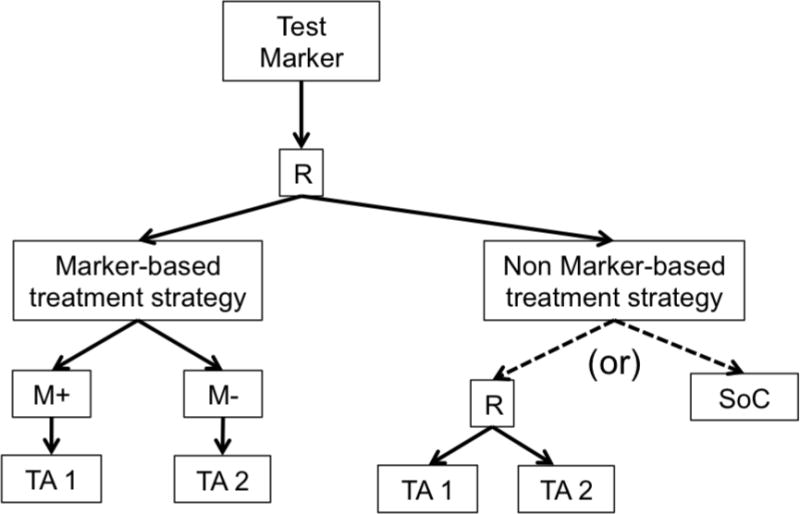
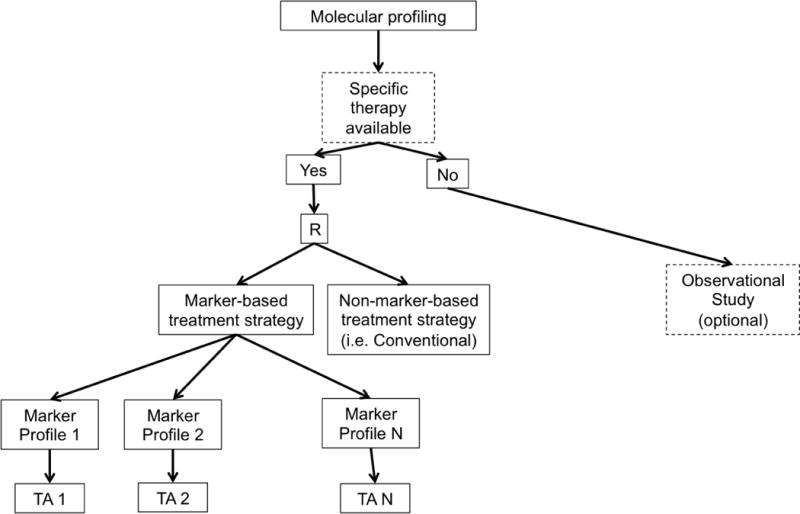
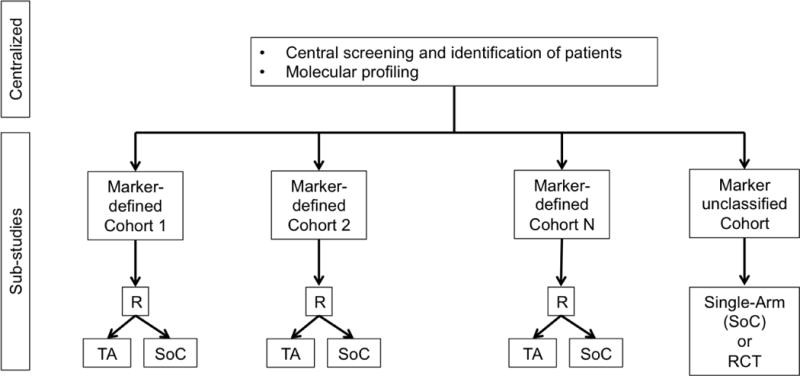
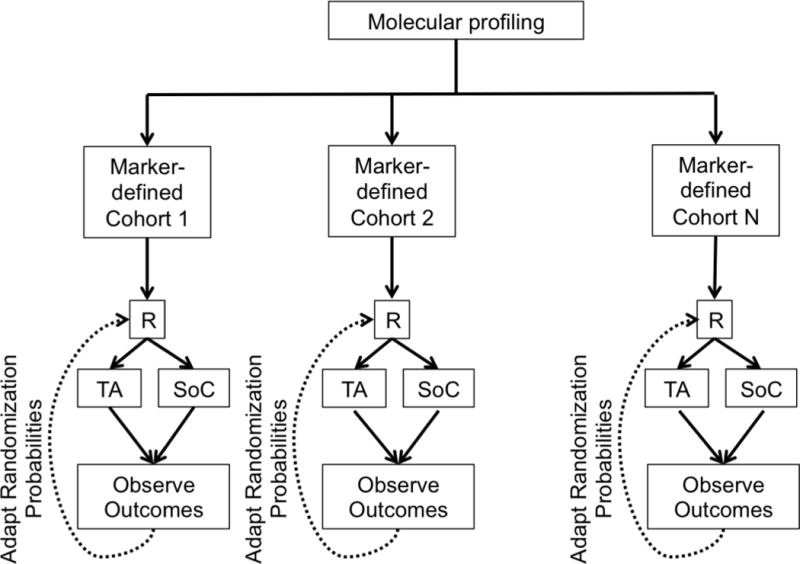
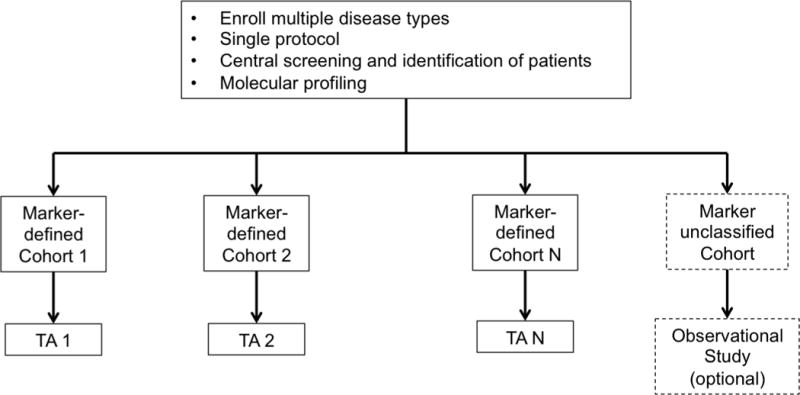
a. Enrichment or Targeted Design. R = randomization M+=marker positive, M−=marker negative TA=Targeted Agent b. Marker Stratified or Marker-by-Treatment Interaction Design. R = randomization M+=marker positive, M−=marker negative TA=Targeted Agent c. Marker Strategy Design. R = randomization. d. Modified Marker Strategy Design. R = randomization, TA = Targeted Agent. e. Umbrella Design. R = randomization. TA = Targeted Agent. SoC = Standard of Care. RCT = randomized controlled trial. f. Adaptive Design. R = randomization. TA = Targeted Agent. SoC = Standard of Care. g. Basket Trial Design. TA = Targeted Agent.
Figure 1
Figure 1. Design Schematics
a. Enrichment or Targeted Design. R = randomization M+=marker positive, M−=marker negative TA=Targeted Agent b. Marker Stratified or Marker-by-Treatment Interaction Design. R = randomization M+=marker positive, M−=marker negative TA=Targeted Agent c. Marker Strategy Design. R = randomization. d. Modified Marker Strategy Design. R = randomization, TA = Targeted Agent. e. Umbrella Design. R = randomization. TA = Targeted Agent. SoC = Standard of Care. RCT = randomized controlled trial. f. Adaptive Design. R = randomization. TA = Targeted Agent. SoC = Standard of Care. g. Basket Trial Design. TA = Targeted Agent.
Figure 1
Figure 1. Design Schematics
a. Enrichment or Targeted Design. R = randomization M+=marker positive, M−=marker negative TA=Targeted Agent b. Marker Stratified or Marker-by-Treatment Interaction Design. R = randomization M+=marker positive, M−=marker negative TA=Targeted Agent c. Marker Strategy Design. R = randomization. d. Modified Marker Strategy Design. R = randomization, TA = Targeted Agent. e. Umbrella Design. R = randomization. TA = Targeted Agent. SoC = Standard of Care. RCT = randomized controlled trial. f. Adaptive Design. R = randomization. TA = Targeted Agent. SoC = Standard of Care. g. Basket Trial Design. TA = Targeted Agent.
Figure 1
Figure 1. Design Schematics
a. Enrichment or Targeted Design. R = randomization M+=marker positive, M−=marker negative TA=Targeted Agent b. Marker Stratified or Marker-by-Treatment Interaction Design. R = randomization M+=marker positive, M−=marker negative TA=Targeted Agent c. Marker Strategy Design. R = randomization. d. Modified Marker Strategy Design. R = randomization, TA = Targeted Agent. e. Umbrella Design. R = randomization. TA = Targeted Agent. SoC = Standard of Care. RCT = randomized controlled trial. f. Adaptive Design. R = randomization. TA = Targeted Agent. SoC = Standard of Care. g. Basket Trial Design. TA = Targeted Agent.
Figure 1
Figure 1. Design Schematics
a. Enrichment or Targeted Design. R = randomization M+=marker positive, M−=marker negative TA=Targeted Agent b. Marker Stratified or Marker-by-Treatment Interaction Design. R = randomization M+=marker positive, M−=marker negative TA=Targeted Agent c. Marker Strategy Design. R = randomization. d. Modified Marker Strategy Design. R = randomization, TA = Targeted Agent. e. Umbrella Design. R = randomization. TA = Targeted Agent. SoC = Standard of Care. RCT = randomized controlled trial. f. Adaptive Design. R = randomization. TA = Targeted Agent. SoC = Standard of Care. g. Basket Trial Design. TA = Targeted Agent.
Figure 1
Figure 1. Design Schematics
a. Enrichment or Targeted Design. R = randomization M+=marker positive, M−=marker negative TA=Targeted Agent b. Marker Stratified or Marker-by-Treatment Interaction Design. R = randomization M+=marker positive, M−=marker negative TA=Targeted Agent c. Marker Strategy Design. R = randomization. d. Modified Marker Strategy Design. R = randomization, TA = Targeted Agent. e. Umbrella Design. R = randomization. TA = Targeted Agent. SoC = Standard of Care. RCT = randomized controlled trial. f. Adaptive Design. R = randomization. TA = Targeted Agent. SoC = Standard of Care. g. Basket Trial Design. TA = Targeted Agent.
Figure 1
Figure 1. Design Schematics
a. Enrichment or Targeted Design. R = randomization M+=marker positive, M−=marker negative TA=Targeted Agent b. Marker Stratified or Marker-by-Treatment Interaction Design. R = randomization M+=marker positive, M−=marker negative TA=Targeted Agent c. Marker Strategy Design. R = randomization. d. Modified Marker Strategy Design. R = randomization, TA = Targeted Agent. e. Umbrella Design. R = randomization. TA = Targeted Agent. SoC = Standard of Care. RCT = randomized controlled trial. f. Adaptive Design. R = randomization. TA = Targeted Agent. SoC = Standard of Care. g. Basket Trial Design. TA = Targeted Agent.

References

    1. Armado RG, Wolf M, Peeters M, et al. Wild-type KRAS is required for panitumumab efficacy in patients with metastatic colorectal cancer. J Clin Oncol. 2008;26:1626–34. - PubMed
    1. Jonker DJ, O’Callaghan CJ, Karapetis CS, et al. Cetuximab for the treatment of colorectal cancer. N Engl J Med. 2007;357:2040–8. - PubMed
    1. Zhou C, Wu YL, Chen G, et al. Erlotinib versus chemotherapy as first-line treatment for patients with advanced EGFR mutation-positive non-small-cell lung cancer (OPTIMAL, CTONG-0802): a multicenter, open-label, randomized, phase 3 study. Lancet Oncol. 2011;12:735–42. - PubMed
    1. Maemondo M, Inoue A, Kobayashi K, et al. Gefitinib or chemotherapy for non-small-cell lung cancer with mutated EGFR. N Engl J Med. 2010;362:2380–8. - PubMed
    1. Shaw AT, Kim D, Mehra R, et al. Ceritinib in ALK-rearranged non-small-cell lung cancer. N Engl J Med. 2014;370:1189–97. - PMC - PubMed

Publication types

MeSH terms

Substances