The Bidirectional Associations Between Psychotic Experiences and DSM-IV Mental Disorders
- PMID: 26988628
- PMCID: PMC5175400
- DOI: 10.1176/appi.ajp.2016.15101293
The Bidirectional Associations Between Psychotic Experiences and DSM-IV Mental Disorders
Abstract
Objective: While it is now recognized that psychotic experiences are associated with an increased risk of later mental disorders, we lack a detailed understanding of the reciprocal time-lagged relationships between first onsets of psychotic experiences and mental disorders. Using data from World Health Organization World Mental Health (WMH) Surveys, the authors assessed the bidirectional temporal associations between psychotic experiences and mental disorders.
Method: The WMH Surveys assessed lifetime prevalence and age at onset of psychotic experiences and 21 common DSM-IV mental disorders among 31,261 adult respondents from 18 countries. Discrete-time survival models were used to examine bivariate and multivariate associations between psychotic experiences and mental disorders.
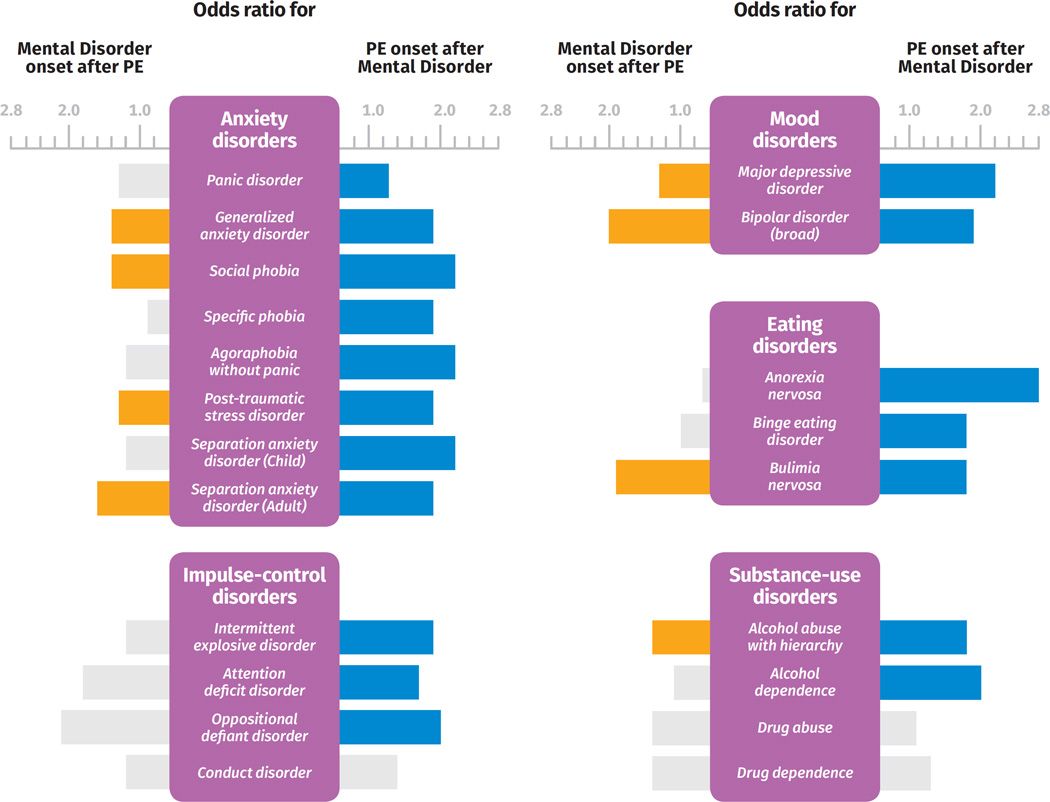
Results: Temporally primary psychotic experiences were significantly associated with subsequent first onset of eight of the 21 mental disorders (major depressive disorder, bipolar disorder, generalized anxiety disorder, social phobia, posttraumatic stress disorder, adult separation anxiety disorder, bulimia nervosa, and alcohol abuse), with odds ratios ranging from 1.3 (95% CI=1.2-1.5) for major depressive disorder to 2.0 (95% CI=1.5-2.6) for bipolar disorder. In contrast, 18 of 21 primary mental disorders were significantly associated with subsequent first onset of psychotic experiences, with odds ratios ranging from 1.5 (95% CI=1.0-2.1) for childhood separation anxiety disorder to 2.8 (95% CI=1.0-7.8) for anorexia nervosa.
Conclusions: While temporally primary psychotic experiences are associated with an elevated risk of several subsequent mental disorders, these data show that most mental disorders are associated with an elevated risk of subsequent psychotic experiences. Further investigation of the underlying factors accounting for these time-order relationships may shed light on the etiology of psychotic experiences.
Conflict of interest statement
All other authors have no conflict of interest.
Figures
Comment in
-
Putting Psychosis in Its Place.Am J Psychiatry. 2016 Oct 1;173(10):951-952. doi: 10.1176/appi.ajp.2016.16070810. Am J Psychiatry. 2016. PMID: 27690556 No abstract available.
References
-
- McGrath JJ, Saha S, Al-Hamzawi A, Alonso J, Bromet EJ, Bruffaerts R, Caldas-de-Almeida JM, Chiu WT, de Jonge P, Fayyad J, Florescu S, Gureje O, Haro JM, Hu C, Kovess-Masfety V, Lepine JP, Lim CC, Mora ME, Navarro-Mateu F, Ochoa S, Sampson N, Scott K, Viana MC, Kessler RC. Psychotic Experiences in the General Population: A Cross-National Analysis Based on 31261 Respondents From 18 Countries. JAMA Psychiatry. 2015;72:697–705. - PMC - PubMed
-
- Linscott RJ, van Os J. An updated and conservative systematic review and meta-analysis of epidemiological evidence on psychotic experiences in children and adults: on the pathway from proneness to persistence to dimensional expression across mental disorders. Psychol Med. 2013;43:1133–1149. - PubMed
-
- Saha S, Chant D, Welham J, McGrath J. A systematic review of the prevalence of schizophrenia. Schizophrenia Research. 2006;81:182–183.
-
- Poulton R, Caspi A, Moffitt TE, Cannon M, Murray R, Harrington H. Children's self-reported psychotic symptoms and adult schizophreniform disorder: a 15-year longitudinal study. Arch Gen Psychiatry. 2000;57:1053–1058. - PubMed
MeSH terms
Grants and funding
LinkOut - more resources
Full Text Sources
Other Literature Sources
Medical