. 2017 Jul;22(4):977-990.
doi: 10.1111/adb.12386. Epub 2016 Mar 14.

Incubation of extinction responding and cue-induced reinstatement, but not context- or drug priming-induced reinstatement, after withdrawal from methamphetamine

Affiliations

Incubation of extinction responding and cue-induced reinstatement, but not context- or drug priming-induced reinstatement, after withdrawal from methamphetamine

Sweta Adhikary et al. Addict Biol. 2017 Jul.

Abstract

In rats trained to self-administer methamphetamine, extinction responding in the presence of drug-associated contextual and discrete cues progressively increases after withdrawal (incubation of methamphetamine craving). The conditioning factors underlying this incubation are unknown. Here, we studied incubation of methamphetamine craving under different experimental conditions to identify factors contributing to this incubation. We also determined whether the rats' response to methamphetamine priming incubates after withdrawal. We trained rats to self-administer methamphetamine in a distinct context (context A) for 14 days (6 hours/day). Lever presses were paired with a discrete light cue. We then tested groups of rats in context A or a different non-drug context (context B) after 1 day, 1 week or 1 month for extinction responding with or without the discrete cue. Subsequently, we tested the rats for reinstatement of drug seeking induced by exposure to contextual, discrete cue, or drug priming (0, 0.25 and 0.5 mg/kg). Operant responding in the extinction sessions in contexts A or B was higher after 1 week and 1 month of withdrawal than after 1 day; this effect was context-independent. Independent of the withdrawal period, operant responding in the extinction sessions was higher when responding led to contingent delivery of the discrete cue. After extinction, discrete cue-induced reinstatement, but not context- or drug priming-induced reinstatement, progressively increased after withdrawal. Together, incubation of methamphetamine craving, as assessed in extinction tests, is primarily mediated by time-dependent increases in non-reinforced operant responding, and this effect is potentiated by exposure to discrete, but not contextual, cues.

Keywords: context; drug priming; extended access; extinction; incubation; reinstatement; relapse; self-administration.


Conflict of interest statement

The authors declare that they do not have any conflicts of interest (financial or otherwise) related to the data presented in this manuscript.

Figures
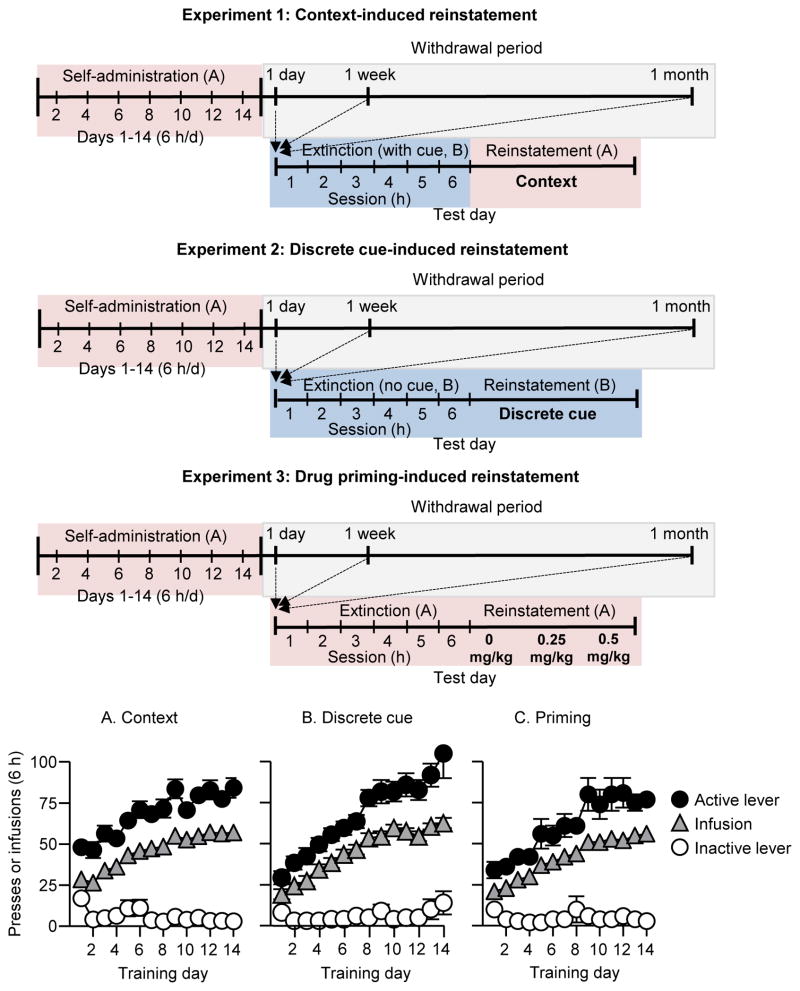
Figure 1
Figure 1. Experiment design and methamphetamine self-administration training
(A) Exp. 1. Context: Mean±SEM number of infusions and active and inactive lever responses during the 14 d of methamphetamine self-administration training (n=27) (B) Exp. 2. Discrete cue: Mean±SEM number of infusions and active and inactive lever responses during the 14 d of methamphetamine self-administration training (n=29) (C) Exp. 3. Priming: Mean±SEM number of infusions and active and inactive lever responses during the 14 d of methamphetamine self-administration training for (n=26).
Figure 2
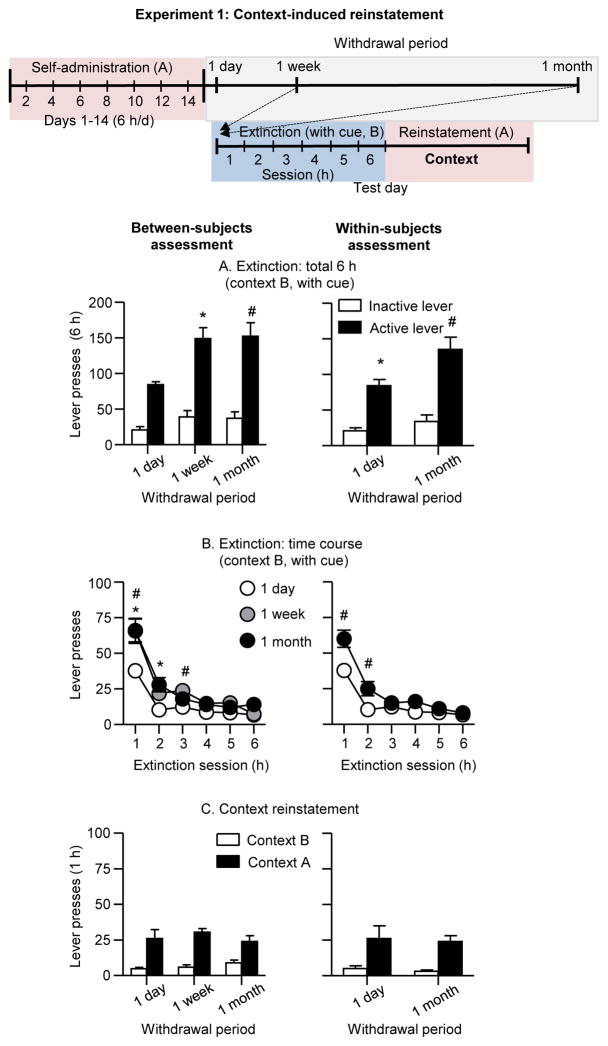
Figure 2. Context-induced reinstatement at different withdrawal periods (Exp. 1)
Left panel: between-subjects assessment. Right panel: within-subjects assessment. (A) Extinction responding: Total number of active lever presses in rats tested in the extinction context (context B, with cue) after 1 day, 1 week, or 1 month of withdrawal. (B) Extinction time course: Number of active lever presses over six 1-h extinction sessions in rats tested in context B (with cue) after 1 day, 1 week, or 1 month of withdrawal. (C) Context-induced reinstatement: Total number of active lever presses in rats tested in context A (1 h) and the last h of extinction in context B after 1 day, 1 week, or 1 month of withdrawal. * Differences between 1 day and 1 month, # differences between 1 day and 1 week, p<0.05.
Figure 3
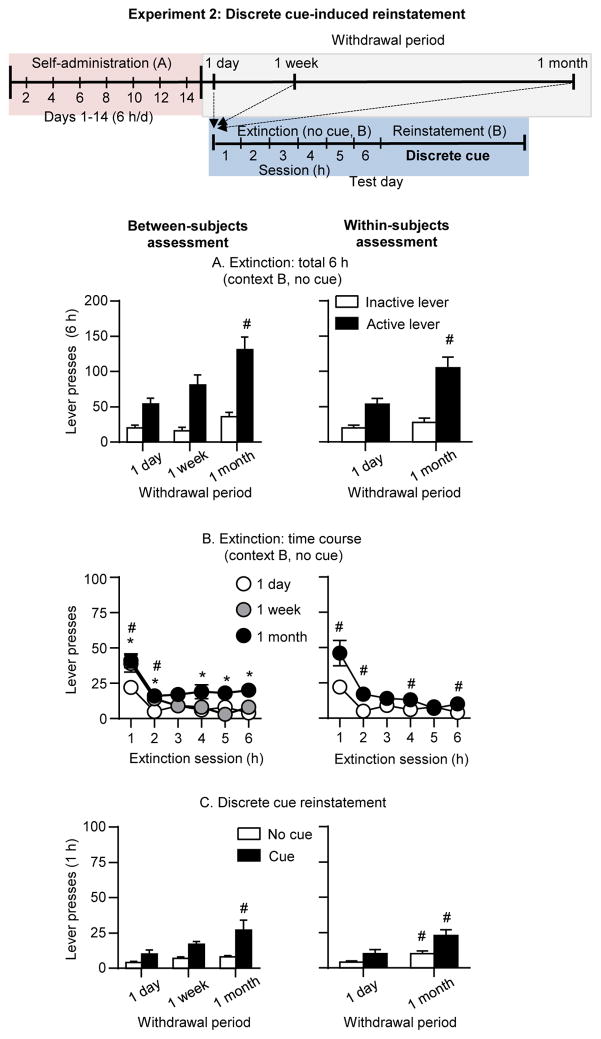
Figure 3. Discrete cue-induced reinstatement at different withdrawal periods (Exp. 2)
Left panel: between-subjects assessment. Right panel: within-subjects assessment. (A) Extinction responding: Total number of active lever presses in rats tested in the extinction context (context B, no cue) after 1 day, 1 week, or 1 month of withdrawal. * Different from 1 day, p<0.05 (B) Extinction time course: Number of active lever presses over six 1-h extinction sessions in rats tested in context B (no cue) after 1 day, 1 week, or 1 month of withdrawal. * Different from 1 day, p<0.05 (C) Discrete cue-induced reinstatement: Total number of active lever presses in rats tested for discrete cue-induced reinstatement (1 hour) and the last hour of extinction (no cue) after 1 day, 1 week, or 1 month of withdrawal. * Differences between 1 day and 1 month, # differences between 1 day and 1 week, p<0.05.
Figure 4
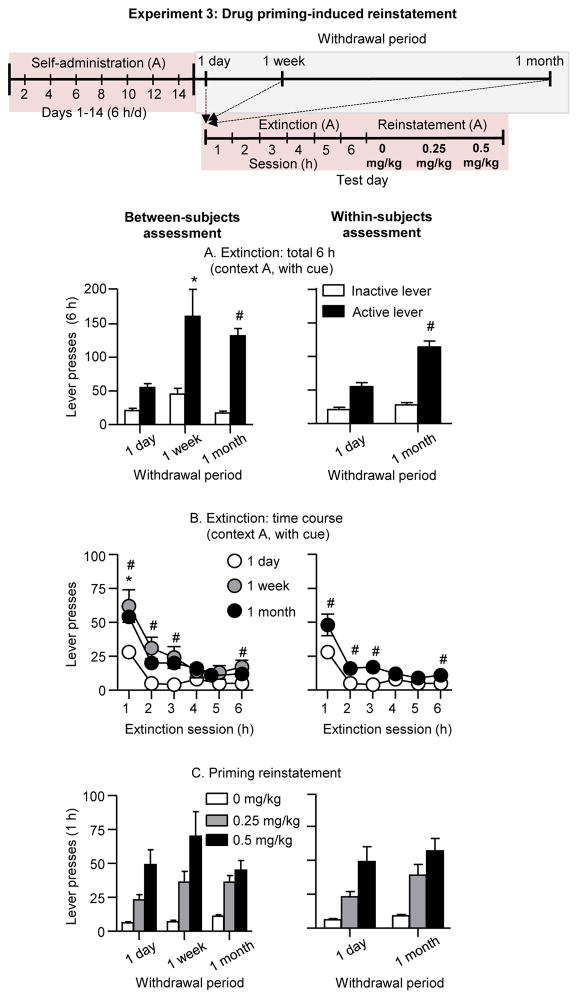
Figure 4. Drug priming-induced reinstatement at different withdrawal periods (Exp. 3)
Left panel: between-subjects assessment. Right panel: within-subjects assessment. (A) Extinction responding: Total number of active lever presses in rats tested in the extinction context (context A, with cue) after 1 day, 1 week, or 1 month of withdrawal. (B) Extinction time course: Number of active lever presses over six 1-h extinction sessions in rats tested in context A (with cue) after 1 day, 1 week, or 1 month of withdrawal. (C) Priming-induced reinstatement: Total number of active lever presses for priming induced reinstatement (0, 0.25, and 0.5 mg/kg, i.p.) after 1 day, 1 week, or 1 month of withdrawal * Differences between 1 day and 1 month, # differences between 1 day and 1 week, p<0.05.
Figure 5
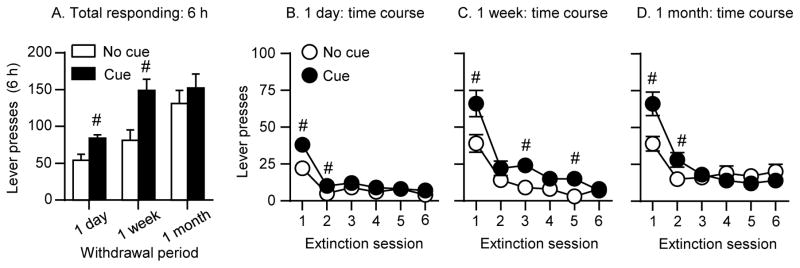
Figure 5. Extinction responding in context B: Cue versus no cue (Exp 1 vs 2). (A)
Extinction responding: Total number of active lever presses in rats tested in the extinction context (context B) in the cue or no-cue conditions after 1 day, 1 week, or 1 month of withdrawal. # Different from no cue, p<0.05 (B) Extinction time course (1 day): Number of active lever presses over six 1-h extinction sessions in rats tested in context B in the cue or no-cue conditions after 1 day of withdrawal. (C) Extinction time course (1 week): Number of active lever presses over six 1-h extinction sessions in rats tested in context B in the cue or no-cue conditions after 1 week of withdrawal. (D) Extinction time course (1 month): Number of active lever presses over six 1-h extinction sessions in rats tested in context B in the cue or no-cue conditions after 1 month of withdrawal. # Different from no cue, p<0.05

References

    1. Abdolahi A, Acosta G, Breslin FJ, Hemby SE, Lynch WJ. Incubation of nicotine seeking is associated with enhanced protein kinase A-regulated signaling of dopamine- and cAMP-regulated phosphoprotein of 32 kDa in the insular cortex. Eur J Neurosci. 2010;31:733–741. - PMC - PubMed
    1. Airavaara M, Pickens CL, Stern AL, Wihbey KA, Harvey BK, Bossert JM, Liu QR, Hoffer BJ, Shaham Y. Endogenous GDNF in ventral tegmental area and nucleus accumbens does not play a role in the incubation of heroin craving. Addiction Biol. 2011;16:261–272. - PMC - PubMed
    1. Bedi G, Preston KL, Epstein DH, Heishman SJ, Marrone GF, Shaham Y, de Wit H. Incubation of cue-induced cigarette craving during abstinence in human smokers. Biol Psychiatry. 2011;69:708–711. - PMC - PubMed
    1. Bienkowski P, Rogowski A, Korkosz A, Mierzejewski P, Radwanska K, Kaczmarek L, Bogucka-Bonikowska A, Kostowski W. Time-dependent changes in alcohol-seeking behaviour during abstinence. Eur Neuropsychopharmacol. 2004;14:355–360. - PubMed
    1. Bossert JM, Adhikary S, St Laurent R, Marchant NJ, Wang HL, Morales M, Shaham Y. Role of projections from ventral subiculum to nucleus accumbens shell in context-induced reinstatement of heroin seeking in rats. Psychopharmacology (Berl) 2015 - PMC - PubMed

Substances