


A randomized controlled trial of cognitive behavioral therapy for ADHD in medication-treated adolescents
- PMID: 26990084
- PMCID: PMC5026858
- DOI: 10.1111/jcpp.12549
A randomized controlled trial of cognitive behavioral therapy for ADHD in medication-treated adolescents
Abstract
Objective: To test cognitive behavioral therapy (CBT) for persistent attention-deficit hyperactivity disorder (ADHD) symptoms in a sample of medication-treated adolescents.
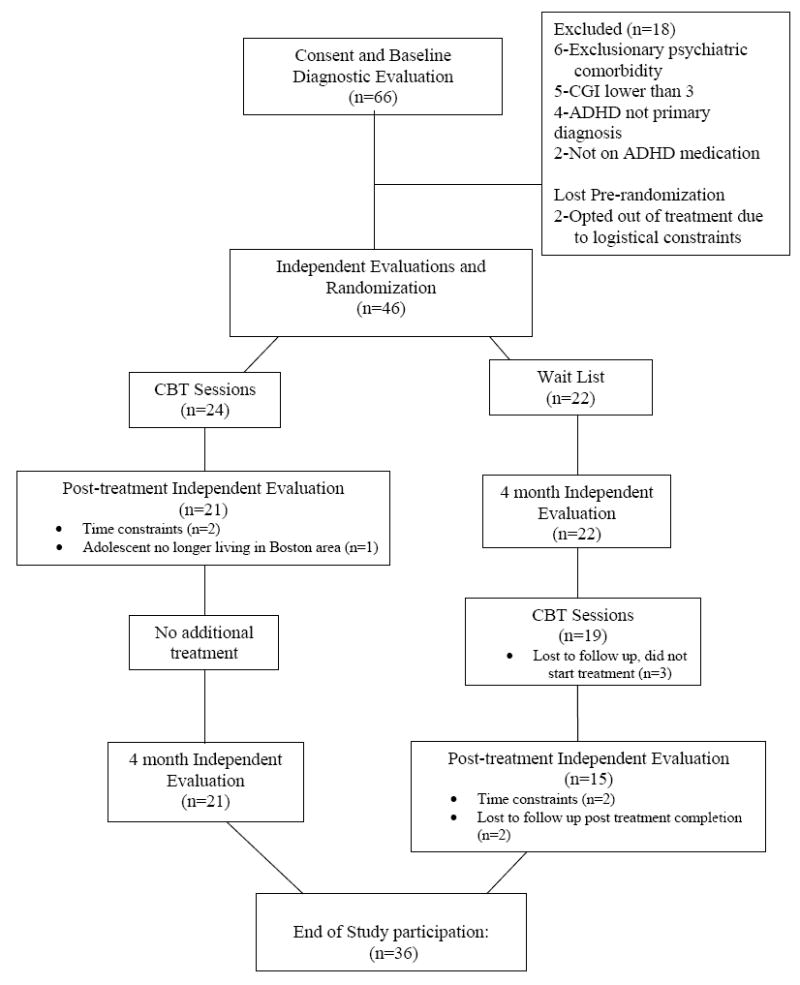
Methods: Forty-six adolescents (ages 14-18), with clinically significant ADHD symptoms despite stable medication treatment were randomly assigned to receive CBT for ADHD or wait list control in a cross-over design. Twenty-four were randomized to CBT, 22 to wait list, and 15 crossed-over from wait list to CBT. A blind independent evaluator (IE) rated symptom severity on the ADHD Current Symptom Scale, by adolescent and parent report, and rated each subject using the Clinical Global Impression Severity Scale (CGI), a global measure of distress and impairment. These assessments were performed at baseline, 4-months (post-CBT or post wait list), and 8-months (post-treatment for those originally assigned to the wait list condition and 4-month follow-up for those originally assigned to CBT).
Trial registration: http://clinicaltrials.gov/show/NCT01019252.
Results: Using all available data, mixed effects modeling, and pooling for the wait list cross-over, participants who received CBT received a mean score 10.93 lower on the IE-rated parent assessment of symptom severity (95% CI: -12.93, -8.93; p < .0001), 5.24 lower on the IE-rated adolescent assessment of symptom severity (95% CI: -7.21, -3.28; p < .0001), and 1.17 lower IE-rated CGI (95% CI: -1.39, -.94; p < .0001). Results were consistent across 100 multiple imputations (all p < .0001). There was a greater proportion of responders after CBT by parent (50% vs. 18%, p = .00) and adolescent (58% vs. 18% p = .02) report.
Conclusions: This study demonstrates initial efficacy of CBT for adolescents with ADHD who continued to exhibit persistent symptoms despite medications.
Keywords: ADHD; adolescence; behavior therapy; cognitive therapy.
© 2016 Association for Child and Adolescent Mental Health.
Conflict of interest statement
The rest of the authors have declared that they have no potential or competing conflicts of interest in relation to the work reported.
Comment in
-
Commentary: Development of a new, much-needed, cognitive-behavioral intervention for adolescents with ADHD - a reflection on Sprich et al. (2016).J Child Psychol Psychiatry. 2016 Nov;57(11):1227-1228. doi: 10.1111/jcpp.12629. J Child Psychol Psychiatry. 2016. PMID: 27804159
References
-
- American Psychiatric Association. Diagnostic and statistical manual of mental disorders. 5. American Psychiatric Publishing; 2013.
-
- Antshel KM, Faraone SV, Gordon M. Cognitive Behavioral Treatment Outcomes in Adolescent ADHD. Journal of Attention Disorders. 2012 http://doi.org/10.1177/1087054712443155. - DOI - PubMed
-
- Barkley RA. Attention-deficit hyperactivity disorder: A handbook for diagnosis and treatment. New York, NY: Guilford Press; 1990.
-
- Barkley RA, Anastopoulos AD, Guevremont DC, Fletcher KE. Adolescents with ADHD: patterns of behavioral adjustment, academic functioning, and treatment utilization. Journal of the American Academy of Child and Adolescent Psychiatry. 1991;30(5):752–761. - PubMed
Publication types
MeSH terms
Associated data
Grants and funding
LinkOut - more resources
Full Text Sources
Other Literature Sources
Medical
