


The Impact of Dietary and Metabolic Risk Factors on Cardiovascular Diseases and Type 2 Diabetes Mortality in Brazil
- PMID: 26990765
- PMCID: PMC4798497
- DOI: 10.1371/journal.pone.0151503
The Impact of Dietary and Metabolic Risk Factors on Cardiovascular Diseases and Type 2 Diabetes Mortality in Brazil
Abstract
Background: Trends in food availability and metabolic risk factors in Brazil suggest a shift toward unhealthy dietary patterns and increased cardiometabolic disease risk, yet little is known about the impact of dietary and metabolic risk factors on cardiometabolic mortality in Brazil.
Methods: Based on data from Global Burden of Disease (GBD) Study, we used comparative risk assessment to estimate the burden of 11 dietary and 4 metabolic risk factors on mortality due to cardiovascular diseases and diabetes in Brazil in 2010. Information on national diets and metabolic risks were obtained from the Brazilian Household Budget Survey, the Food and Agriculture Organization database, and large observational studies including Brazilian adults. Relative risks for each risk factor were obtained from meta-analyses of randomized trials or prospective cohort studies; and disease-specific mortality from the GBD 2010 database. We quantified uncertainty using probabilistic simulation analyses, incorporating uncertainty in dietary and metabolic data and relative risks by age and sex. Robustness of findings was evaluated by sensitivity to varying feasible optimal levels of each risk factor.
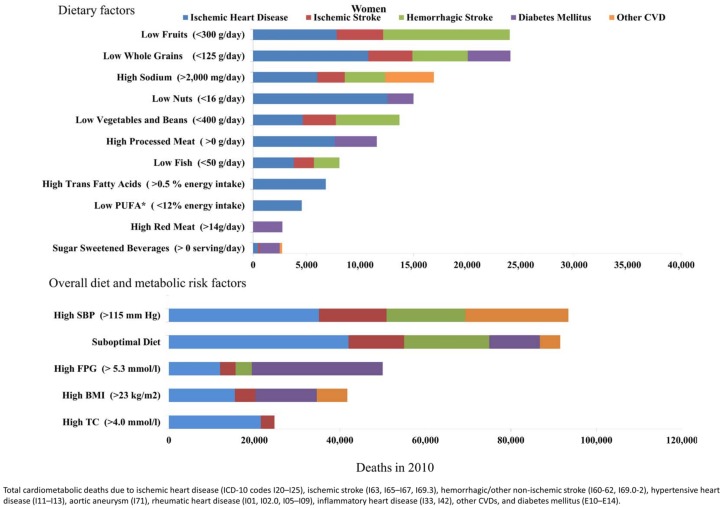
Results: In 2010, high systolic blood pressure (SBP) and suboptimal diet were the largest contributors to cardiometabolic deaths in Brazil, responsible for 214,263 deaths (95% uncertainty interval [UI]: 195,073 to 233,936) and 202,949 deaths (95% UI: 194,322 to 211,747), respectively. Among individual dietary factors, low intakes of fruits and whole grains and high intakes of sodium were the largest contributors to cardiometabolic deaths. For premature cardiometabolic deaths (before age 70 years, representing 40% of cardiometabolic deaths), the leading risk factors were suboptimal diet (104,169 deaths; 95% UI: 99,964 to 108,002), high SBP (98,923 deaths; 95%UI: 92,912 to 104,609) and high body-mass index (BMI) (42,643 deaths; 95%UI: 40,161 to 45,111).
Conclusion: suboptimal diet, high SBP, and high BMI are major causes of cardiometabolic death in Brazil, informing priorities for policy initiatives.
Conflict of interest statement
Figures



References
-
- Ministerio da Saude Brasil. Informacoes de Saude 2013 [June 2015]. Available: http://www.datasus.gov.br.
-
- Levy RB, Claro RM, Mondini L, Sichieri R, Monteiro CA. Regional and socioeconomic distribution of household food availability in Brazil, in 2008–2009. Rev Saude Publica. 2012;46(1):6–15. Epub 2011/12/21. . - PubMed
Publication types
MeSH terms
Substances
Grants and funding
LinkOut - more resources
Full Text Sources
Other Literature Sources
Medical
