


Influence of Screen-Based Peer Modeling on Preschool Children's Vegetable Consumption and Preferences
- PMID: 26992483
- PMCID: PMC4865424
- DOI: 10.1016/j.jneb.2016.02.005
Influence of Screen-Based Peer Modeling on Preschool Children's Vegetable Consumption and Preferences
Abstract
Objective: To determine the influence of screen-based peer modeling on children's vegetable consumption and preference.
Methods: A total of 42 children aged 3-5 years were randomly assigned to view individually a video segment of peers consuming a modeled vegetable (bell pepper), vs a nonfood video segment or no video. Analysis of covariance models examined bell pepper preference and consumption during initial video exposure (day 1) and without video exposure (days 2 and 7), adjusted for age, sex, body mass index, and initial bell pepper consumption.
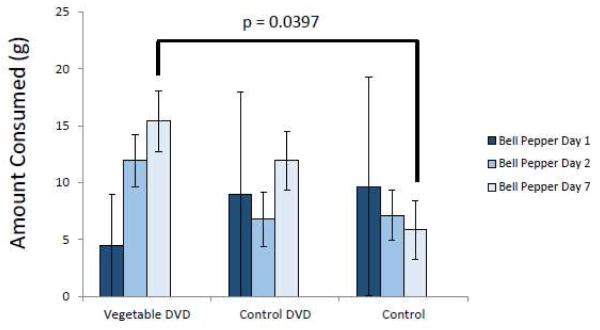
Results: Children in the vegetable condition ate more bell peppers (15.5 g) than did those in the control condition (5.9 g; P = .04; model η(2) = 0.85) on day 7, with no differences on days 1 or 2. Among children who ate the modeled vegetable, those in the vegetable DVD condition reported greater preference for eating the vegetable again (P = .01).
Conclusions and implications: Screen-based peer modeling is a promising tool to influence children's vegetable consumption.
Keywords: child; food preferences; preschool; video.
Copyright © 2016 Society for Nutrition Education and Behavior. Published by Elsevier Inc. All rights reserved.
Figures


References
-
- Guenther PM, Dodd KW, Reedy J, Krebs-Smith SM. Most Americans eat much less than recommended amounts of fruits and vegetables. Journal of the American Dietetic Association. 2006;106:1371–1379. - PubMed
-
- Addessi E, Galloway AT, Visalberghi E, Birch LL. Specific social influences on the acceptance of novel foods in 2–5-year-old children. Appetite. 2005;45:264–271. - PubMed
-
- Birch LL. Effects of peer models' food choices and eating behaviors on preschoolers' food preferences. Child development. 1980:489–496.
-
- Nicklaus S, Boggio V, Chabanet C, Issanchou S. A prospective study of food preferences in childhood. Food quality and preference. 2004;15:805–818.
Publication types
MeSH terms
Grants and funding
LinkOut - more resources
Full Text Sources
Other Literature Sources
Research Materials
