


Non-fatal overdose as a risk factor for subsequent fatal overdose among people who inject drugs
- PMID: 26993373
- PMCID: PMC4833586
- DOI: 10.1016/j.drugalcdep.2016.02.024
Non-fatal overdose as a risk factor for subsequent fatal overdose among people who inject drugs
Abstract
Objectives: To examine the relationship between non-fatal overdose and risk of subsequent fatal overdose.
Methods: We assessed risk factors for overdose death among two prospective cohorts of persons who inject drugs (PWID) in Vancouver, Canada. Extended Cox regression was used to examine if reports of non-fatal overdose were associated with the time to fatal overdose while adjusting for other behavioral, social and structural confounders.
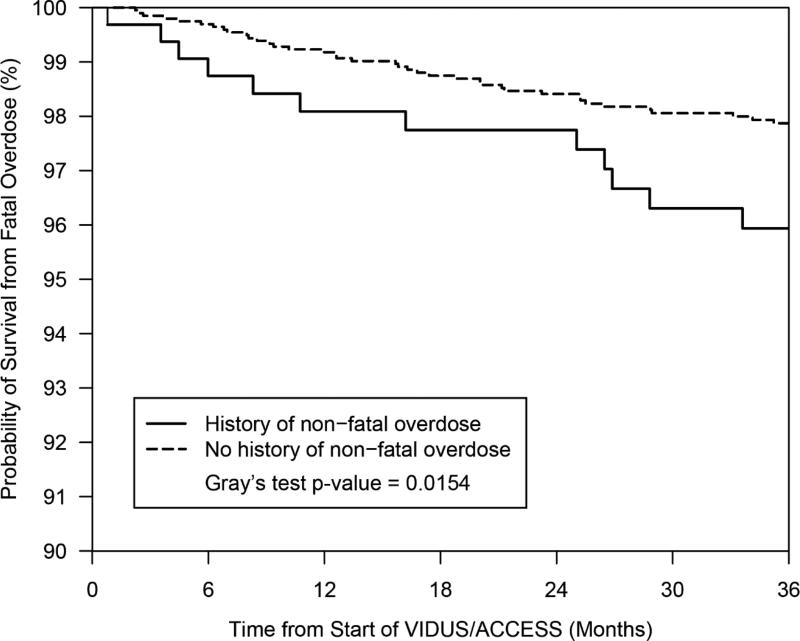
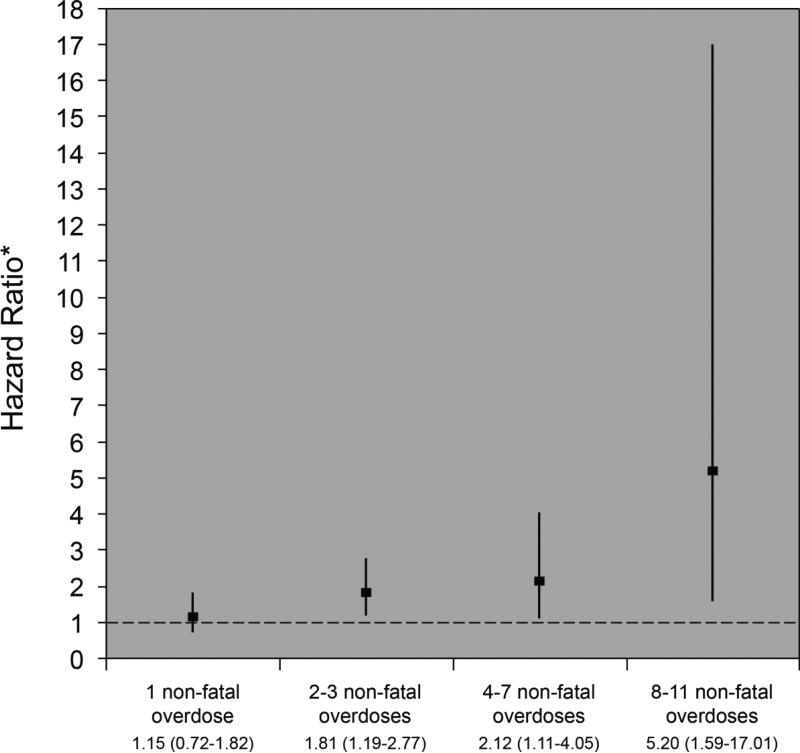
Results: Between May, 1996 and December, 2011, 2317 individuals were followed for a median of 60.8 months. In total, 134 fatal overdose deaths were identified for an incidence density of 8.94 (95% confidence interval [CI]: 7.55-10.59) deaths per 1000 person-years. During the study period there were 1795 reports of non-fatal overdose. In a multivariate model, recent non-fatal overdose was independently associated with the time to overdose mortality (adjusted hazard ratio [AHR]=1.95; 95% CI: 1.17-3.27). As well, there was a dose response effect of increasing cumulative reports of non-fatal overdose on subsequent fatal overdose.
Conclusion: Reports of recent non-fatal overdose were independently associated with subsequent overdose mortality in a dose-response relationship. These findings suggest that individuals reporting recent non-fatal overdose should be engaged with intensive overdose prevention interventions.
Keywords: Injection drug use; Mortality; Non-fatal overdose; Vancouver.
Copyright © 2016 Elsevier Ireland Ltd. All rights reserved.
Figures
References
-
- Bergenstrom A, Quan VM, Van Nam L, McClausland K, Thuoc NP, Celentano D, Go V. A cross-sectional study on prevalence of non-fatal drug overdose and associated risk characteristics among out-of-treatment injecting drug users in North Vietnam. Subst. Use Misuse. 2008;43:73–84. - PubMed
-
- Coffin PO, Tracy M, Bucciarelli A, Ompad D, Vlahov D, Galea S. Identifying injection drug users at risk of nonfatal overdose. Acad. Emerg. Med. 2007;14:616–623. - PubMed
-
- Darke S, Mills KL, Ross J, Teesson M. Rates and correlates of mortality amongst heroin users: findings from the Australian Treatment Outcome Study (ATOS), 2001-2009. Drug Alcohol Depend. 2011;115:190–195. - PubMed
-
- Darke S, Ross J, Hall W. Overdose among heroin users in Sydney, Australia: I. Prevalence and correlates of non-fatal overdose. Addiction. 1996;91:405–411. - PubMed
Publication types
MeSH terms
Grants and funding
LinkOut - more resources
Full Text Sources
Other Literature Sources
