. 2016 Mar 19:13:45.
doi: 10.1186/s12985-016-0503-9.

Characterisation of the epidemic strain of H3N8 equine influenza virus responsible for outbreaks in South America in 2012

Affiliations

Characterisation of the epidemic strain of H3N8 equine influenza virus responsible for outbreaks in South America in 2012

Edsel Alves Beuttemmüller et al. Virol J. .

Abstract

Background: An extensive outbreak of equine influenza occurred across multiple countries in South America during 2012. The epidemic was first reported in Chile then spread to Brazil, Uruguay and Argentina, where both vaccinated and unvaccinated animals were affected. In Brazil, infections were widespread within 3months of the first reported cases. Affected horses included animals vaccinated with outdated vaccine antigens, but also with the OIE-recommended Florida clade 1 strain South Africa/4/03.

Methods: Equine influenza virus strains from infected horses were isolated in eggs, then a representative strain was subjected to full genome sequencing using segment-specific primers with M13 tags. Phylogenetic analyses of nucleotide sequences were completed using PhyML. Amino acid sequences of haemagglutinin and neuraminidase were compared against those of vaccine strains and recent isolates from America and Uruguay, substitutions were mapped onto 3D protein structures using PyMol. Antigenic analyses were completed by haemagglutination-inhibition assay using post-infection ferret sera.

Results: Nucleotide sequences of the haemaglutinin (HA) and neuraminidase (NA) genes of Brazilian isolate A/equine/Rio Grande do Sul/2012 were very similar to those of viruses belonging to Florida clade 1 and clustered with contemporary isolates from the USA. Comparison of their amino acid sequences against the OIE-recommended Florida clade 1 vaccine strain A/equine/South Africa/4/03 revealed five amino acid substitutions in HA and seven in NA. Changes in HA included one within antigenic site A and one within the 220-loop of the sialic acid receptor binding site. However, antigenic analysis by haemagglutination inhibition (HI) assay with ferret antisera raised against representatives of European, Kentucky and Florida sublineages failed to indicate any obvious differences in antigenicity.

Conclusions: An extensive outbreak of equine influenza in South America during 2012 was caused by a virus belonging to Florida clade 1, closely related to strains circulating in the USA in 2011. Despite reports of vaccine breakdown with products containing the recommended strain South Africa/03, no evidence was found of significant antigenic drift. Other factors may have contributed to the rapid spread of this virus, including poor control of horse movement.

Keywords: Brazil; Epidemic; Equine influenza; Florida clade 1; Haemagglutinin; Neuraminidase.


Figures

Fig. 1
Fig. 1
Map of Brazil showing the distance in kilometers between the extreme points of the country, and indicating the states where the outbreak was reported in chronological order: March (1), April (2) and May (3)
Fig. 2
Fig. 2
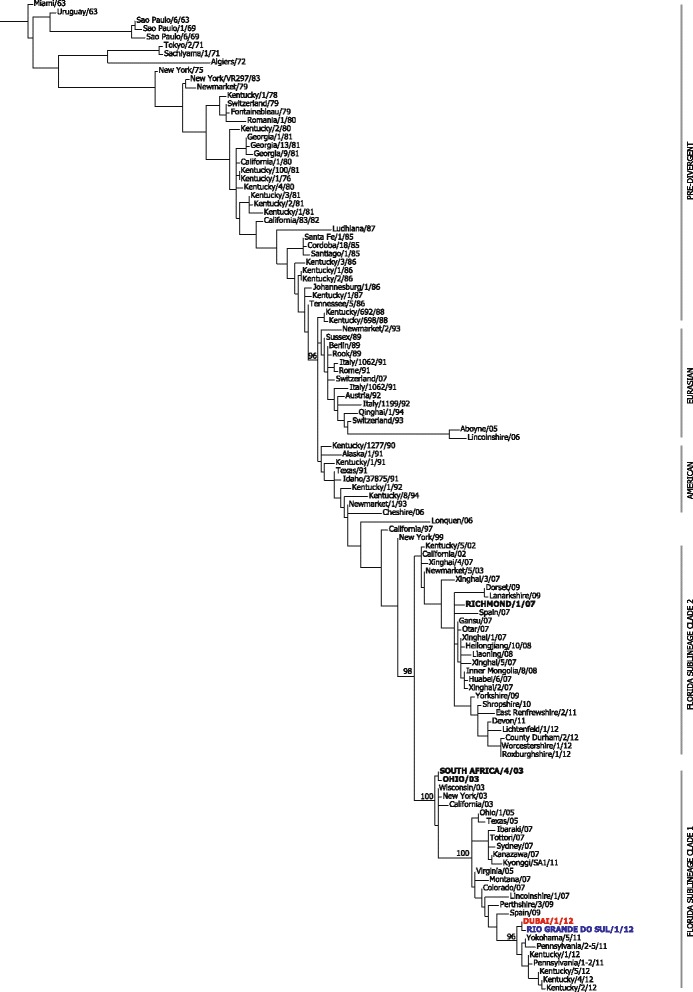
Phylogenetic analysis of HA1 nucleotide sequences from South America, 2012. Maximum likelihood tree based on EIV strains isolated between 1963 and 2012. Bootstrap values obtained after 100 replicates are shown at major nodes. Major lineages and sub-lineages are labeled by bars on the right. The OIE recommended strains South Africa/4/03, Ohio/03 (Florida clade 1) and Richmond/1/07 (Florida clade 2) are in black uppercase letters. The vaccine strain Kentucky/97 is shown in green, the Brazilian strain Rio Grande do Sul/1/12 in blue, Dubai/1/12 and Argentina/E-2345-1/12 in red
Fig. 3
Fig. 3
Phylogenetic analysis of NA nucleotide sequences from EIV. Maximum likelihood tree based on EIV strains isolated between 1963 and 2012. Bootstrap values obtained after 100 replicates are shown at major nodes. Major lineages and sub-lineages are shown by bars on the right. The OIE recommended strains South Africa/4/03, Ohio/03 (Florida clade 1) and Richmond/1/07 (Florida clade 2) are in black uppercase letters. Representative of the South American outbreak, Rio Grande do Sul/1/12 is shown in blue and Dubai/1/12 in red
Fig. 4
Fig. 4
Comparison of HA amino acid sequences. Rio Grande do Sul/1/12 and 2011–12 Florida clade 1 strains from the USA were aligned to the OIE-recommended vaccine strains Ohio/03 and South Africa/4/03 strains (top). Additional complete and partial sequences available from the South American outbreak were also included for Dubai/1-3/12, Argentina/E-2397-3/12, Argentina/E-2345-1/12, Colina/2/12, São Paulo/IB19/12 and Uruguay/E-1918-1/12. Kentucky/97, a vaccine strain used during the outbreak, is also shown. Amino acid identity is represented with a dot
Fig. 5
Fig. 5
HA structure, showing location of amino acid substitutions between Rio Grande do Sul/1/12 and vaccine strains. The amino acid sequence of the outbreak strain was compared against two vaccine strains, A/equine/South Africa/4/03 and A/equine/Kentucky/97. The locations of the substitutions are indicated in red on the influenza H3 structure for A/equine/Richmond/1/07 (protein database number PDB: 4UO0, [44]). Structures were examined using MacPyMOL and images collected for top and vertical views
Fig. 6
Fig. 6
NA amino acid alignment. Amino acid sequences for Rio Grande do Sul/1/12, and 2011–13 Florida clade 1 strains from the USA were compared to the recommended OIE strain Ohio/03 (top). Amino acid identity is represented with a dot
Fig. 7
Fig. 7
NA structure, showing locations of amino acid substitutions between A/equine/Rio Grande do Sul/1/12 NA and Kentucky/97 (a, b) and Ohio/03 (c, d). Top and bottom views are shown, with substitutions indicated in red using an N1 backbone, protein database number PDB: 2HTY [45]. The residues are numbered according to the N8 sequence. The substitutions N205S, S359A, L371F, G424V (K/97), and N205S (Ohio/03) were buried within the NA structure

References

    1. Weis W, Brown JH, Cusack S, Paulson JC, Skehel JJ, Wiley DC. Structure of the influenza virus haemagglutinin complexed with its receptor, sialic acid. Nature. 1988;333:426–431. doi: 10.1038/333426a0. - DOI - PubMed
    1. Halbherr SJ, Ludersdorfer TH, Ricklin M, Locher S, Berger Rentsch M, Summerfield A, Zimmer G. Biological and protective properties of immune sera directed to influenza virus neuraminidase. J Virol. 2015;89:1550–63. doi: 10.1128/JVI.02949-14. - DOI - PMC - PubMed
    1. Sovinova O, Tumova B, Pouska F, Nemec J. Isolation of a virus causing respiratory disease in horses. Acta Virol. 1958;2:52–61. - PubMed
    1. Waddell GH, Teigland MB, Sigel MM. A new influenza virus associated with equine respiratory disease. J Am Vet Med Assoc. 1963;143:587–590. - PubMed
    1. Ito T, Kawaoka Y, Ohira M, Takakuwa H, Yasuda J, Kida H, Otsuki K. Replacement of internal protein genes, with the exception of the matrix, in equine 1 viruses by equine 2 influenza virus genes during evolution in nature. J Vet Med Sci. 1999;61:987–9. doi: 10.1292/jvms.61.987. - DOI - PubMed

Publication types

MeSH terms

LinkOut - more resources