


doi: 10.1038/srep23414.
Autonomous pump against concentration gradient
Affiliations
- PMID: 26996204
- PMCID: PMC4800498
- DOI: 10.1038/srep23414
Item in Clipboard
Autonomous pump against concentration gradient
Sci Rep.
.
Abstract
Using non-equilibrium molecular dynamics and Monte Carlo methods, we have studied the molecular transport in asymmetric nanochannels. The efficiency of the molecular pump depends on the angle and apertures of the asymmetric channel, the environmental temperature and average concentration of the particles. The pumping effect can be explained as the competition between the molecular force field and the thermal disturbance. Our results provide a green approach for pumping fluid particles against the concentration gradient through asymmetric nanoscale thin films without any external forces. It indicates that pumping vacuum can be a spontaneous process.
Figures

Diagram of the asymmetric carbon nanochannels; the insets (a,b) are side section and cross section of the nanotube, respectively.

Diagrams of asymmetric carbon nanotubes with various angles, (a) the cross section, (b) side section.

Force distribution in the asymmetric nanotubes with different angles: (a) 19.2°, (b) 38.9°, and (c) 60.0°. The dash lines are the walls of nanochannels.


The probability distribution of atoms at the right (a) and left (b) entrance.

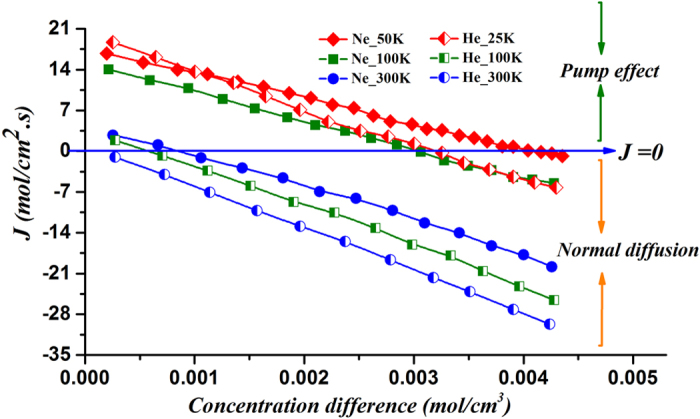
The angle of asymmetric channel is 38.9°, which refers to the corresponding carbon nanotubes in Fig. 2.


References
-
- Ge M. & Sattler K. Observation of fullerene cones. Chem. Phys. Lett., 220, 192–196 (1994).
-
- Krishnan A. et al. Graphitic cones and the nucleation of curved carbon surfaces. Nature 388, 451–456 (1997).
-
- Charlier J. C. & Rignanese G. M. Electronic structure of carbon nanocones. Phys. Rev. Lett. 86, 5970–5973 (2001). - PubMed
-
- Yang N., Zhang G. & Li B. W. Carbon nanocone: a promising thermal rectifier. Appl. Phys. Lett. 93, 243111 (2008).
-
- Dimitrakakis G. K., Tylianakis E. & Froudakis G. E. Pillared graphene: a new 3-D network nanostructure for enhanced hydrogen storage. Nano Lett., 8, 3166–3170 (2008). - PubMed
Publication types
LinkOut - more resources
Full Text Sources
Other Literature Sources
