Antimicrobial properties of poly (methyl methacrylate) acrylic resins incorporated with silicon dioxide and titanium dioxide nanoparticles on cariogenic bacteria
- PMID: 26998471
- PMCID: PMC4778177
- DOI: 10.4103/2278-0203.176652
Antimicrobial properties of poly (methyl methacrylate) acrylic resins incorporated with silicon dioxide and titanium dioxide nanoparticles on cariogenic bacteria
Abstract
Aim: To assess the effects of adding nano-titanium dioxide (nano-TiO2) and nano-silicon dioxide (nano-SiO2) and their mixture to poly (methyl methacrylate) (PMMA) to induce antimicrobial activity in acrylic resins.
Materials and methods: Acrylic specimens in size of 20 mm × 20 mm × 1 mm of 0.5% and 1% of nano-TiO2 (21 nm) and nano-SiO2 (20 nm) and their mixture (TiO2/SiO2 nanoparticles) (1:1 w/w) were prepared from the mixture of acrylic liquid containing nanoparticles and acrylic powder. To obtain 0.5% and 1% concentration, 0.02 g and 0.04 g of the nanoparticles was added to each milliliter of the acrylic monomer, respectively. Antimicrobial properties of six specimens of these preparations, as prepared, were assessed against planktonic Lactobacillus acidophilus and Streptococcus mutans at 0, 15, 30, 45, 60, 75, and 90 min follow-up by broth dilution assay. The specimens of each group were divided into three subgroups: Dark, daylight, or ultraviolet A (UVA). The percent of bacterial reduction is found out from the counts taken at each time point.
Statistical analysis: Data were analyzed using one-way analysis of variance and Tukey's post hoc analysis.
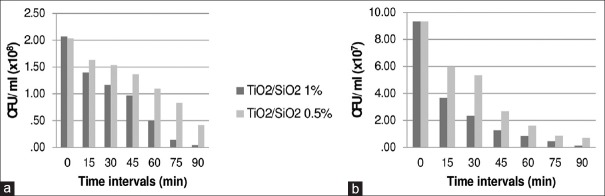
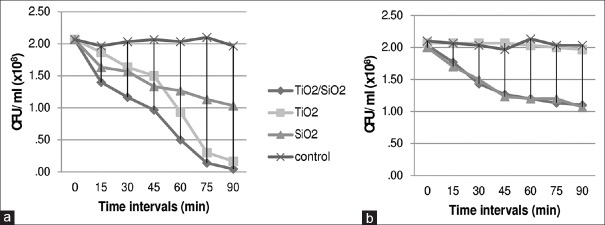
Results: Exposure to PMMA containing the nanoparticles reduced the bacterial count by 3.2-99%, depending on the nanoparticles, bacterial types, and light conditions. Planktonic cultures of S. mutans and L. acidophilus exposed to PMMA containing 1% of TiO2/SiO2 nanoparticles showed a significant decrease (P < 0.001) (98% and 99%, respectively) in a time-dependent manner under UVA. The S. mutans and L. acidophilus counts did not significantly decrease in PMMA containing 0.5% nano-TiO2 and PMMA containing 0.5% nano-SiO2 in the dark. No statistically significant reduction (P > 0.05) was observed in the counts of S. mutans and L. acidophilus in PMMA without the nanoparticles exposed to UVA.
Conclusions: PMMA resins incorporated with TiO2/SiO2 nanoparticles showed strong antimicrobial activity against the cariogenic bacteria.
Keywords: Antimicrobial activity; cariogenic bacteria; nano-silicon dioxide; nano-titanium dioxide; poly(methyl methacrylate).
Figures
References
-
- Faltermeier A, Rosentritt M, Müssig D. Acrylic removable appliances: Comparative evaluation of different postpolymerization methods. Am J Orthod Dentofacial Orthop. 2007;131:301.e16–22. - PubMed
-
- Ghorbanzadeh R, Pourakbari B, Bahador A. Effects of baseplates of orthodontic appliances with in situ generated silver nanoparticles on cariogenic bacteria: A randomized, double-blind cross-over clinical trial. J Contemp Dent Pract. 2015;16:291–8. - PubMed
-
- Morgan TD, Wilson M. The effects of surface roughness and type of denture acrylic on biofilm formation by Streptococcus oralis in a constant depth film fermentor. J Appl Microbiol. 2001;91:47–53. - PubMed
-
- Duymus ZY, Yanikoglu ND. The investigation of solubility values, water sorption and bond strength of auto-polymerising and heat-polymerising acrylic resin materials. Eur J Prosthodont Restor Dent. 2006;14:116–20. - PubMed
-
- Borzabadi-Farahani A, Borzabadi E, Lynch E. Nanoparticles in orthodontics, a review of antimicrobial and anti-caries applications. Acta Odontol Scand. 2014;72:413–7. - PubMed
LinkOut - more resources
Full Text Sources
Other Literature Sources