Review
. 2016 Mar;49(2):139-46.
doi: 10.5946/ce.2016.024. Epub 2016 Mar 22.

Mechanisms of Biliary Plastic Stent Occlusion and Efforts at Prevention

Affiliations
Review

Mechanisms of Biliary Plastic Stent Occlusion and Efforts at Prevention

Chang-Il Kwon et al. Clin Endosc. 2016 Mar.

Abstract

Biliary stenting via endoscopic retrograde cholangiopancreatography has greatly improved the quality of patient care over the last 30 years. Plastic stent occlusion limits the life span of such stents. Attempts to improve plastic stent patency duration have mostly failed. Metal stents (self-expandable metal stents [SEMSs]) have therefore replaced plastic stents, especially for malignant biliary strictures. SEMS are at least 10 times more expensive than plastic stents. In this focused review, we will discuss basic mechanisms of plastic stent occlusion, along with a systematic summary of previous efforts and related studies to improve stent patency and potential new techniques to overcome existing limitations.

Keywords: Biliary tract; Biofilms; Occlusion; Patency; Stents.


Conflict of interest statement

Conflicts of Interest: The authors have no financial conflicts of interest.

Figures

Fig. 1.
Fig. 1.
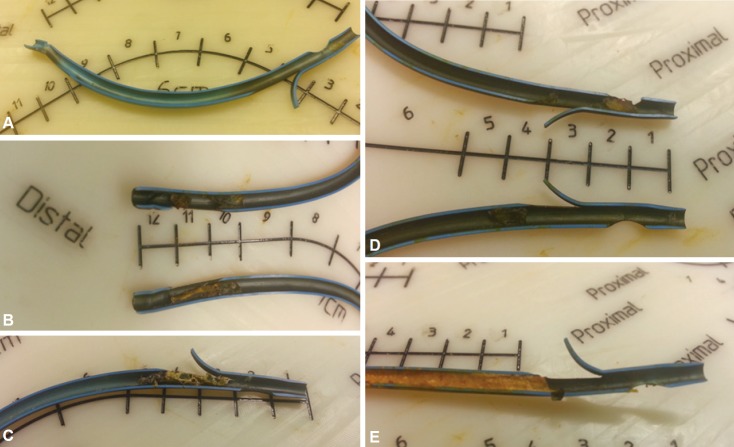
(A-E) Retrieved biliary plastic stents with the inner layer exposed by longitudinal cutting. The dark greenish biofilms do not contribute significantly to increased thickness of the occluded inner layer. Stent occlusion is mostly caused by debris, sludge, and food components.
Fig. 2.
Fig. 2.
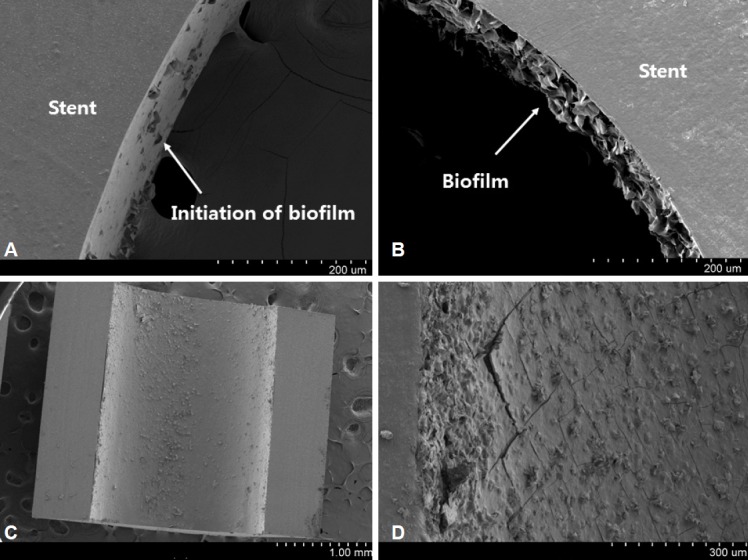
Scanning electron microscopy (SEM) examination of stent occlusion. SEM images of the inner surface of a stent retrieved at about 4 weeks. The biofilm starts to appear on the inner surface of the stent (A, ×250). The biofilm itself becomes gradually thicker relatively evenly (B, ×250; C, ×30). The surface becomes more solid and cracked in some areas (D, ×150).
Fig. 3.
Fig. 3.
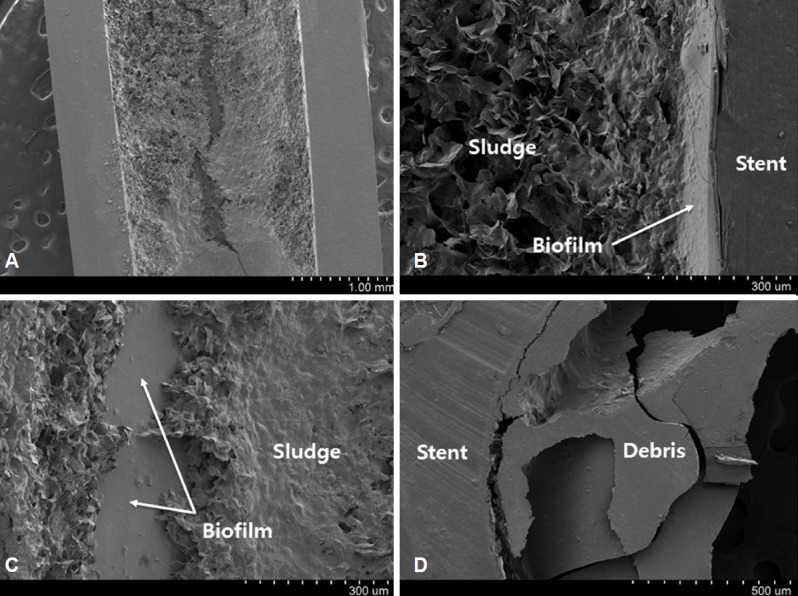
Scanning electron microscopy (SEM) examination of stent occlusion. SEM images of the inner surface of a stent retrieved at about 8 weeks. Sludge covers the biofilm and narrows the inner diameter of the stent (A, ×30; B, ×150). The biofilm is exposed in some areas that are not covered by sludge (C, ×150). Debris, presumably derived from other causes even before the formation of the biofilm, is attached to the inner layer of the stent (D, ×100).
Fig. 4.
Fig. 4.
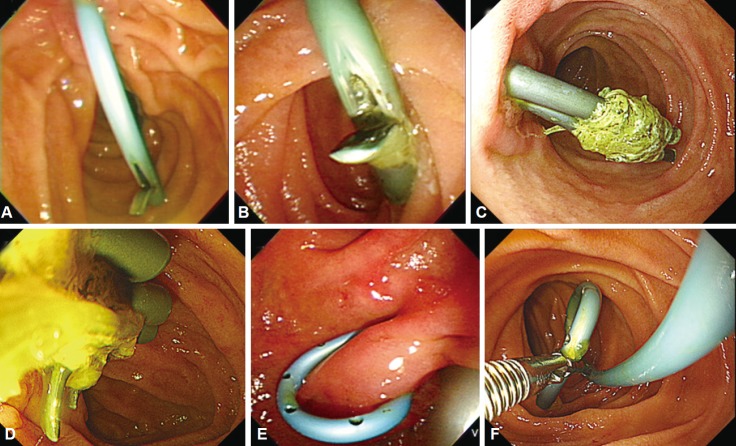
Factors causing plastic biliary stent malfunction. (A, B) Distal ends of the straight stents are touching the duodenal wall as a result of partial distal migration. This may lead to flow disturbance and sludge accumulation, causing occlusion. (C, D) The straight stents have not migrated, but dietary fibers are clinging to the side flaps, causing stent occlusion. (E, F) Distal ends of the pigtail stents are touching the duodenal wall or partially migrated, but the side holes still allow bile flow.

References

    1. Ballinger AB, McHugh M, Catnach SM, Alstead EM, Clark ML. Symptom relief and quality of life after stenting for malignant bile duct obstruction. Gut. 1994;35:467–470. - PMC - PubMed
    1. Faigel DO. Preventing biliary stent occlusion. Gastrointest Endosc. 2000;51:104–107. - PubMed
    1. Raijman I. Biliary and pancreatic stents. Gastrointest Endosc Clin N Am. 2003;13:561–592. - PubMed
    1. Soehendra N, Reynders-Frederix V. Palliative bile duct drainage: a new endoscopic method of introducing a transpapillary drain. Endoscopy. 1980;12:8–11. - PubMed
    1. Speer AG, Cotton PB, Russell RC, et al. Randomised trial of endoscopic versus percutaneous stent insertion in malignant obstructive jaundice. Lancet. 1987;2:57–62. - PubMed

LinkOut - more resources