


Opposing effects of oxidative challenge and carotenoids on antioxidant status and condition-dependent sexual signalling
- PMID: 27000655
- PMCID: PMC4802301
- DOI: 10.1038/srep23546
Opposing effects of oxidative challenge and carotenoids on antioxidant status and condition-dependent sexual signalling
Abstract
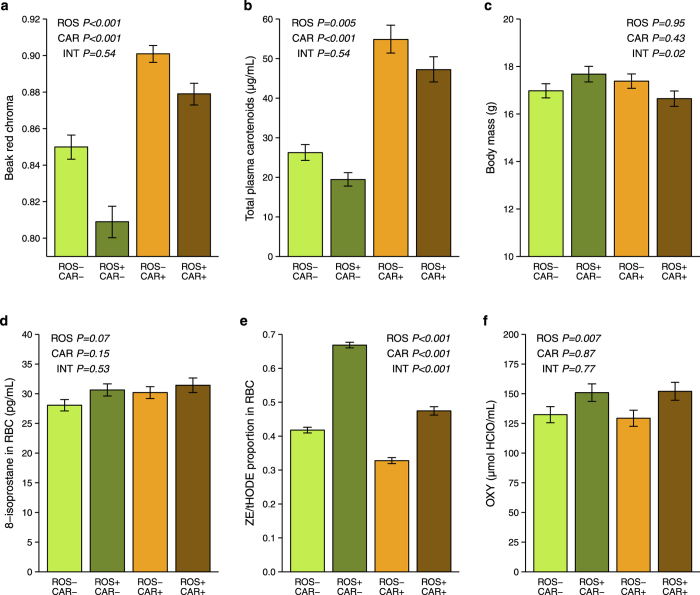
Several recent hypotheses consider oxidative stress to be a primary constraint ensuring honesty of condition-dependent carotenoid-based signalling. The key testable difference between these hypotheses is the assumed importance of carotenoids for redox homeostasis, with carotenoids being either antioxidant, pro-oxidant or unimportant. We tested the role of carotenoids in redox balance and sexual signalling by exposing adult male zebra finches (Taeniopygia guttata) to oxidative challenge (diquat dibromide) and manipulating carotenoid intake. As the current controversy over the importance of carotenoids as antioxidants could stem from the hydrophilic basis of commonly-used antioxidant assays, we used the novel measure of in vivo lipophilic antioxidant capacity. Oxidative challenge reduced beak pigmentation but elicited an increase in antioxidant capacity suggesting resource reallocation from signalling to redox homeostasis. Carotenoids counteracted the effect of oxidative challenge on lipophilic (but not hydrophilic) antioxidant capacity, thereby supporting carotenoid antioxidant function in vivo. This is inconsistent with hypotheses proposing that signalling honesty is maintained through either ROS-induced carotenoid degradation or the pro-oxidant effect of high levels of carotenoid-cleavage products acting as a physiological handicap. Our data further suggest that assessment of lipophilic antioxidant capacity is necessary to fully understand the role of redox processes in ecology and evolution.
Conflict of interest statement
The authors declare no competing financial interests.
Figures
References
-
- Folstad I. & Karter A. J. Parasites, bright males, and the immunocompetence handicap. Am. Nat. 139, 603–622 (1992).
-
- Hill G. E. Condition‐dependent traits as signals of the functionality of vital cellular processes. Ecol. Lett. 14, 625–634 (2011). - PubMed
Publication types
MeSH terms
Substances
LinkOut - more resources
Full Text Sources
Other Literature Sources
Medical
