Effect of Covered Metallic Stents Compared With Plastic Stents on Benign Biliary Stricture Resolution: A Randomized Clinical Trial
- PMID: 27002446
- PMCID: PMC5544902
- DOI: 10.1001/jama.2016.2619
Effect of Covered Metallic Stents Compared With Plastic Stents on Benign Biliary Stricture Resolution: A Randomized Clinical Trial
Abstract
Importance: Endoscopic placement of multiple plastic stents in parallel is the first-line treatment for most benign biliary strictures; it is possible that fully covered, self-expandable metallic stents (cSEMS) may require fewer endoscopic retrograde cholangiopancreatography procedures (ERCPs) to achieve resolution.
Objective: To assess whether use of cSEMS is noninferior to plastic stents with respect to stricture resolution.
Design, setting, and participants: Multicenter (8 endoscopic referral centers), open-label, parallel, randomized clinical trial involving patients with treatment-naive, benign biliary strictures (N = 112) due to orthotopic liver transplant (n = 73), chronic pancreatitis (n = 35), or postoperative injury (n = 4), who were enrolled between April 2011 and September 2014 (with follow-up ending October 2015). Patients with a bile duct diameter less than 6 mm and those with an intact gallbladder in whom the cystic duct would be overlapped by a cSEMS were excluded.
Interventions: Patients (N = 112) were randomized to receive multiple plastic stents or a single cSEMS, stratified by stricture etiology and with endoscopic reassessment for resolution every 3 months (plastic stents) or every 6 months (cSEMS). Patients were followed up for 12 months after stricture resolution to assess for recurrence.
Main outcomes and measures: Primary outcome was stricture resolution after no more than 12 months of endoscopic therapy. The sample size was estimated based on the noninferiority of cSEMS to plastic stents, with a noninferiority margin of -15%.
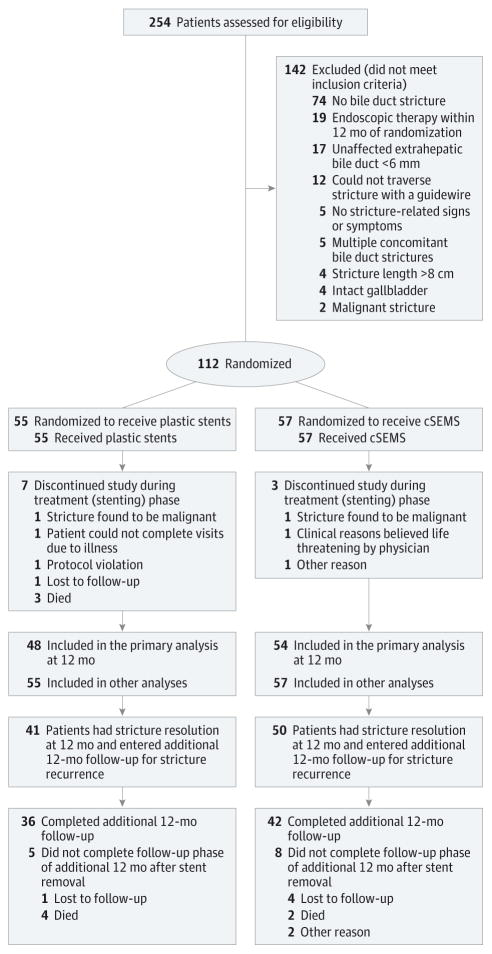
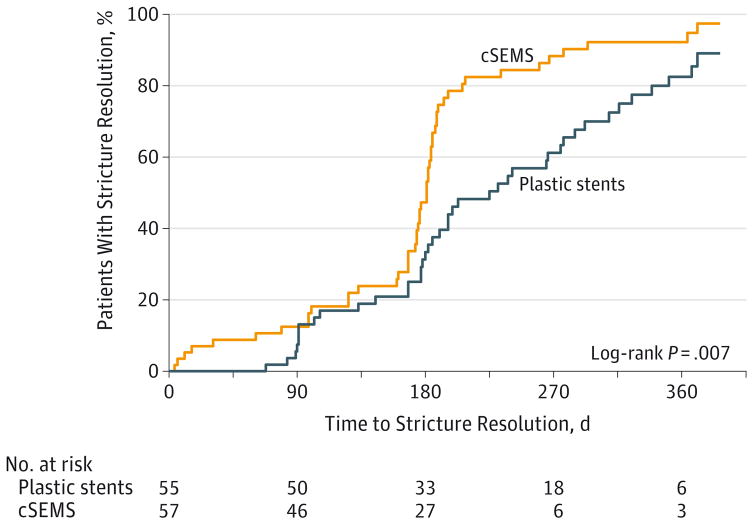
Results: There were 55 patients in the plastic stent group (mean [SD] age, 57 [11] years; 17 women [31%]) and 57 patients in the cSEMS group (mean [SD] age, 55 [10] years; 19 women [33%]). Compared with plastic stents (41/48, 85.4%), the cSEMS resolution rate was 50 of 54 patients (92.6%), with a rate difference of 7.2% (1-sided 95% CI, -3.0% to ∞; P < .001). Given the prespecified noninferiority margin of -15%, the null hypothesis that cSEMS is less effective than plastic stents was rejected. The mean number of ERCPs to achieve resolution was lower for cSEMS (2.14) vs plastic (3.24; mean difference, 1.10; 95% CI, 0.74 to 1.46; P < .001).
Conclusions and relevance: Among patients with benign biliary strictures and a bile duct diameter 6 mm or more in whom the covered metallic stent would not overlap the cystic duct, cSEMS were not inferior to multiple plastic stents after 12 months in achieving stricture resolution. Metallic stents should be considered an appropriate option in patients such as these.
Trial registration: clinicaltrials.gov Identifier: NCT01221311.
Conflict of interest statement
Figures
Comment in
-
Metallic vs Plastic Stents for Benign Biliary Strictures.JAMA. 2016 Aug 2;316(5):540. doi: 10.1001/jama.2016.7303. JAMA. 2016. PMID: 27483070 No abstract available.
-
Metallic vs Plastic Stents for Benign Biliary Strictures--Reply.JAMA. 2016 Aug 2;316(5):540-1. doi: 10.1001/jama.2016.7306. JAMA. 2016. PMID: 27483071 No abstract available.
-
Plastic stents or covered self-expandable metal stents for benign biliary strictures: same song, different verse?Hepatobiliary Surg Nutr. 2016 Dec;5(6):506-508. doi: 10.21037/hbsn.2016.11.07. Hepatobiliary Surg Nutr. 2016. PMID: 28124009 Free PMC article. No abstract available.
-
The freedom of choice.Hepatobiliary Surg Nutr. 2017 Feb;6(1):52-54. doi: 10.21037/hbsn.2017.01.13. Hepatobiliary Surg Nutr. 2017. PMID: 28261596 Free PMC article. No abstract available.
-
Effectiveness of covered metallic stents of benign biliary stricture resolution.Hepatobiliary Surg Nutr. 2017 Feb;6(1):55-56. doi: 10.21037/hbsn.2017.02.01. Hepatobiliary Surg Nutr. 2017. PMID: 28261597 Free PMC article. No abstract available.
-
The evolving superiority of covered metallic stents for benign biliary strictures.Hepatobiliary Surg Nutr. 2017 Feb;6(1):63-64. doi: 10.21037/hbsn.2017.01.10. Hepatobiliary Surg Nutr. 2017. PMID: 28261600 Free PMC article. No abstract available.
-
Endoscopic therapy for benign biliary strictures: evaluation of metal vs. plastic biliary stents.Hepatobiliary Surg Nutr. 2017 Aug;6(4):268-271. doi: 10.21037/hbsn.2017.05.04. Hepatobiliary Surg Nutr. 2017. PMID: 28848751 Free PMC article. No abstract available.
References
-
- Dumonceau JM, Tringali A, Blero D, et al. European Society of Gastrointestinal Endoscopy. Biliary stenting: indications, choice of stents and results: European Society of Gastrointestinal Endoscopy (ESGE) clinical guideline. Endoscopy. 2012;44(3):277–298. - PubMed
-
- Warshaw AL, Schapiro RH, Ferrucci JT, Jr, Galdabini JJ. Persistent obstructive jaundice, cholangitis, and biliary cirrhosis due to common bile duct stenosis in chronic pancreatitis. Gastroenterology. 1976;70(4):562–567. - PubMed
-
- Costamagna G, Pandolfi M, Mutignani M, Spada C, Perri V. Long-term results of endoscopic management of postoperative bile duct strictures with increasing numbers of stents. Gastrointest Endosc. 2001;54(2):162–168. - PubMed
-
- Draganov P, Hoffman B, Marsh W, Cotton P, Cunningham J. Long-term outcome in patients with benign biliary strictures treated endoscopically with multiple stents. Gastrointest Endosc. 2002;55(6):680–686. - PubMed
-
- Rossi P, Bezzi M, Salvatori FM, Maccioni F, Porcaro ML. Recurrent benign biliary strictures: management with self-expanding metallic stents. Radiology. 1990;175(3):661–665. - PubMed
Publication types
MeSH terms
Substances
Associated data
Grants and funding
LinkOut - more resources
Full Text Sources
Other Literature Sources
Medical
Miscellaneous