


Is there a Benefit of Multidisciplinary Cancer Team Meetings for Patients with Gastrointestinal Malignancies?
- PMID: 27002814
- PMCID: PMC4927602
- DOI: 10.1245/s10434-016-5178-3
Is there a Benefit of Multidisciplinary Cancer Team Meetings for Patients with Gastrointestinal Malignancies?
Abstract
Background: Multidisciplinary cancer team meetings are intended to optimize the diagnosis of a patient with a malignancy. The aim of this study was to assess the number of correct diagnoses formulated by the multidisciplinary team (MDT) and whether MDT decisions were implemented.
Methods: In a prospective study, data of consecutive patients discussed at gastrointestinal oncology MDT meetings were studied, and MDT diagnoses were validated with pathology or follow-up. Factors of influence on the correct diagnosis were identified by use of a Poisson regression model. Electronic patient records were used to assess whether MDT decisions were implemented, and reasons to deviate from these decisions were hand-searched within these records.
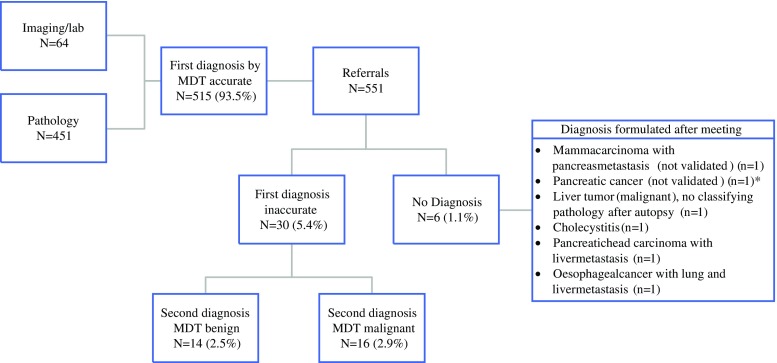
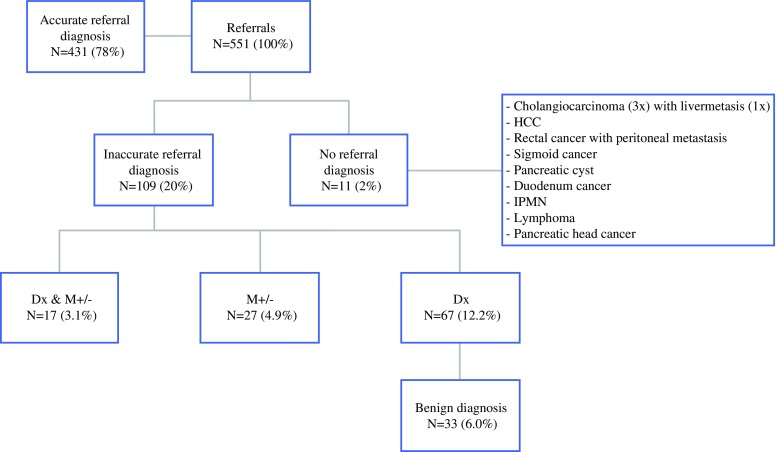
Results: In 74 MDT meetings, 551 patients were discussed a total of 691 times. The MDTs formulated a correct diagnosis for 515/551 patients (93.4 %), and for 120/551 (21.8 %) patients the MDT changed the referral diagnosis. Of the MDT diagnoses, 451/515 (87.6 %) were validated with pathology. Patients presented to the MDT by their treating physician were 20 % more likely to receive a correct diagnosis [relative risk (RR) 1.2, 95 % confidence interval (CI) 1.1-1.5], while the number of patients discussed or the duration of the meeting had no influence on this (RR 1.0, 95 % CI 0.99-1.0; RR 1.0, 95 % CI 0.9-1.1; resp.). MDT decisions were implemented in 94.4 % of cases. Deviations of MDT decisions occurred when a patient's wishes or physical condition were not taken into account.
Conclusions: MDTs rectify 20 % of the referral diagnoses. The presence of the treating physician is the most important factor to ensure a correct diagnosis and adherence to the treatment plan.
Figures
References
-
- Signaleringscommissie Kanker van KWF Kankerbestrijding. Kanker in Nederland, Trends, prognoses en implicaties voor zorgvraag [Signalling Comittee Cancer of the Dutch Cancer Society. Cancer in the Netherlands: Trends, prognosis and implications for the demand for care]. Amsterdam: Report of the Dutch Cancer Society; 2004.
Publication types
MeSH terms
LinkOut - more resources
Full Text Sources
Other Literature Sources
