. 2016 Mar 22;11(3):e0151233.
doi: 10.1371/journal.pone.0151233. eCollection 2016.

D-Serine and Glycine Differentially Control Neurotransmission during Visual Cortex Critical Period

Affiliations

D-Serine and Glycine Differentially Control Neurotransmission during Visual Cortex Critical Period

Claire N J Meunier et al. PLoS One. .

Abstract

N-methyl-D-aspartate receptors (NMDARs) play a central role in synaptic plasticity. Their activation requires the binding of both glutamate and d-serine or glycine as co-agonist. The prevalence of either co-agonist on NMDA-receptor function differs between brain regions and remains undetermined in the visual cortex (VC) at the critical period of postnatal development. Here, we therefore investigated the regulatory role that d-serine and/or glycine may exert on NMDARs function and on synaptic plasticity in the rat VC layer 5 pyramidal neurons of young rats. Using selective enzymatic depletion of d-serine or glycine, we demonstrate that d-serine and not glycine is the endogenous co-agonist of synaptic NMDARs required for the induction and expression of Long Term Potentiation (LTP) at both excitatory and inhibitory synapses. Glycine on the other hand is not involved in synaptic efficacy per se but regulates excitatory and inhibitory neurotransmission by activating strychnine-sensitive glycine receptors, then producing a shunting inhibition that controls neuronal gain and results in a depression of synaptic inputs at the somatic level after dendritic integration. In conclusion, we describe for the first time that in the VC both D-serine and glycine differentially regulate somatic depolarization through the activation of distinct synaptic and extrasynaptic receptors.


Conflict of interest statement

Competing Interests: Part of the work of CNJM was funded by Sanofi-Aventis. However, this does not alter the authors’ adherence to PLOS ONE policies on sharing data and materials.

Figures

Fig 1
Fig 1
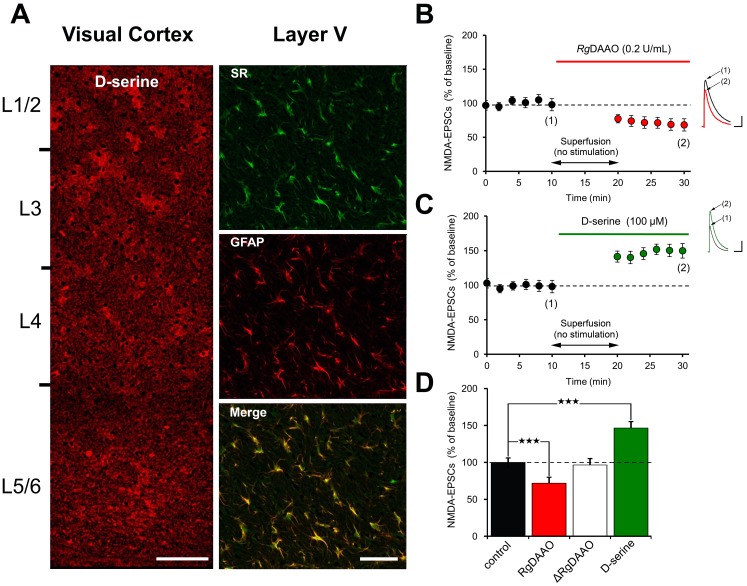
D-serine modulates synaptic NMDARs current at VC L5PyNs A: Immunofluorescence for D-serine, and GFAP revealed that D-serine is expressed across all layers of P22-25 (5 slices, 3 animals) VC. The D-serine producing enzyme serine racemase (SR) was also found to be expressed and co-localized with the astroglial marker GFAP. Images are Z-stack of 10 serial confocal images with a thickness of 1μm. Scale bars: left, 200 μm; right, 50μm B-D: Applications of the D-serine degrading enzyme RgDAAO (0.2 U/ml) reduces synaptically evoked NMDA-EPSCs (n = 5 cells, 5 slices, 2 animals) (B) while its inactive form ΔRgDAAO has no effect (n = 5 cells, 5 slices, 2 animals) (D). Scale bars: 100pA, 500ms. Conversely D-serine (100 μM) significantly potentiates NMDA-EPSCs (n = 5 cells, 5 slices, 2 animals) (C) Scale bars: 200pA, 500ms. ***p<0.001.
Fig 2
Fig 2
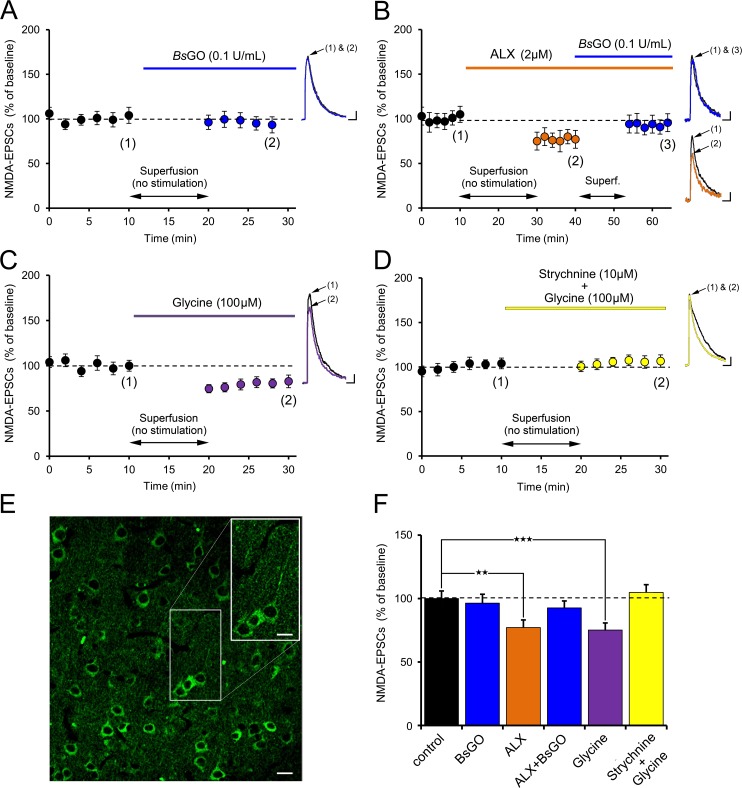
Glycine is not the endogenous co-agonist of L5PyNs VC NMDARs A: Application of the glycine degrading enzyme BsGO (0.1 U/ml) has no effect on NMDA-EPSCs (n = 5 cells, 5 slices, 2 animals), indicating that glycine is not the endogenous co-agonist of synaptic L5PyrNs VC NMDARs. Scale bars: 100pA, 500ms. B: Further, enhancing endogenous glycine levels with the glycine transporter blocker ALX5407 (2 μM) decreased the NMDARs response, an effect blocked by BsGO (n = 4 cells, 4 slices, 2 animals). Scale bars: 25pA, 250ms. C: A similar result is obtained by exogenous application of glycine (100μM) (n = 5 cells, 5 slices, 2 animals). Scale bars: 50pA, 500ms. D: Such downregulation of NMDA-EPSCs by glycine is remarkably blocked by the glycinergic receptors (GyRs) antagonist strychnine (10μM) (n = 5 cells, 5 slices, 2 animals). Scale bars: 50pA, 500ms. E: Immunofluorescence for GlyRs revealed that, in the VC, they are mainly expressed in L5PyRNs notably at the somatic and dendritic level. Scale bar: 50μm, inset: 30μm. F: Altogether, these results indicate that glycine downregulates NMDA-EPSCs through activation of GlyRs ** p<0.01, *** p<0.001.
Fig 3
Fig 3
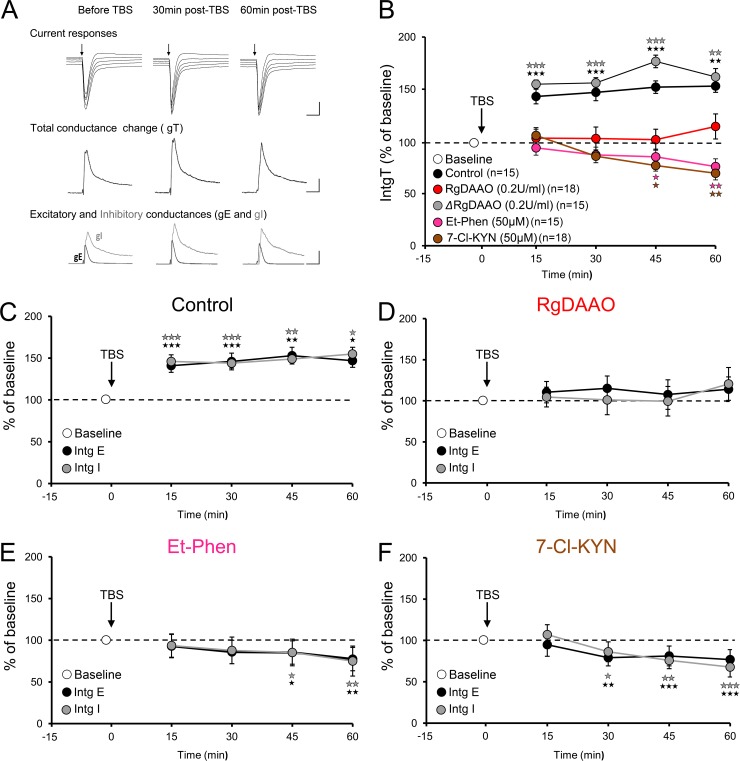
D-serine is required for VC long-term potentiation A: Upper panel shows representative composite current responses of L5PyN for the range of imposed potentials before and during LTP. Scale bars: 300pA, 50ms. Medium panels displays the corresponding total conductance change gT before and during LTP. Lower panels show decomposition of gT into excitatory (gE, black) and inhibitory (gI, grey) conductances (n = 15 cells, 15 slices, 8 animals). Scale bars: 4nS, 50ms. B: Changes in the gT integral (IntgT) calculated every 15 min, up to 1 h post-TBS, show that LTP is abolished by blocking the co-agonist binding site of NMDARs with 7-Cl-KYN, removing D-serine through the D-serine degrading enzyme RgDAAO (n = 18 cells, 18 slices, 9 animals) or preventing D-serine production via blockade of the D-serine producing enzyme serine racemase with Et-Phen (n = 17 cells, 17 slices, 8 animals). This indicates that D-serine is required for VC L5PyNs LTP. C-F: Excitatory (black) and inhibitory (grey) conductances were found to be equally affected by TBS application, regardless of the treatment, indicating that the E-I balance is unaltered by D-serine and LTP. *p<0.05, **p<0.01, ***p<0.001 compared to pre-TBS.
Fig 4
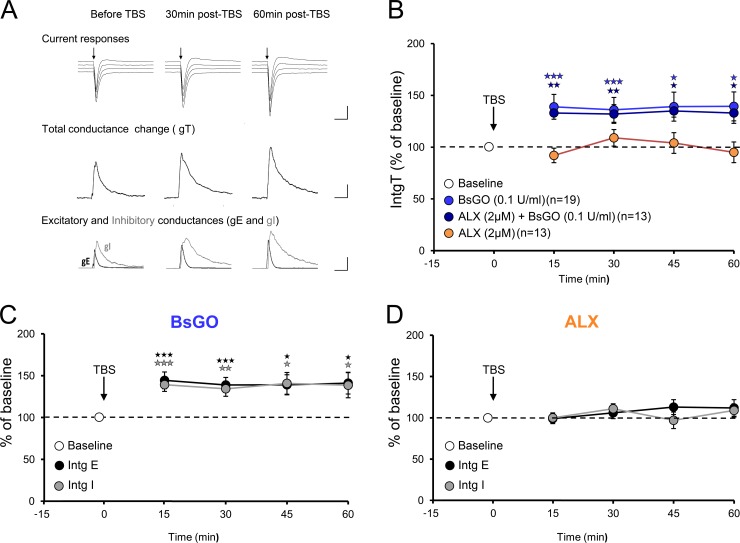
Fig 4. Increasing endogenous glycine level prevents the induction of LTP.
A: Upper panel shows representative composite current responses of L5PyN for the range of imposed potentials before and during LTP. Scale bars: 150pA, 50ms. Medium panels displays the corresponding total conductance change gT before and during LTP. Lower panels show decomposition of gT into excitatory (gE, black) and inhibitory (gI, grey) conductances. Scale bars: 4nS, 50ms. B: Changes in IntgT up to 1 h post-TBS show that LTP is abolished when endogenous glycine levels are increased by blocking the glycine transporter with ALX (2μM) (n = 13 cells, 13 slices, 6 animals). The glycine degrading enzyme BsGO has no effect on LTP (n = 19 cells, 19 slices, 9 animals), and prevents the effect of ALX (n = 13 cells, 13 slices, 6 animals), thus confirming that the latter is attributable to endogenous glycine rise. C-D: Excitatory (black) and inhibitory (grey) conductances were found to be equally affected by TBS application, regardless of the treatment, indicating that the E-I balance is unaltered by glycine and LTP. *p<0.05, **p<0.01, ***p<0.001 compared to pre-TBS.
Fig 5
Fig 5
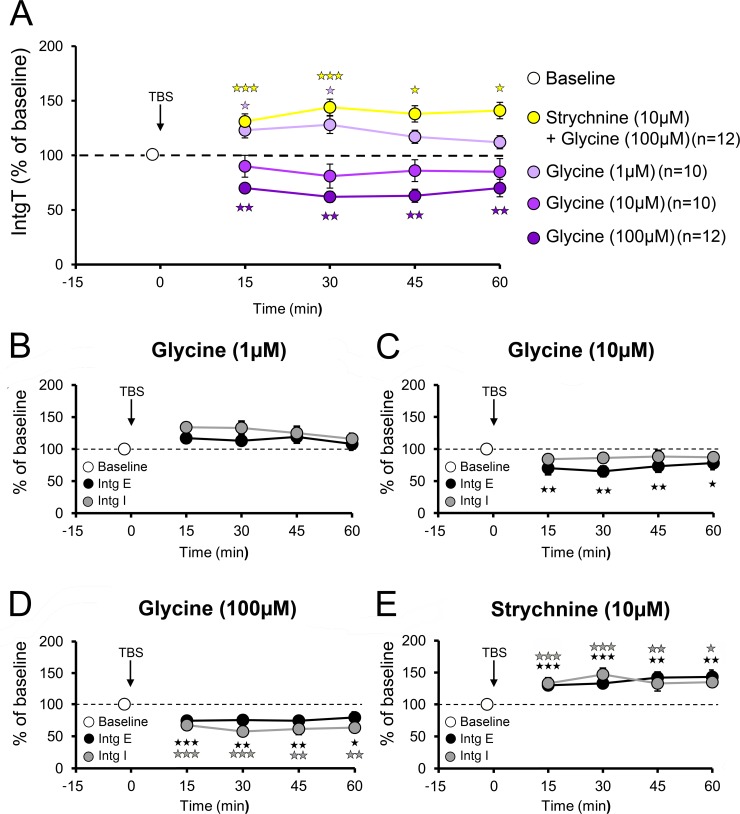
Dose effects of various concentrations of glycine on LTP A: At the concentration of 1μM glycine the initial potentiation induced by TBS does not last 1 h, thus indicating that at such low concentration is enough to prevent LTP (n = 10 cells, 10 slices, 5 animals). At 10μM glycine not only prevents all potentiation but also slightly decreases conductances recorded at the soma (n = 10 cells, 10 slices, 5 animals), although this reduction is not significant. At 100μM glycine blocks LTP and induces a significant depression up to 1 h post-TBS (n = 12 cells, 12 slices, 6 animals). B-E: Excitatory (black) and inhibitory (grey) conductances were found to be equally affected by TBS application, regardless of the treatment, confirming that the E-I balance is unaltered by glycine and LTP. *p<0.05, **p<0.01, ***p<0.001 compared to pre-TBS.
Fig 6
Fig 6
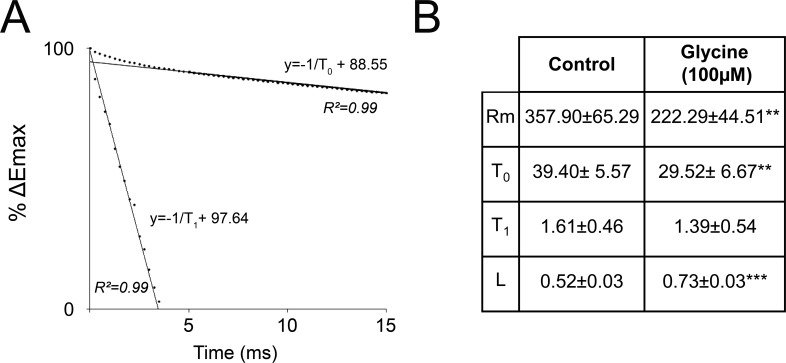
Glycine reduces VC L5PyNs dendritic current spread A: Membrane time constants Ƭ0 and Ƭ1. were calculated by plotting the natural log of the response expressed as percentage of the peak negative potential (% ΔEmax) to “peel” the first order exponential for time points lying between 5 and 15ms. Ƭ0 could then be read as the slope negative inverse of the regression line. The second order exponential for time points earlier than 5ms was peeled by plotting the difference between the Ƭ0 regression line from the points lying above this line and normalizing the y-intercept of the Ƭ1 regression line to 100%. Ƭ1 could then be read as the slope negative inverse of the normalized Ƭ1 regression line. B: Calculation of the electrotonic length (L) using the equation L = π (Ƭ0/ Ƭ 1)-1/2 showed that L is significantly increased in the presence of 100μM glycine, indicating that the dentritic current spread attenuation is higher in the latter case. **p<0.01,***p<0.001.

References

    1. Collingridge GL, Volianskis A, Bannister N, France G, Hanna L, Mercier M, et al. (2013) The NMDA receptor as a target for cognitive enhancement. Neuropharmacology 64: 13–26. 10.1016/j.neuropharm.2012.06.051 - DOI - PMC - PubMed
    1. Paoletti P, Bellone C, Zhou Q (2013) NMDA receptor subunit diversity: impact on receptor properties, synaptic plasticity and disease. Nat Rev Neurosci 14: 383–400. 10.1038/nrn3504 - DOI - PubMed
    1. Johnson JW, Ascher P (1987) Glycine potentiates the NMDA response in cultured mouse brain neurons. Nature 325: 529–531. 10.1038/325529a0 - DOI - PubMed
    1. Kleckner NW, Dingledine R (1988) Requirement for glycine in activation of NMDA-receptors expressed in Xenopus oocytes. Science 241: 835–837. - PubMed
    1. Wolosker H, Sheth KN, Takahashi M, Mothet JP, Brady RO, Ferris CD, et al. (1999) Purification of serine racemase: biosynthesis of the neuromodulator D-serine. Proc Natl Acad Sci U S A 96: 721–725. - PMC - PubMed

Publication types

LinkOut - more resources