


Response of enzyme activities and microbial communities to soil amendment with sugar alcohols
- PMID: 27005019
- PMCID: PMC4985594
- DOI: 10.1002/mbo3.355
Response of enzyme activities and microbial communities to soil amendment with sugar alcohols
Abstract
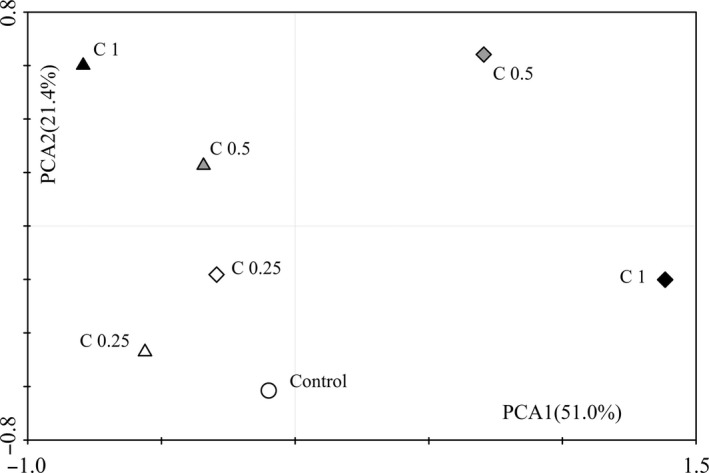
Changes in microbial community structure are widely known to occur after soil amendment with low-molecular-weight organic compounds; however, there is little information on concurrent changes in soil microbial functional diversity and enzyme activities, especially following sorbitol and mannitol amendment. Soil microbial functional diversity and enzyme activities can be impacted by sorbitol and mannitol, which in turn can alter soil fertility and quality. The objective of this study was to investigate the effects of sorbitol and mannitol addition on microbial functional diversity and enzyme activities. The results demonstrated that sorbitol and mannitol addition altered the soil microbial community structure and improved enzyme activities. Specifically, the addition of sorbitol enhanced the community-level physiological profile (CLPP) compared with the control, whereas the CLPP was significantly inhibited by the addition of mannitol. The results of a varimax rotated component matrix demonstrated that carbohydrates, polymers, and carboxylic acids affected the soil microbial functional structure. Additionally, we found that enzyme activities were affected by both the concentration and type of inputs. In the presence of high concentrations of sorbitol, the urease, catalase, alkaline phosphatase, β-glucosidase, and N-acetyl-β-d-glucosaminidase activities were significantly increased, while invertase activity was decreased. Similarly, this increase in invertase, catalase, and alkaline phosphatase and N-acetyl-β-d-glucosaminidase activities was especially evident after mannitol addition, and urease activity was only slightly affected. In contrast, β-glucosidase activity was suppressed at the highest concentration. These results indicate that microbial community diversity and enzyme activities are significantly affected by soil amendment with sorbitol and mannitol.
Keywords: Biolog CLPP; enzyme activity; soil microbial community; sugar alcohols.
© 2016 The Authors. MicrobiologyOpen published by John Wiley & Sons Ltd.
Figures


References
-
- Ai, C. , Liang G., Sun J., Wang X., and Zhou W.. 2012. Responses of extracellular enzyme activities and microbial community in both the rhizosphere and bulk soil to long‐term fertilization practices in a fluvo‐aquic soil. Geoderma 173:330–338.
-
- Ai, C. , Liang G., Sun J., He P., Tang S., Yang S., et al. 2015. The alleviation of acid soil stress in rice by inorganic or organic ameliorants is associated with changes in soil enzyme activity and microbial community composition. Biol. Fertil. Soils 51:465–477.
-
- Akinterinwa, O. , Khankal R., and Cirino P. C.. 2008. Metabolic engineering for bioproduction of sugar alcohols. Curr. Opin. Biotechnol. 19:461–467. - PubMed
-
- An, T. , Schaeffer S., Zhuang J., Radosevich M., Li S., Li H., et al. 2015. Dynamics and distribution of 13C‐labeled straw carbon by microorganisms as affected by soil fertility levels in the Black Soil region of Northeast China. Biol. Fertil. Soils 51:605–613.
-
- Bending, G. D. , Turner M. K., and Jones J. E.. 2002. Interactions between crop residue and soil organic matter quality and the functional diversity of soil microbial communities. Soil Biol. Biochem. 34:1073–1082.
Publication types
MeSH terms
Substances
LinkOut - more resources
Full Text Sources
Other Literature Sources
