Review
. 2016 Oct;16(10):2781-2794.
doi: 10.1111/ajt.13801. Epub 2016 Apr 28.

Unlocking the Potential of Purinergic Signaling in Transplantation

Affiliations
Review

Unlocking the Potential of Purinergic Signaling in Transplantation

R Zeiser et al. Am J Transplant. 2016 Oct.

Abstract

Purinergic signaling has been recognized as playing an important role in inflammation, angiogenesis, malignancy, diabetes and neural transmission. Activation of signaling pathways downstream from purinergic receptors may also be implicated in transplantation and related vascular injury. Following transplantation, the proinflammatory "danger signal" adenosine triphosphate (ATP) is released from damaged cells and promotes proliferation and activation of a variety of immune cells. Targeting purinergic signaling pathways may promote immunosuppression and ameliorate inflammation. Under pathophysiological conditions, nucleotide-scavenging ectonucleotidases CD39 and CD73 hydrolyze ATP, ultimately, to the anti-inflammatory mediator adenosine. Adenosine suppresses proinflammatory cytokine production and is associated with improved graft survival and decreased severity of graft-versus-host disease. Furthermore, purinergic signaling is involved both directly and indirectly in the mechanism of action of several existing immunosuppressive drugs, such as calcineurin inhibitors and mammalian target of rapamycin inhibitors. Targeting of purinergic receptor pathways, particularly in the setting of combination therapies, could become a valuable immunosuppressive strategy in transplantation. This review focuses on the role of the purinergic signaling pathway in transplantation and immunosuppression and explores possible future applications in clinical practice.

Keywords: clinical research/practice; immune regulation; immunosuppressant; immunosuppressive regimens; molecular biology; organ transplantation in general.


Figures

Figure 1
Figure 1. Overview of purinergic signaling
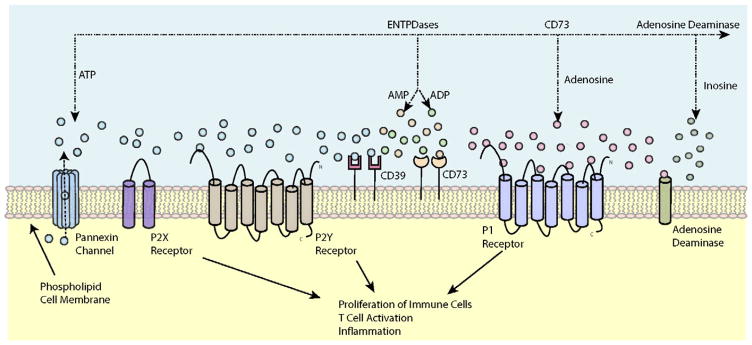
Intracellular ATP is released from cells through the opening of pannexin hemi channels or via P2X7 receptors and can serve as an extracellular signaling molecule. ATP subsequently signals with various P2 receptors, both ligand-gated P2X and G protein–coupled P2Y receptors, in an autocrine manner, which has been implicated in a wide variety of physiological processes. Eventually, ATP is hydrolyzed by ENTPDases expressed on cell surfaces, including CD39 and the ecto-5′-nucleotidase CD73, which promote the generation of adenosine. Adenosine signals on G protein–coupled P1 receptors and is metabolized to inosine by the enzyme adenosine deaminase. ADP, adenosine diphosphate; AMP, adenosine monophosphate; ATP, adenosine triphosphate.
Figure 2
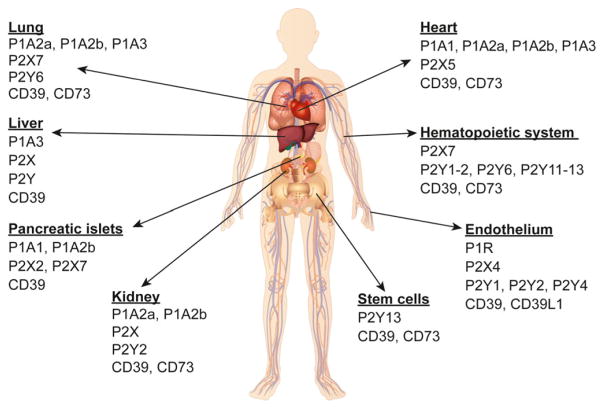
Figure 2. Distribution of purinergic receptors
An overview of purinergic receptor CD39 and CD73 expression is shown in selected organs, tissues, and cells. Further information on the distribution of purinergic receptors can be found in Table 1.
Figure 3
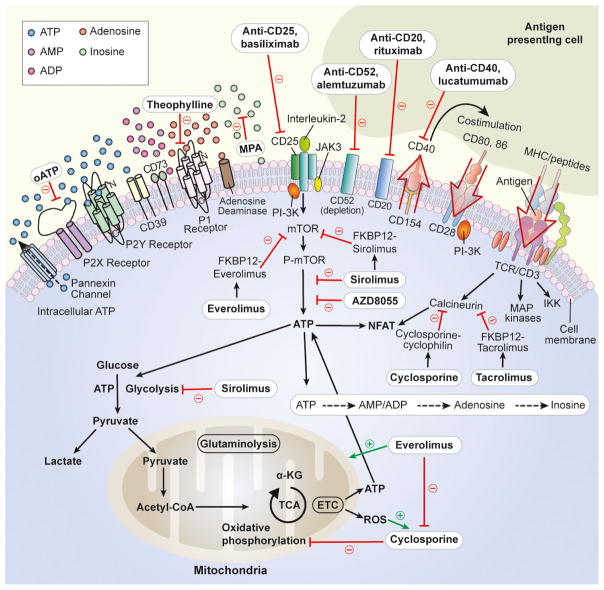
Figure 3. Immunosuppressive drugs and purinergic signaling
The intracellular or extracellular site of action of immunosuppressive drugs is shown. Green arrows indicate a stimulatory effect. Red lines indicate an inhibitory effect. ADP, adenosine diphosphate; AMP, adenosine monophosphate; ATP, adenosine triphosphate; CoA, coenzyme A; CD, cluster of differentiation; ETC, electron transport chain; FKBP, FK506 binding protein; IKK, I-kappa-B kinase; JAK, janus kinase; KG, ketoglutarate; MAP, mitogen-activated protein; MHC, major histocompatibility complex; MPA, mycophenolic acid; mTOR, mammalian target of rapamycin; NFAT, nuclear factor of activated T cells; oATP, oxidized adenosine triphosphate; P1/2, purinergic 1/2; P-, phospho-; PI-3K, phosphoinositide 3-kinase; ROS, reactive oxygen species; TCA, tricarboxylic acid; TCR, T cell receptor.

References

    1. Saidi RF, Hejazii Kenari SK. Clinical transplantation and tolerance: Are we there yet? Int J Organ Transplant Med. 2014;5:137–145. - PMC - PubMed
    1. Kunzli BM, Bernlochner MI, Rath S, et al. Impact of CD39 and purinergic signalling on the growth and metastasis of colorectal cancer. Purinergic Signal. 2011;7:231–241. - PMC - PubMed
    1. Burnstock G, Novak I. Purinergic signalling and diabetes. Purinergic Signal. 2013;9:307–324. - PMC - PubMed
    1. Burnstock G, Di Virgilio F. Purinergic signalling and cancer. Purinergic Signal. 2013;9:491–540. - PMC - PubMed
    1. Fumagalli M, Lecca D, Abbracchio MP. Role of purinergic signalling in neuro-immune cells and adult neural progenitors. Front Biosci (Landmark Ed) 2011;16:2326–2341. - PubMed

Publication types