


Sex differences in the rate of abdominal adipose accrual during adulthood: the Fels Longitudinal Study
- PMID: 27005404
- PMCID: PMC4970892
- DOI: 10.1038/ijo.2016.48
Sex differences in the rate of abdominal adipose accrual during adulthood: the Fels Longitudinal Study
Abstract
Objectives: The purpose of this analysis was to evaluate sex differences in the rate of visceral adipose tissue (VAT) and subcutaneous adipose tissue (SAT) accrual in adults. Secondary analyses examined differences in the rate of VAT and SAT accrual in premenopausal, perimenopausal and postmenopausal women.
Subjects/methods: Participants were 472 (60% female) non-Hispanic whites and aged 18-84 years at baseline in whom abdominal VAT and SAT were assessed using multiple-image magnetic resonance imaging at two time points, with an average follow-up of 7.3±2.6 years. Linear regression models were used to examine the effects of sex, baseline age and their interaction on rate of change per year in body composition measures (ΔBMI, ΔVAT and ΔVAT/SAT ratio (ΔVSR)) independent of baseline body composition measures, visit year, income, marital status, physical activity, smoking and alcohol intake. Secondary analyses examined differences in the rate of fat change by menopausal status (premenopausal, perimenopausal, postmenopausal).
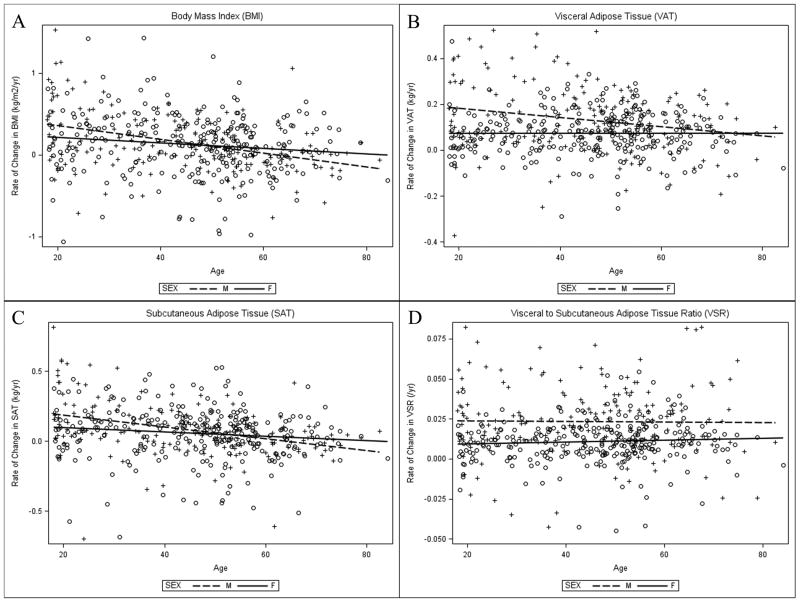
Results: Levels of body mass index (BMI), VAT and VSR all increased over the 7-year period on average (P<0.001); however, the change in BMI (mean ΔBMI=+0.5%) was far smaller than for VAT (mean ΔVAT=+6.8%), SAT (mean ΔSAT=+2.4%) and VSR (mean ΔVSR=+3.6%). ΔBMI, ΔVAT and ΔSAT decreased linearly with age in both sexes (P<0.01), such that older individuals had lower rates of BMI, VAT and SAT gain, and this deceleration in BMI, VAT and SAT accrual was greater in men than women (P for interaction <0.05). ΔVSR did not vary with age in either sex but remained higher in men than women throughout adulthood. There were no differences in rate of weight or fat gain by menopausal status after adjustment for age.
Conclusions: Men and women continue to accrue abdominal adiposity with age, but the rate of weight and fat gain decreases over time, particularly in men.
Conflict of interest statement
Figures
References
-
- Despres JP, Lemieux I. Abdominal obesity and metabolic syndrome. Nature. 2006;444(7121):881–7. - PubMed
-
- Kuk JL, Katzmarzyk PT, Nichaman MZ, Church TS, Blair SN, Ross R. Visceral fat is an independent predictor of all-cause mortality in men. Obesity (Silver Spring) 2006;14(2):336–41. - PubMed
-
- Boyko EJ, Fujimoto WY, Leonetti DL, Newell-Morris L. Visceral adiposity and risk of type 2 diabetes: a prospective study among Japanese Americans. Diabetes Care. 2000;23(4):465–71. - PubMed
-
- Hayashi T, Boyko EJ, Leonetti DL, McNeely MJ, Newell-Morris L, Kahn SE, et al. Visceral adiposity is an independent predictor of incident hypertension in Japanese Americans. Ann Intern Med. 2004;140(12):992–1000. - PubMed
-
- Misra A, Vikram NK. Clinical and pathophysiological consequences of abdominal adiposity and abdominal adipose tissue depots. Nutrition. 2003;19(5):457–66. - PubMed
MeSH terms
Grants and funding
LinkOut - more resources
Full Text Sources
Other Literature Sources
Medical
Research Materials
