Review
. 2016 Nov;8(6):872-890.
doi: 10.1002/wnan.1402. Epub 2016 Mar 23.

Nanoparticles and radiotracers: advances toward radionanomedicine

Affiliations
Review

Nanoparticles and radiotracers: advances toward radionanomedicine

Edwin C Pratt et al. Wiley Interdiscip Rev Nanomed Nanobiotechnol. 2016 Nov.

Abstract

In this study, we cover the convergence of radiochemistry for imaging and therapy with advances in nanoparticle (NP) design for biomedical applications. We first explore NP properties relevant for therapy and theranostics and emphasize the need for biocompatibility. We then explore radionuclide-imaging modalities such as positron emission tomography (PET), single-photon emission computed tomography (SPECT), and Cerenkov luminescence (CL) with examples utilizing radiolabeled NP for imaging. PET and SPECT have served as diagnostic workhorses in the clinic, while preclinical NP design examples of multimodal imaging with radiotracers show promise in imaging and therapy. CL expands the types of radionuclides beyond PET and SPECT tracers to include high-energy electrons (β- ) for imaging purposes. These advances in radionanomedicine will be discussed, showing the potential for radiolabeled NPs as theranostic agents. WIREs Nanomed Nanobiotechnol 2016, 8:872-890. doi: 10.1002/wnan.1402 For further resources related to this article, please visit the WIREs website.


Conflict of interest statement

statement The authors declare no competing financial interests.

Figures
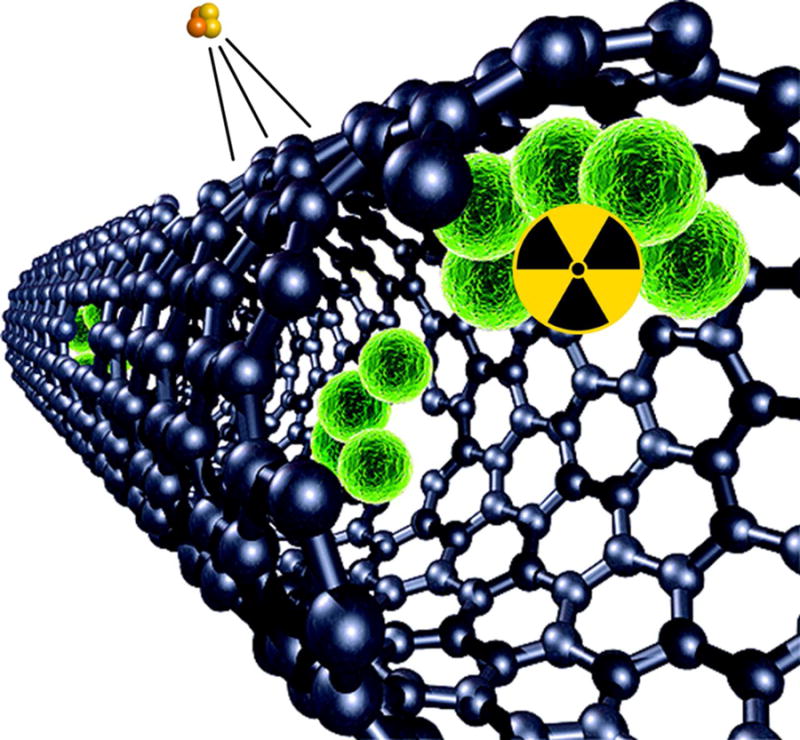
Figure 1
Figure 1
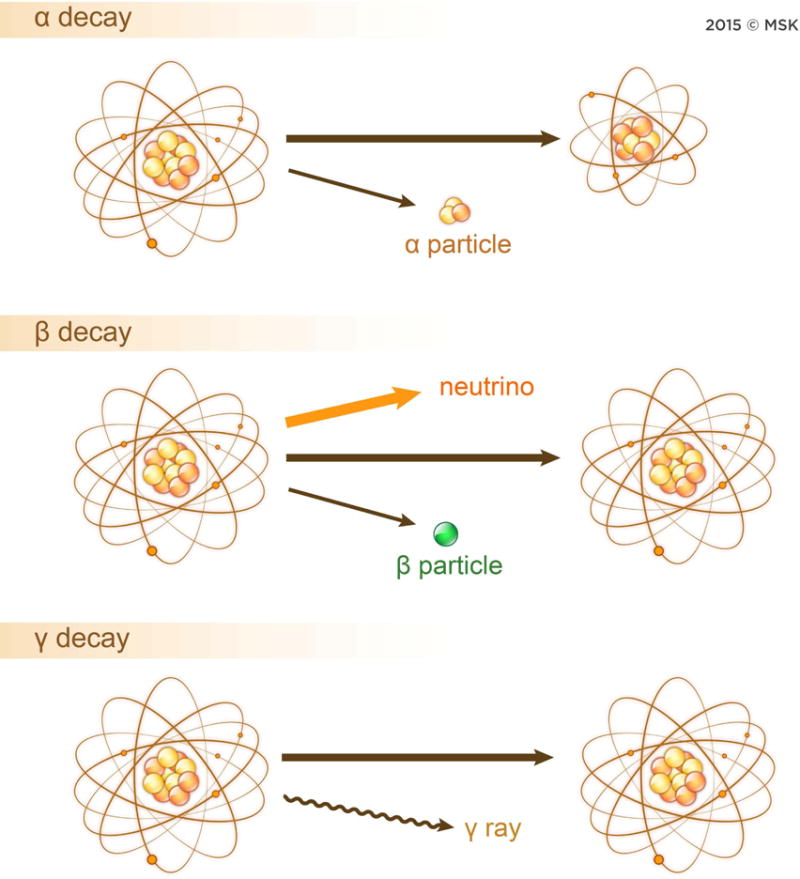
Three modes of radiation decay: α, β, and γ. Alpha decay is characterized by the ejection of a He2+ atom during decay. Beta decay occurs by the ejection of an electron or positron. The beta decay depicted here is for the positron with simultaneous neutrino ejection. In gamma decay, a high energy photon is generated as the atom relaxes to a lower energy state.
Figure 2
Figure 2
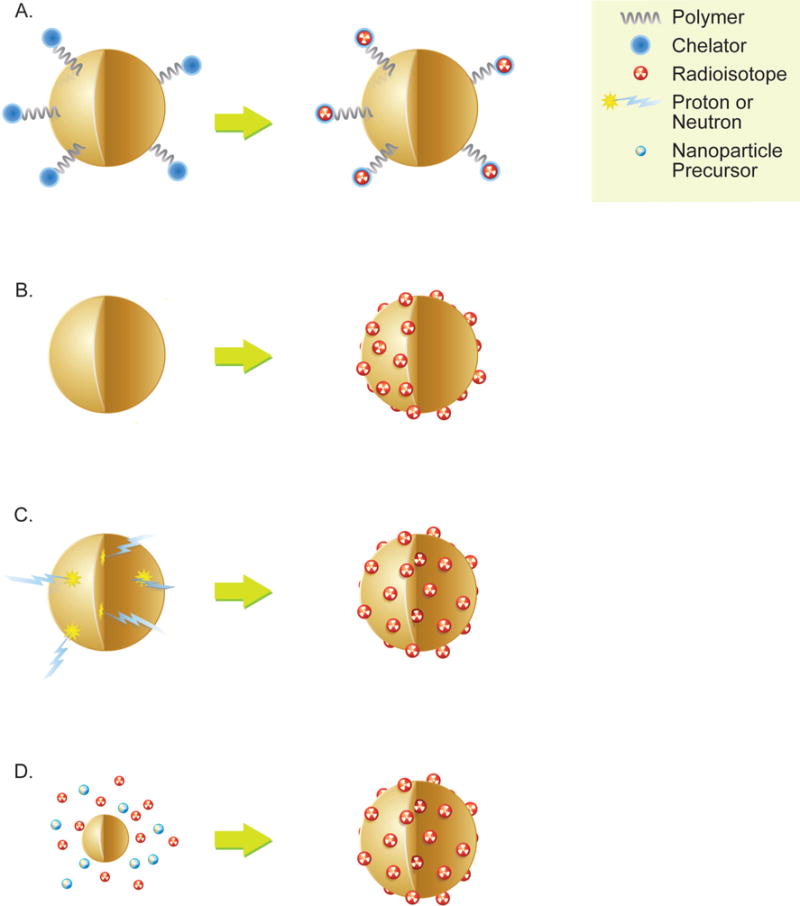
Four methods of radiolabeling nanoparticles. A) Traditional chelators are chemically conjugated to the surface to serve as sites for radiometal attachment. B) Chelator free radiolabeling method whereby radiometal is directly attached to the nanoparticle surface. C) Direct bombardment of a suitable nanoparticle atom by neutron or proton to yield a radiolabeled nanoparticle. No chelator nor surface chemistry required for radiolabeling. D) Direct synthesis methods whereby cold and hot precursors can be added to produce a nanoparticle with radioisotopes embedded into the nanoparticle lattice.
Figure 3
Figure 3
Representation of 225Ac@GNT construct. Green represents Gd3+ ions, yellow with radioactive symbol represents 225Ac3+ ion, and orange and yellow cluster represents emitted α particle. Reprinted with permission from The Journal of Nuclear Medicine (2015;56:897–900)
Figure 4
Figure 4
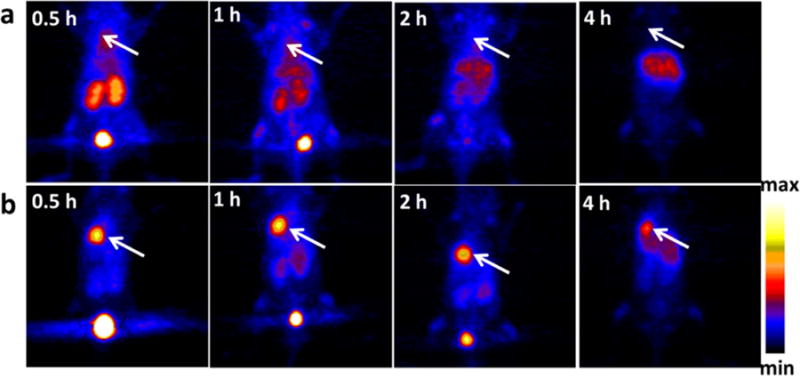
In vivo PET imaging and biodistribution. Representative PET images of coronal single slices on orthotopic A549 lung tumor bearing mice after intravenous injection of 6.7 MBq of [64Cu]CuNC@BSA (a) and [64Cu]CuNC@BSA-LHRH (b). Images were acquired at 0.5, 1, 2, and 4 h. White arrows indicate the lung tumor. Reprinted and adapted with permission from Gao, F. et al. Ultrasmall [64Cu] Cu Nanoclusters for Using Accurate Positron Emission. ACS Appl. Mater. Interfaces 9, 4976–4986 (2015). Copyright 2015 American Chemical Society.
Figure 5
Figure 5
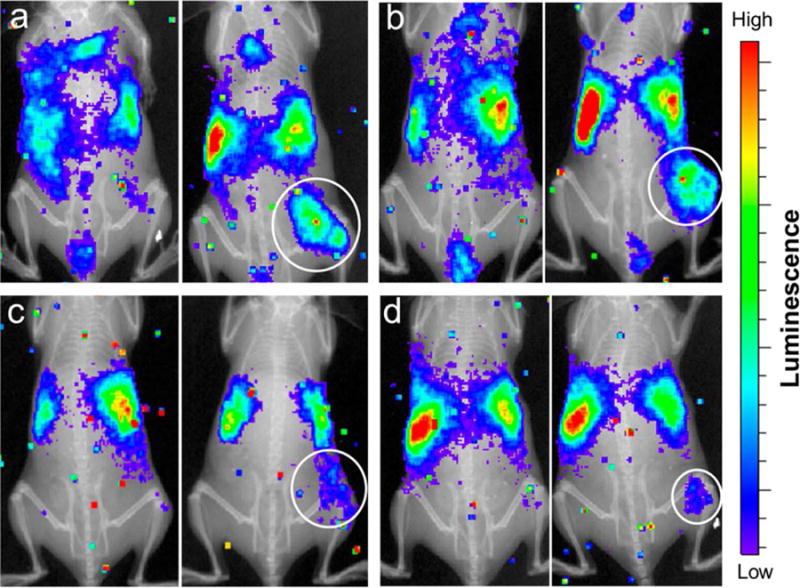
Co-registered in vivo luminescence and X-ray images of the tumor-bearing mice at 1 h (left panel) and 24 h (right panel) post injection of the different types of 198Au-incorporated nanostructures: (a) nanospheres, (b) nanodisks, (c) nanorods, and (d) cubic nanocages. Reprinted with permission from Black, Kvar C. L. et al.; ACS Nano 2014, 8, 4385–4394. Copyright © 2014 American Chemical Society
Figure 6
Figure 6
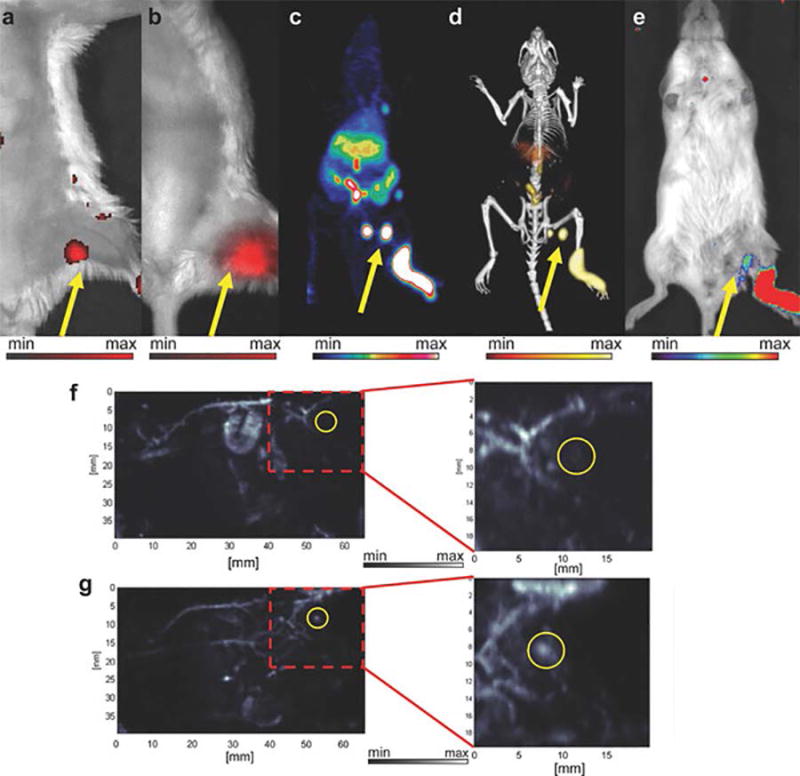
In vivo lymphatic imaging using PoP-UCNPs in mice. PoP-UCNPs were injected in the rear left footpad and imaged in six modalities 1 h post-injection. Accumulation of PoP-UCNPs in the first draining lymph node is indicated with yellow arrows. a) Traditional FL and b) UC images with the injection site cropped out of frame. c) Full anatomy PET, d) merged PET/CT, and e) CL images. f) PA images before and g) after injection show endogenous PA blood signal compared to the contrast enhancement that allowed visualization of the previously undetected lymph node. Reprinted with permission from Rieffel, J. et al. (2015), Hexamodal Imaging with Porphyrin-Phospholipid-Coated Upconversion Nanoparticles. Adv. Mater., 27: 1785–1790.
Figure 7
Figure 7
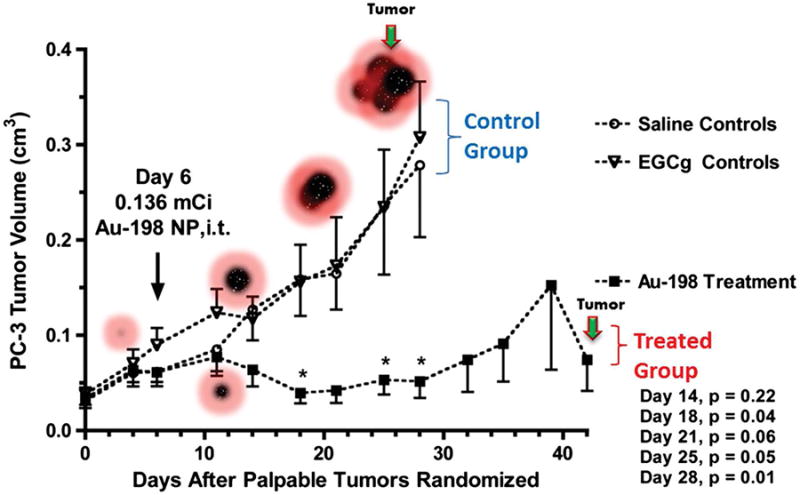
Tumor therapy using GA-198AuNPs. (A) Therapeutic efficacy of GA-198AuNPs in prostate tumor–bearing SCID mice. Subcutaneous tumors were generated in SCID mice by PC-3 engraftment. Mice bearing palpable tumors were randomized for treatment (n = 7) and control (n = 7) groups followed by intratumoral (IT) injections of GA-198AuNPs (408 μCi per animal) or DPBS, respectively. Graph represents mean tumor volume following 30 days of treatment. (B) TEM image showing uptake of GA- AuNPs in PC-3 prostate cancer cells. Reprinted with permission from Shukla, R. et al. Laminin receptor specific therapeutic gold nanoparticles (198AuNP-EGCg) show efficacy in treating prostate cancer. Proc. Natl. Acad. Sci. 109, 12426–12431 (2012).

References

    1. Harmsen S, et al. Surface-enhanced resonance Raman scattering nanostars for high-precision cancer imaging. Sci Transl Med. 2015;7:271ra7. - PMC - PubMed
    1. Lipinski CA, Lombardo F, Dominy BW, Feeney PJ. Experimental and computational approaches to estimate solubility and permeability in drug discovery and development settings. Adv Drug Deliv Rev. 2001;46:3–26. - PubMed
    1. Grimm J, Scheinberg Da. Will Nanotechnology Influence Targeted Cancer Therapy? Semin Radiat Oncol. 2011;21:80–87. - PMC - PubMed
    1. Lukyanov AN, Elbayoumi Ta, Chakilam AR, Torchilin VP. Tumor-targeted liposomes: Doxorubicin-loaded long-circulating liposomes modified with anti-cancer antibody. J Control Release. 2004;100:135–144. - PubMed
    1. Torchilin VP. Targeted polymeric micelles for delivery of poorly soluble drugs. Cell Mol Life Sci. 2004;61:2549–2559. - PMC - PubMed

Publication types

Substances

LinkOut - more resources