. 2016 Mar 23:7:11053.
doi: 10.1038/ncomms11053.

Water electrolysis on La(1-x)Sr(x)CoO(3-δ) perovskite electrocatalysts

Affiliations

Water electrolysis on La(1-x)Sr(x)CoO(3-δ) perovskite electrocatalysts

J Tyler Mefford et al. Nat Commun. .

Abstract

Perovskite oxides are attractive candidates as catalysts for the electrolysis of water in alkaline energy storage and conversion systems. However, the rational design of active catalysts has been hampered by the lack of understanding of the mechanism of water electrolysis on perovskite surfaces. Key parameters that have been overlooked include the role of oxygen vacancies, B-O bond covalency, and redox activity of lattice oxygen species. Here we present a series of cobaltite perovskites where the covalency of the Co-O bond and the concentration of oxygen vacancies are controlled through Sr(2+) substitution into La(1-x)Sr(x)CoO(3-δ) . We attempt to rationalize the high activities of La(1-x)Sr(x)CoO(3-δ) through the electronic structure and participation of lattice oxygen in the mechanism of water electrolysis as revealed through ab initio modelling. Using this approach, we report a material, SrCoO2.7, with a high, room temperature-specific activity and mass activity towards alkaline water electrolysis.


Figures
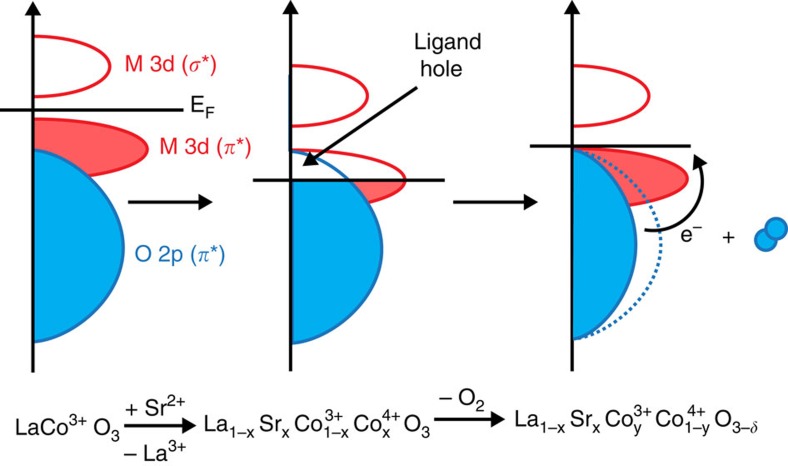
Figure 1
Figure 1. Relationship between oxygen vacancy concentration and Co–O bond covalency.
As the oxidation state of Co is increased through Sr2+ substitution, the Co 3d/O 2p band overlap is increased (covalency increases) and the Fermi level decreases into the Co 3d/O 2p π* band, creating ligand holes. Oxygen is released from the system resulting in oxygen vacancies and pinning the Fermi level at the top of the Co 3d/O 2p π* band.
Figure 2
Figure 2. Structural characterization of La1−xSrxCoO3−δ.
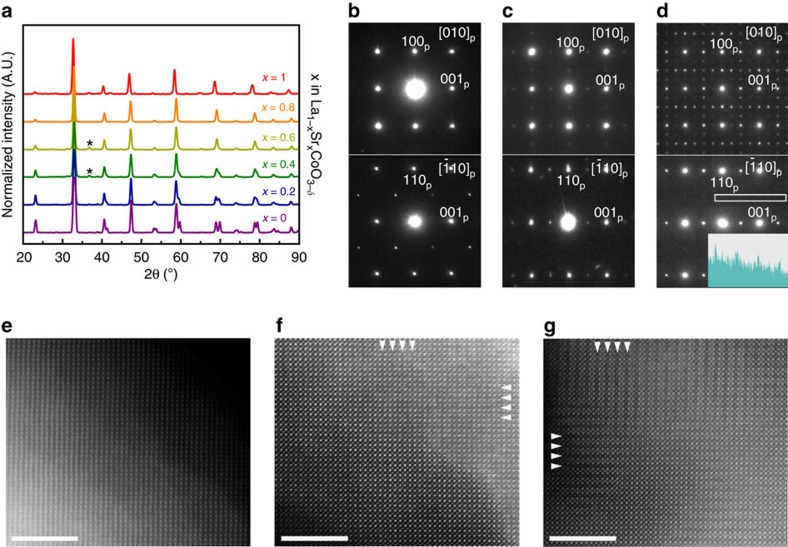
(a) Powder X-ray diffraction patterns for La1−xSrxCoO3−δ (0≤x≤1). The reflection from Co3O4 is marked with an asterisk. (bd) SAED patterns of LSCO82 (b), LSCO28 (c) and SCO (d). The reflections of the basic perovskite structure are indexed. The [−110]p SAED pattern of LSCO82 shows weak Gp±1/2<111>p-type reflections (Gp—reciprocal lattice vector of the perovskite structure) characteristic of the aaa octahedral tilting distortion of the perovskite structure. The [010]p SAED pattern of LSCO28 demonstrates the orientationally twinned Gp±1/2<001>p superlattice reflections resulting in the P4/mmm ap × ap × 2ap supercell. The superstructure in the [010]p SAED pattern of SCO can be described with the Gp±n/4<201>p (n—integer) and Gp±1/2<110>p superstructure vectors corresponding to the orientationally twinned I4/mmm 2ap × 2ap × 4ap supercell (see details in Supplementary Fig. 1). Note that the Gp±1/2<110>p superlattice reflections are barely visible in the formula image SAED patterns of SCO, but the intensity profile (shown as insert in d) along the area marked with the white rectangle demonstrates their presence undoubtedly. (eg) [010]p HAADF-STEM images of LSCO82 (e), LSCO28 (f) and SCO (g). The image of LSCO82 shows uniform perovskite structure, whereas the images of LSCO28 and SCO show faint darker stripes spaced by 2ap (marked by arrowheads) indicating nanoscale-twinned arrangement of the alternating (CoO2) perovskite layers and (CoO2−δ) anion-deficient layers. Scale bars are 5 nm.
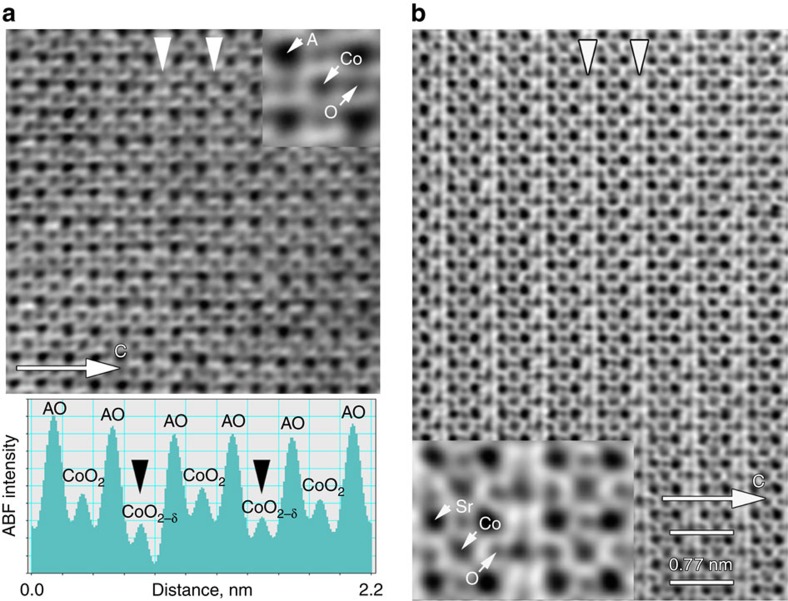
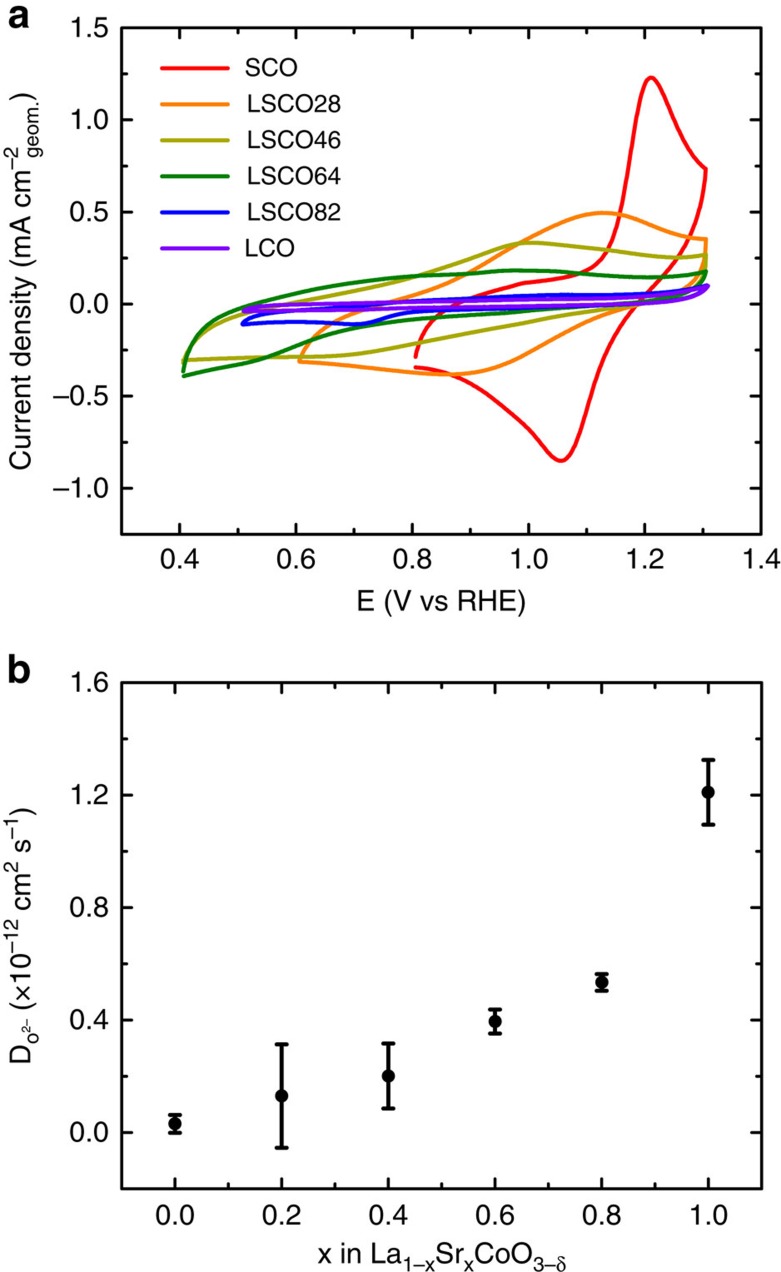
Figure 3
Figure 3. ABF-STEM imaging of oxygen vacancy ordering in La1−xSrxCoO3−δ (x=0.8, 1.0).
(a) [001]p ABF-STEM image of LSCO28 showing the cation and anion sublattices. The contrast is inverted in comparison with the HAADF-STEM images. The assignment of the atomic columns is shown in the enlargement at the top right corner. Half of the perovskite (CoO2) layers appear brighter indicating oxygen deficiency (marked with white arrowheads). The complete (CoO2) layers and anion-deficient (CoO2−δ) layer alternate (see the ABF intensity profile below, the anion-deficient layers are marked with black arrowheads) resulting in doubling of the perovskite lattice parameter in the direction perpendicular to the layers. (b) [001]P ABF-STEM image of SCO showing layered anion-vacancy ordering. The (CoO2−δ) layers are marked with the white arrowheads and demonstrate the contrast clearly distinct from that of the (CoO2) layers. The assignment of the atomic columns is shown in the enlarged part at the bottom left.
Figure 4
Figure 4. Electrochemical oxygen intercalation into La1−xSrxCoO3−δ.
(a) Cyclic voltammetry at 20 mV s−1 for each member of LSCO in Ar saturated 1 M KOH. The redox peaks, indicative of the insertion and removal of oxygen from the crystal, shift to higher potentials with increasing Sr2+ and oxygen vacancy concentrations. (b) Oxygen diffusion rates measured at 25 °C chronoamperometrically. The diffusion rate increases with Sr2+ and oxygen vacancy concentrations as well. Error bars represent the standard deviation of triplicate measurements.
Figure 5
Figure 5. Electrochemical characterization of La1−xSrxCoO3−δ for the OER.
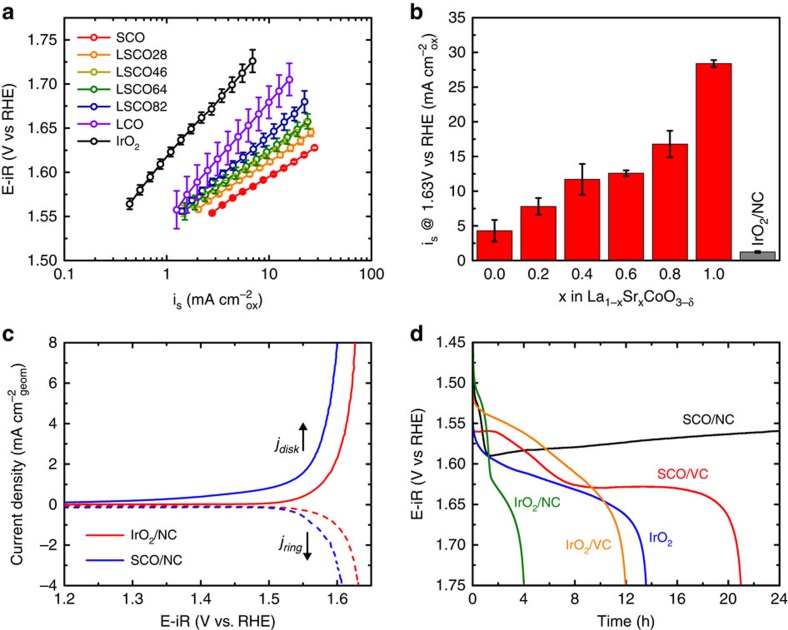
(a) Capacitance corrected specific OER current densities in O2 saturated 0.1 M KOH, a scan rate of 10 mV s−1, and ω=1,600 r.p.m., for 30 wt% La1−xSrxCoO3−δ supported on 2 at. % NC. The performance of 30 wt% IrO2 supported on 2 at. % NC is included as a reference. (b) Specific activities of La1−xSrxCoO3−δ and IrO2 at a 400 mV overpotential for the OER (1.63 V versus RHE). (c) Confirmation of oxygen generation using a RRDE. The disk has a thin layer of either 30 wt% SrCoO2.7/NC or 30 wt% IrO2/NC and the ring is Pt. O2 is generated at the disk then reduced back to OH at the ring which is poised at +0.4 V versus RHE. The collection efficiency of the RRDE was found to be 37%. (d) Galvanostatic stability at 10 A g−1ox and ω=1,600 r.p.m. of SrCoO2.7 and IrO2 supported on two different carbons, 2 at% nitrogen-doped NC and non-nitrogen doped VC. It is evident that both carbons are unstable at the anodic potentials of the OER, with rapid degradation occurring for all samples once the potential is >1.65 V versus RHE. The high activity and stability of SrCoO2.7 on NC allows the electrode to generate 10 A g−1ox of current without reaching this potential, which results in a relatively stable catalyst for 24 h of operation. For all electrochemical studies the mass loading of the electrode was 51 μgtot cm−2geom. Error bars represent the standard deviation of triplicate measurements.
Figure 6
Figure 6. Oxygen evolution mechanisms on La1−xSrxCoO3−δ and activity correlations.
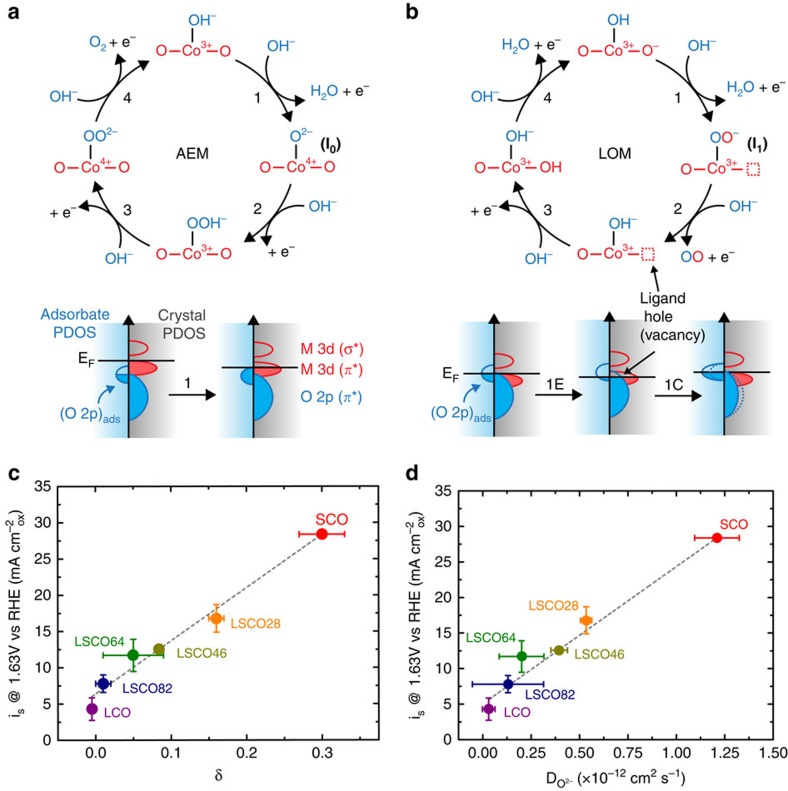
(a) AEM. In the AEM, the transition metal 3d bands are significantly higher in energy than the O 2p band in the lattice as shown qualitatively in the PDOS diagram below the mechanism. Because of this, all intermediates during the reaction originate from the electrolyte and Co in the active-site undergoes the catalytic redox reactions. This allows Co to access a higher oxidation state of Co4+ in Step 1 (a) AEM. As the covalency of the material increases, the transition metal 3d bands are lowered into the O 2p band in the lattice, where the Fermi energy is pinned at the top of the O 2p band through generation of oxygen vacancies. In contrast, in Step 1 (b) of the LOM, applying an anodic potential oxidizes a ligand hole in the O 2p band allowing for exchange of lattice oxygen to the adsorbed intermediate to yield the superoxide ion O2 rather than oxidizing Co to Co4+. This is shown qualitatively in the PDOS diagram below the mechanism where Step 1 of the LOM is separated into an electrochemical (1E) step in which the ligand hole is generated and a chemical step (1C) in which the lattice oxygen is exchanged into the adsorbed intermediate. For both (a,b) lattice species are shown in red and electrolyte species are shown in blue. In the PDOS diagrams, the electrolyte species are shown to the left of the energy axis and the crystal PDOS are shown to the right. (c) Correlation of oxygen evolution activity with the vacancy parameter δ. The vacancy parameter is indicative of the underlying electronic structure where vacancies are generated when there is significant Co 3d and O 2p band overlap. (d) Correlation of oxygen evolution activity with the oxygen ion diffusion rate, indicating that increased surface exchange kinetics trend with increased OER activity. Error bars represent standard deviation of triplicate measurements.
Figure 7
Figure 7. Density functional theory modelling of vacancy-mediated oxygen evolution on La1−xSrxCoO3−δ.
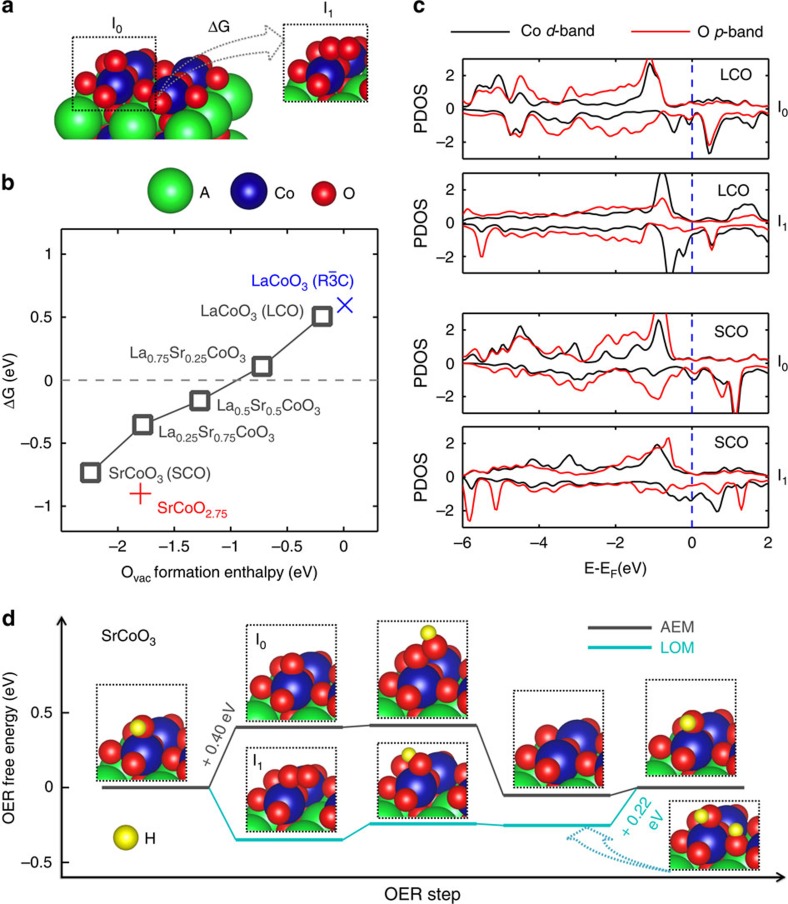
(a) Surface configurations of the intermediate after AEM Step 1 (I0) and the one after LOM Step 1 (I1). (b) The free energy change of I1 over I0 versus the O vacancy formation enthalpy in the bulk, for the cubic La1−xSrxCoO3−δ (black mark), where x=0, 0.25, 0.5, 0.75 and 1, with the rhombohedral LaCoO3 and optimized SrCoO2.75 phases; for x=0.25 and 0.75, the most energetic favourable vacancy site is selected; the O vacancy formation energy is calculated at the concentration of 1 per 2 × 2 × 2 unit cell with respect to H2O(g) and H2(g) at standard condition; using O2(g) as the reference will shift the O vacancy formation enthalpy around +2.5 eV larger. (c) The density of states of d-band for the active surface Co and the overall p-band for its ligand O, for LaCoO3 and SrCoO3 before and after the lattice oxygen exchange. (d) The OER free energy changes of LOM and AEM on SrCoO3 at the concentration of ¼ ML, with indicated intermediates structures and potential-determining steps.

References

    1. Cui C., Gan L., Heggen M., Rudi S. & Strasser P. Compositional segregation in shaped Pt alloy nanoparticles and their structural behaviour during electrocatalysis. Nat. Mater. 12, 765–771 (2013). - PubMed
    1. Slanac D. A., Hardin W. G., Johnston K. P. & Stevenson K. J. Atomic ensemble and electronic effects in Ag-rich AgPd nanoalloy catalysts for oxygen reduction in alkaline media. J. Am. Chem. Soc. 134, 9812–9819 (2012). - PMC - PubMed
    1. Gupta G. et al. Highly stable and active Pt−Cu oxygen reduction electrocatalysts based on mesoporous graphitic carbon supports. Chem. Mater. 21, 4515–4526 (2009).
    1. James Patrick H. The Electrochemistry of Oxygen Interscience Publishers (1968).
    1. McCrory C. C. L., Jung S., Peters J. C. & Jaramillo T. F. Benchmarking heterogeneous electrocatalysts for the oxygen evolution reaction. J. Am. Chem. Soc. 135, 16977–16987 (2013). - PubMed

Publication types