


Meta-Analysis
doi: 10.1093/hmg/ddw092.
Epub 2016 Mar 23.
GWAS meta-analysis of 16 852 women identifies new susceptibility locus for endometrial cancer
Affiliations
- PMID: 27008869
- PMCID: PMC5868213
- DOI: 10.1093/hmg/ddw092
Item in Clipboard
Meta-Analysis
GWAS meta-analysis of 16 852 women identifies new susceptibility locus for endometrial cancer
Hum Mol Genet.
.
Abstract
Endometrial cancer is the most common gynecological malignancy in the developed world. Although there is evidence of genetic predisposition to the disease, most of the genetic risk remains unexplained. We present the meta-analysis results of four genome-wide association studies (4907 cases and 11 945 controls total) in women of European ancestry. We describe one new locus reaching genome-wide significance (P < 5 × 10 -8) at 6p22.3 (rs1740828; P = 2.29 × 10 -8, OR = 1.20), providing evidence of an additional region of interest for genetic susceptibility to endometrial cancer.
© The Author 2016. Published by Oxford University Press. All rights reserved. For permissions, please e-mail: journals.permissions@oup.com.
Figures
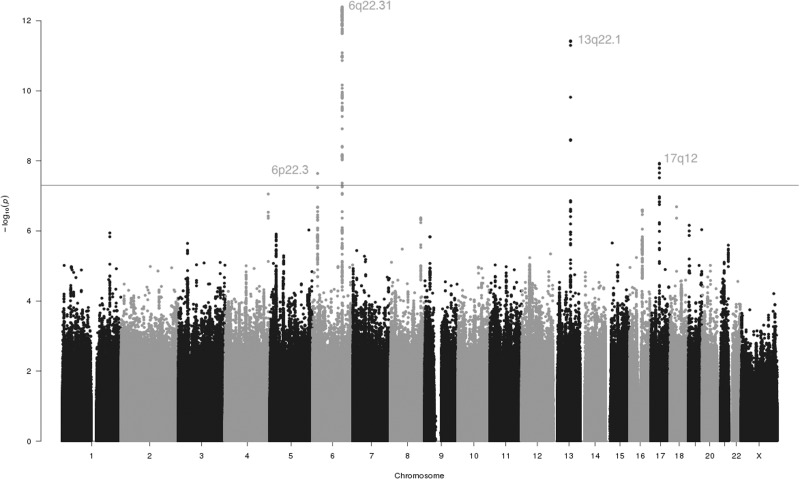
Manhattan plot of meta-analysis
results for EC in four cohorts. Association results between imputed and genotyped
SNPs and risk of EC in women of European ancestry are depicted. Dashed line
indicates the log of the threshold for genome-wide significance (P
< 5.0 × 10 −8).
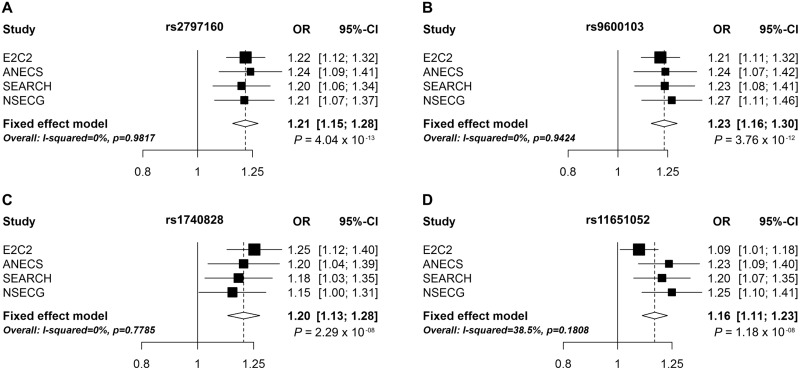
Forest plots of the odds ratios for the association between
rs2797160, rs1740828, rs9600103, rs11651052 and EC.
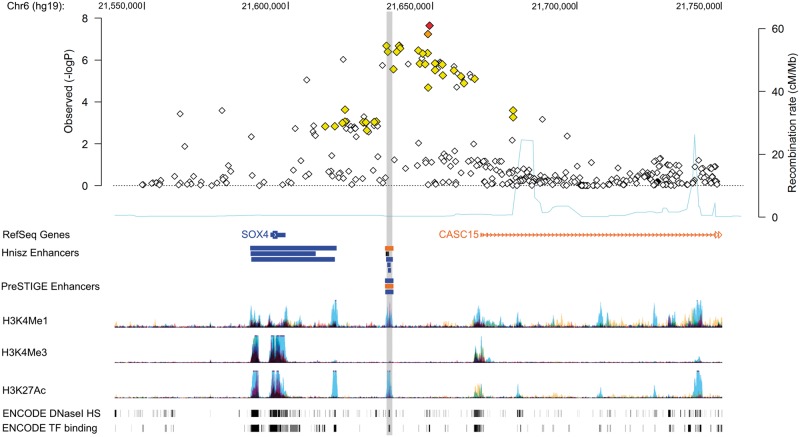
Regional association plot of 6p22.3 with annotation of genomic
features, likely enhancers, and target genes. Association results for all SNPs in
the 6p22.3 locus with EC risk from the meta-analysis are shown in the first panel.
SNPs are plotted as the negative log of the P-value against
relative position across the locus (base position [hg19] displayed across the top).
The lead SNP, rs1740828, is shown as a red filled diamond. LD with surrounding SNPs
are indicated by color (SNPs 0.5 ≤ r2 < 0.8 are
orange, 0.2 ≤ r2 <0.5 are yellow, and
r2 < 0.2 are unfilled). There were no SNPs with an
r2 ≥ 0.8 to the lead SNP. The second panel displays
genes as identified by RefSeq. Likely enhancers predicted by Hnisz et
al. (23) and PreSTIGE
(24) that overlap SNPs in LD
(r2 > 0.2) with the lead SNP are depicted as
colored bars, where the color matches the schematic of its predicted target gene
(the black bar is predicted to target CDKAL1, not shown in this
figure). Histone modification associated with promoters (H3K4Me1) and enhancers
(H3K4Me1 and H3K27Ac) from seven ENCODE Project cell types and DNaseI
hypersensitivity sites (DHS) and transcription factor (TF) binding sites identified
in 125 and 91 ENCODE Project cell types, respectively, are also displayed.
References
-
- Ferlay J., Soerjomataram I., Dikshit R., Eser S., Mathers C., Rebelo M., Parkin D.M., Forman D., Bray F. (2015) Cancer incidence and mortality worldwide: sources, methods and major patterns in GLOBOCAN 2012. Int. J. Cancer, 136, E359–E386. - PubMed
-
- Howlader N., Noone A.M., Krapcho M., Garshell J., Miller D., Altekruse S.F., Kosary C.L., Yu M., Ruhl J., Tatalovich Z. et al. (eds). (2014) SEER Cancer Statistics Review, 1975-2012. National Cancer Institute. Bethesda, MD.
-
- Duncan M.E., Seagroatt V., Goldacre M.J. (2012) Cancer of the body of the uterus: trends in mortality and incidence in England, 1985-2008. BJOG, 119, 333–339. - PubMed
-
- Hemminki K., Vaittinen P., Dong C. (1999) Endometrial cancer in the family-cancer database. Cancer Epidemiol. Biomarkers Prev., 8, 1005–1010. - PubMed
Publication types
MeSH terms
Grants and funding
- P01 CA087969/CA/NCI NIH HHS/United States
- R01 CA134958/CA/NCI NIH HHS/United States
- R03 CA128008/CA/NCI NIH HHS/United States
- 16565/CRUK_/Cancer Research UK/United Kingdom
- R01 CA105212/CA/NCI NIH HHS/United States
- UM1 CA186107/CA/NCI NIH HHS/United States
- R03 CA080636/CA/NCI NIH HHS/United States
- T32 CA009001/CA/NCI NIH HHS/United States
- N01 HD023166/HD/NICHD NIH HHS/United States
- R35 CA197449/CA/NCI NIH HHS/United States
- K05 CA092002/CA/NCI NIH HHS/United States
- R01 CA087538/CA/NCI NIH HHS/United States
- R01 CA091019/CA/NCI NIH HHS/United States
- R01 CA082838/CA/NCI NIH HHS/United States
- P30 CA008748/CA/NCI NIH HHS/United States
- R01 CA077398/CA/NCI NIH HHS/United States
- R01 CA054281/CA/NCI NIH HHS/United States
- 10119/CRUK_/Cancer Research UK/United Kingdom
- WT_/Wellcome Trust/United Kingdom
- R01 CA049449/CA/NCI NIH HHS/United States
- P30 CA016359/CA/NCI NIH HHS/United States
- U01 CA164973/CA/NCI NIH HHS/United States
- R37 CA054281/CA/NCI NIH HHS/United States
- 16561/CRUK_/Cancer Research UK/United Kingdom
- 10124/CRUK_/Cancer Research UK/United Kingdom
LinkOut - more resources
Full Text Sources
Other Literature Sources
