


Cryptococcal Meningitis Treatment Strategies Affected by the Explosive Cost of Flucytosine in the United States: A Cost-effectiveness Analysis
- PMID: 27009249
- PMCID: PMC4885648
- DOI: 10.1093/cid/ciw151
Cryptococcal Meningitis Treatment Strategies Affected by the Explosive Cost of Flucytosine in the United States: A Cost-effectiveness Analysis
Abstract
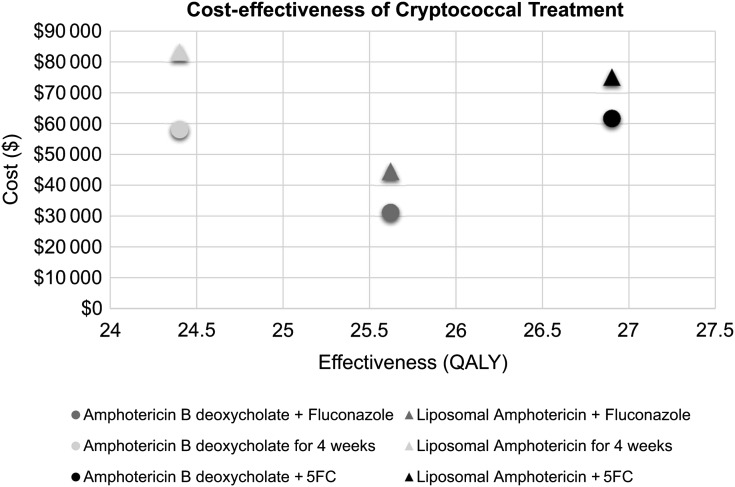
Background: In the United States, cryptococcal meningitis causes approximately 3400 hospitalizations and approximately 330 deaths annually. The US guidelines recommend treatment with amphotericin B plus flucytosine for at least 2 weeks, followed by fluconazole for a minimum of 8 weeks. Due to generic drug manufacturer monopolization, flucytosine currently costs approximately $2000 per day in the United States, with a 2-week flucytosine treatment course costing approximately $28 000. The daily flucytosine treatment cost in the United Kingdom is approximately $22. Cost-effectiveness analysis was performed to determine the value of flucytosine relative to alternative regimens.
Methods: We estimated the incremental cost-effectiveness ratio (ICER) of 3 cryptococcal induction regimens: (1) amphotericin B deoxycholate for 4 weeks; (2) amphotericin and flucytosine (100 mg/kg/day) for 2 weeks; and (3) amphotericin and fluconazole (800 mg/day) for 2 weeks. Costs of care were calculated using 2015 US prices and the medication costs. Survival estimates were derived from a randomized trial and scaled relative to published US survival data.
Results: Cost estimates were $83 227 for amphotericin monotherapy, $75 121 for amphotericin plus flucytosine, and $44 605 for amphotericin plus fluconazole. The ICER of amphotericin plus flucytosine was $23 842 per quality-adjusted life-year.
Conclusions: Flucytosine is currently cost-effective in the United States despite a dramatic increase in price in recent years. Combination therapy with amphotericin and flucytosine is the most attractive treatment strategy for cryptococcal meningitis, though the rising price may be creating access issues that will exacerbate if the trend of profiteering continues.
Keywords: HIV/AIDS; cost-effectiveness analysis; cryptococcal meningitis.
© The Author 2016. Published by Oxford University Press for the Infectious Diseases Society of America. All rights reserved. For permissions, e-mail journals.permissions@oup.com.
Figures
Comment in
-
Editorial Commentary: Life-saving Antimicrobial Drugs: What Are We Doing to Pricing and Availability?Clin Infect Dis. 2016 Jun 15;62(12):1569-70. doi: 10.1093/cid/ciw153. Epub 2016 Mar 23. Clin Infect Dis. 2016. PMID: 27009252 No abstract available.
References
-
- Park BJ, Wannemuehler KA, Marston BJ, Govender N, Pappas PG, Chiller TM. Estimation of the current global burden of cryptococcal meningitis among persons living with HIV/AIDS. AIDS 2009; 23:525–30. - PubMed
-
- Castelblanco RL, Lee M, Hasbun R. Epidemiology of bacterial meningitis in the USA from 1997 to 2010: a population-based observational study. Lancet Infect Dis 2014; 14:813–9. - PubMed
-
- World Health Organization. Rapid advice: diagnosis, prevention and management of cryptococcal disease in HIV-infected adults, adolescents and children. Available at: www.who.int/hiv/pub/cryptococcal_disease2011 Accessed 1 November 2015. - PubMed
Publication types
MeSH terms
Substances
Grants and funding
LinkOut - more resources
Full Text Sources
Other Literature Sources
Medical
