


Therapeutic effect of renin angiotensin system inhibitors on liver fibrosis
- PMID: 27009285
- PMCID: PMC5843853
- DOI: 10.1177/1470320316628717
Therapeutic effect of renin angiotensin system inhibitors on liver fibrosis
Abstract
Background and objective: Currently, there is no effective therapy available for liver fibrosis. This study aims to evaluate the efficacy of renin angiotensin system inhibitors on liver fibrosis.
Method: Full-text randomized controlled trials in patients with liver fibrosis were identified and included in the meta-analysis. The primary outcome measure was the histological fibrosis score of the liver. Secondary outcome measures included fibrosis area of the liver, serological levels of fibrosis markers, adverse events, and withdrawals.
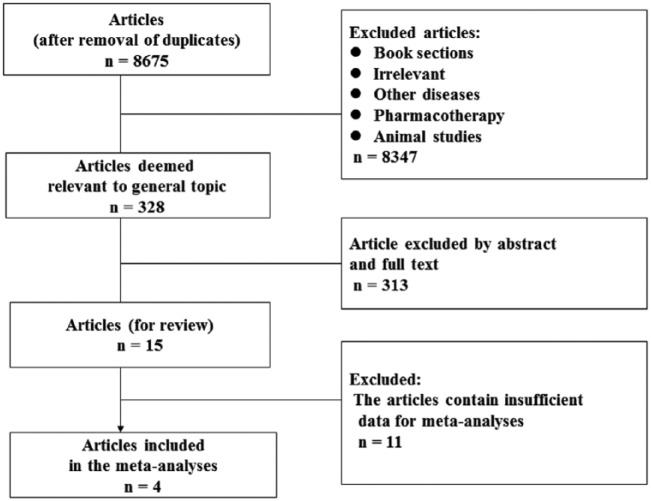
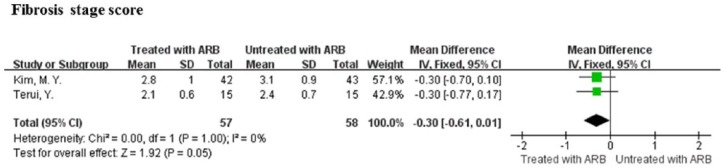
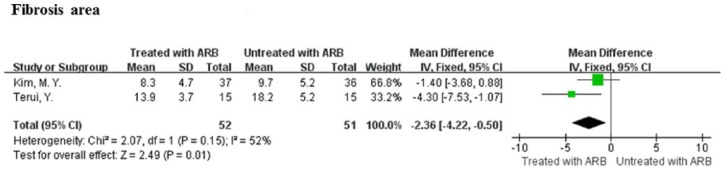
Results: From 6973 non-duplicated entries by systematic search, four randomized controlled trials with 210 patients were identified. The renin angiotensin system inhibitors therapy resulted in a marginally significant reduction in liver fibrosis score (MD = -0.30; 95% CI: -0.62-0.02, p = 0.05) and a significant reduction in liver fibrosis area (MD = -2.36%; 95% CI: -4.22%--0.50%, p = 0.01) as compared with control. The therapy was well tolerated and there was no significant difference in withdrawals between treatment and control groups (RD = 0.00; 95% CI: -0.06-0.06, p = 0.97).
Conclusions: Renin angiotensin system inhibitor therapy results in a reduction in liver fibrosis score and liver fibrosis area in patients with hepatic fibrosis with good safety profile. However, randomized controlled trials of high-quality will clarify the effectiveness of renin angiotensin system inhibitors on liver fibrosis.
Keywords: Angiotensin-converting-enzyme inhibitors; angiotensin receptor blocker; liver fibrosis; treatment.
© The Author(s) 2016.
Conflict of interest statement
Figures
References
-
- Matsuzaki K, Murata M, Yoshida K, et al. Chronic inflammation associated with hepatitis C virus infection perturbs hepatic transforming growth factor beta signaling, promoting cirrhosis and hepatocellular carcinoma. Hepatology 2007; 46: 48–57. - PubMed
-
- Berasain C, Castillo J, Perugorria MJ, et al. Inflammation and liver cancer: New molecular links. Ann N Y Acad Sci 2009; 1155: 206–221. - PubMed
-
- Li D, Friedman SL. Liver fibrogenesis and the role of hepatic stellate cells: New insights and prospects for therapy. J Gastroenterol Hepatol 1999; 14: 618–633. - PubMed
-
- Bataller R, Sancho-Bru P, Gines P, et al. Activated human hepatic stellate cells express the renin-angiotensin system and synthesize angiotensin II. Gastroenterology 2003; 125: 117–125. - PubMed
Publication types
MeSH terms
Substances
LinkOut - more resources
Full Text Sources
Other Literature Sources
Medical
Miscellaneous
