


Medication reconciliation at patient admission: a randomized controlled trial
- PMID: 27011775
- PMCID: PMC4800014
- DOI: 10.18549/PharmPract.2016.01.656
Medication reconciliation at patient admission: a randomized controlled trial
Abstract
Objective: To measure length of hospital stay (LHS) in patients receiving medication reconciliation. Secondary characteristics included analysis of number of preadmission medications, medications prescribed at admission, number of discrepancies, and pharmacists interventions done and accepted by the attending physician.
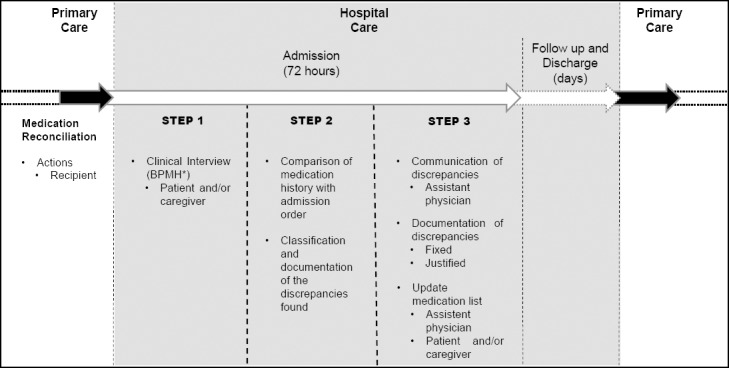
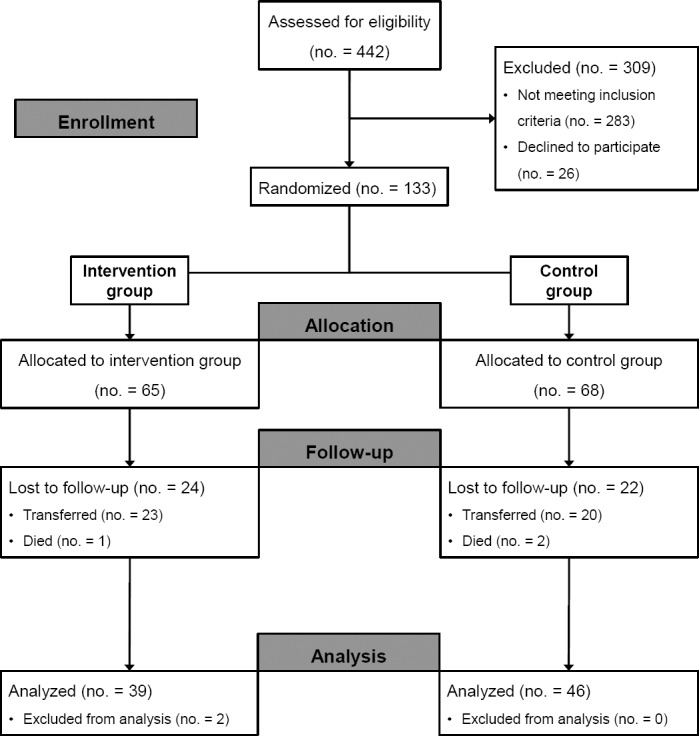
Methods: A 6 month, randomized, controlled trial conducted at a public teaching hospital in southern Brazil. Patients admitted to general wards were randomized to receive usual care or medication reconciliation, performed within the first 72 hours of hospital admission.
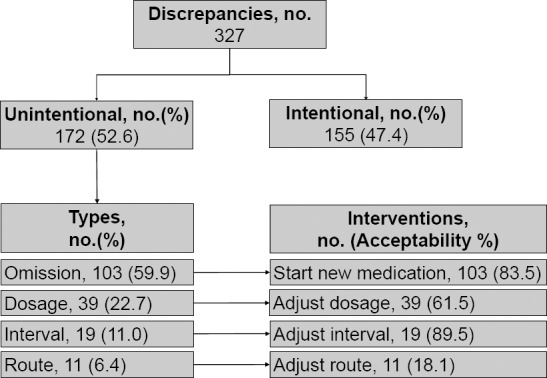
Results: The randomization process assigned 68 patients to UC and 65 to MR. LHS was 10±15 days in usual care and 9±16 days in medication reconciliation (p=0.620). The total number of discrepancies was 327 in the medication reconciliation group, comprising 52.6% of unintentional discrepancies. Physicians accepted approximately 75.0% of the interventions.
Conclusion: These results highlight weakness at patient transition care levels in a public teaching hospital. LHS, the primary outcome, should be further investigated in larger studies. Medication reconciliation was well accepted by physicians and it is a useful tool to find and correct discrepancies, minimizing the risk of adverse drug events and improving patient safety.
Keywords: Brazil; Medication Reconciliation; Pharmaceutical Services; Randomized Controlled Trials as Topic.
Conflict of interest statement
No potential conflict of interest or financial disclosures relevant to this article were reported by any of the authors.
Figures
References
-
- Bodenheimer T. Coordinating care--a perilous journey through the health care system. N Engl J Med. 2008;358(10):1064–1071. doi:10.1056/NEJMhpr0706165. - PubMed
-
- Coleman EA, Berenson RA. Lost in transition: challenges and opportunities for improving the quality of transitional care. Ann Intern Med. 2004;141(7):533–536. - PubMed
-
- Kripalani S, Jackson AT, Schnipper JL, Coleman EA. Promoting effective transitions of care at hospital discharge: a review of key issues for hospitalists. J Hosp Med. 2007;2(5):314–323. - PubMed
-
- Makaryus AN, Friedman EA. Patients’ understanding of their treatment plans and diagnosis at discharge. Mayo Clin Proc. 2005;80(8):991–994. - PubMed
-
- Calkins DR, Davis RB, Reiley P, Phillips RS, Pineo KL, Delbanco TL, Iezzoni LI. Patient-physician communication at hospital discharge and patients’ understanding of the postdischarge treatment plan. Arch Intern Med. 1997;157(9):1026–1030. - PubMed
LinkOut - more resources
Full Text Sources
Other Literature Sources