Review
. 2016 Mar 23:4:23.
doi: 10.1186/s40560-016-0149-0. eCollection 2016.

Sepsis and disseminated intravascular coagulation

Affiliations
Review

Sepsis and disseminated intravascular coagulation

Kohji Okamoto et al. J Intensive Care. .

Abstract

Sepsis is frequently complicated by coagulopathy and, in about 35 % of severe cases, by disseminated intravascular coagulation (DIC). In Japan, aggressive treatment of septic DIC is encouraged using antithrombin and recombinant thrombomodulin. The macrophages, monocytes, and neutrophils are a source of TF and participate in the direct activation of the coagulation cascade in the early phases of sepsis. And activated factor X (FXa), which is involved in hemostasis, thrombogenesis, inflammation, and cellular immune responses, induces TF expression in human peripheral monocytes and, conversely, that inhibition of FXa activity reduces TF expression. Both inflammation and coagulation play an important role in DIC due to sepsis. In addition to inflammatory cytokines (TNF-α, IL-1 and so on), HMGB1 has recently been shown to mediate the lethal late phase of sepsis and caused coagulopathy. TM not only binds HMGB1 but also aids the proteolytic cleavage of HMGB1 by thrombin. There have been many reports of the efficacy of recombinant TM and antithrombin for treatment of septic DIC from Japan. Further investigation of the efficacy of recombinant TM and AT in countries other than Japan, as well as the monitoring of medical costs incurred during hospitalization, will help validate the use of TM and AT for treatment of septic DIC.

Keywords: Antithrombin; Disseminated intravascular coagulation (DIC); HMGB1; Sepsis; Thrombomodulin.


Figures
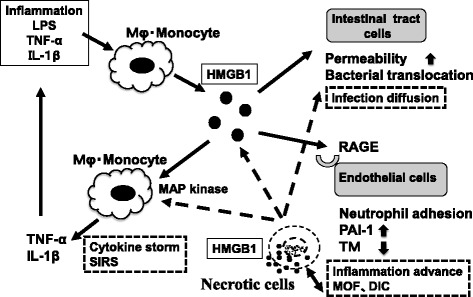
Fig. 1
Fig. 1
The various functions of HMGB1 in sepsis. HMGB1 is actively secreted from macrophages and monocytes, which are activated by inflammatory cytokines, and it is also passively released from necrotic cells. HMGB1 may then cause activation of phagocytic cells, resulting in production of pro-inflammatory mediators and chemokines. HMGB1 binds to RAGE on endothelial cells. And endothelial cells express RAGE, adhesion molecules, TNF-α, chemokines, PAI-1, and promote down regulation of TM. RAGE receptor for advanced glycation end-products, IL interleukin, TNF tumor necrosis factor, PAI-1 plasminogen activator inhibitor-1, DIC disseminated intravascular. Coagulation, SIRS systemic inflammatory response syndrome, MAP mitogen-activated protein
Fig. 2
Fig. 2
A mechanism of DIC and MOF due to sepsis. When the pathogen-associated molecular patterns (PAMPs) (for example, endotoxin) and damage-associated molecular patterns (DAMPs) act on monocytes via TLR and on  neutrophils, a reactivated monocyte produce TF, various inflammatory cytokines, and HMGB1, and moreover, detection of PAMPs and DAMPs trigger neutrophil extracellular traps (NETs) release by neutrophils, promoting immunothrombosis. The uncontrolled immunothrombosis may lead to disseminated intravascular coagulation. And HMGB1 acts on EC and promotes upregulation of TF and downregulation of TM from EC, resulting endothelial cell injury, and microcirculation disorder develops DIC and MOF. TF tissue factor, TM thrombomodulin, TLR Toll-like receptor, IL-1β interleukin-1β, TNF-α tumor necrosis factor-α, EC endothelial cell, HMGB1 high-mobility group box protein 1, PAI plasminogen activator inhibitor, MOF multiple organ failure, NETs neutrophil extracellular traps
Fig. 3
Fig. 3
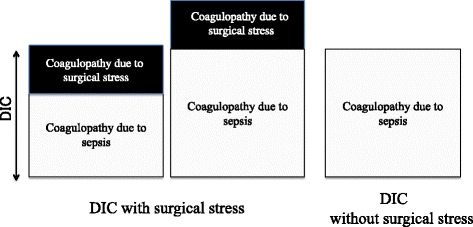
Effect of surgical stress for coagulopathy (DIC) due to infection. If the severity of the infectious disease is the same, coagulopathy of infectious disease in surgically patients is increased by addition of the coagulation disorder due to surgical stress. In the treatment of infection control, the surgeons and intensivists must take that coagulopathy of the surgical stress deteriorates DIC temporarily into consideration
Fig. 4
Fig. 4
Effect of rTM on the plasma levels of HMGB1. Temporal changes in plasma HMGB1 concentrations after injection of lipopolysaccharide (LPS). Rats were given saline plus LPS (closed squares); pretreatment of recombinant human soluble thrombomodulin (rTM), LPS plus saline (closed circles); or saline, LPS plus delayed treatment of rTM (closed triangles). All data represent the mean and SEM (n = 6 per group). [73] *P < 0.05 (vs. the LPS group). # P < 0.01 (vs. the LPS group). rTM recombinant thrombomodulin

References

    1. Kinasewitz GT, Yan SB, Basson B, Comp P, Russell JA, Cariou A, Um SL, Utterback B, Laterre PF, Dhainaut JF, PROWESS Sepsis Study Group Universal changes in biomarkers of coagulation and inflammation occur in patients with severe sepsis, regardless of causative micro-organism [ISRCTN74215569] Crit Care. 2004;8:R82–90. doi: 10.1186/cc2459. - DOI - PMC - PubMed
    1. Levi M, ten Cate H. Disseminated intravascular coagulation. N Engl J Med. 1999;341:586–92. doi: 10.1056/NEJM199908193410807. - DOI - PubMed
    1. Bakhtiari K, Meijers JC, de Jonge E, Levi M. Prospective validation of the International Society of Thrombosis and Haemostasis scoring system for disseminated intravascular coagulation. Crit Care Med. 2004;32:2416–21. doi: 10.1097/01.CCM.0000147769.07699.E3. - DOI - PubMed
    1. Dhainaut JF, Yan SB, Joyce DE, Pettilä V, Basson B, Brandt JT, Sundin DP, Levi M. Treatment effects of drotrecogin alfa (activated) in patients with severe sepsis with or without overt disseminated intravascular coagulation. J Thromb Haemost. 2004;2:1924–33. doi: 10.1111/j.1538-7836.2004.00955.x. - DOI - PubMed
    1. Dellinger RP, Levy MM, Rhodes A, Annane D, Gerlach H, Opal SM, Sevransky JE, Sprung CL, Douglas IS, Jaeschke R, Osborn TM, Nunnally ME, Townsend SR, Reinhart K, Kleinpell RM, Angus DC, Deutschman CS, Machado FR, Rubenfeld GD, Webb S, Beale RJ, Vincent JL, Moreno R. Surviving Sepsis Campaign Guidelines Committee including The Pediatric Subgroup. Surviving Sepsis Campaign: international guidelines for management of severe sepsis and septic shock, 2012. Intensive Care Med. 2013;39(2):165–228. doi: 10.1007/s00134-012-2769-8. - DOI - PMC - PubMed

LinkOut - more resources