


Drug-Eluting Versus Bare-Metal Stents During PCI in Patients With End-Stage Renal Disease on Dialysis
- PMID: 27012407
- PMCID: PMC4808241
- DOI: 10.1016/j.jacc.2015.10.104
Drug-Eluting Versus Bare-Metal Stents During PCI in Patients With End-Stage Renal Disease on Dialysis
Abstract
Background: In patients undergoing percutaneous coronary intervention (PCI), drug-eluting stents (DES) reduce repeat revascularizations compared with bare-metal stents (BMS), but their effects on death and myocardial infarction (MI) are mixed. Few studies have focused on patients with end-stage renal disease.
Objectives: This study compared mortality and cardiovascular morbidity during percutaneous coronary intervention with DES and with BMS in dialysis patients.
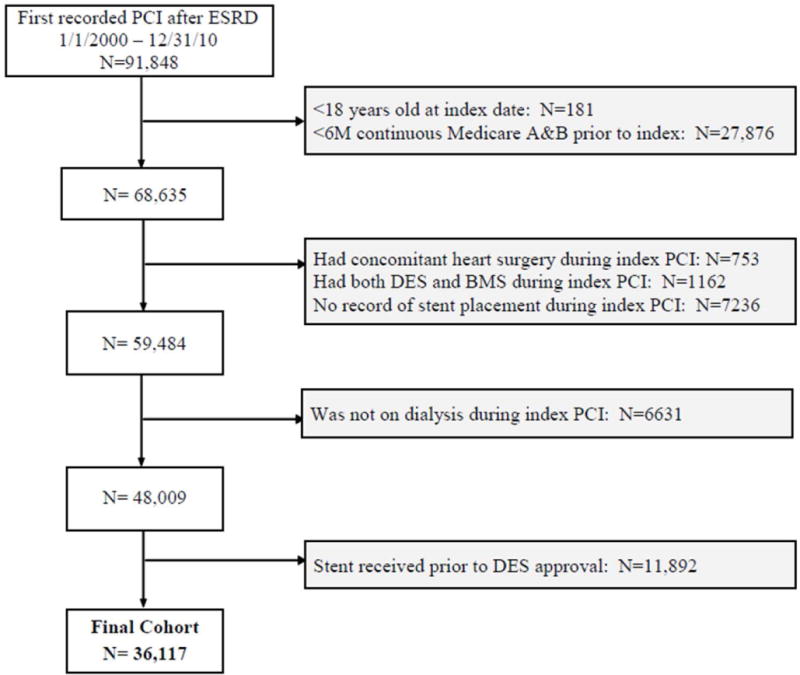
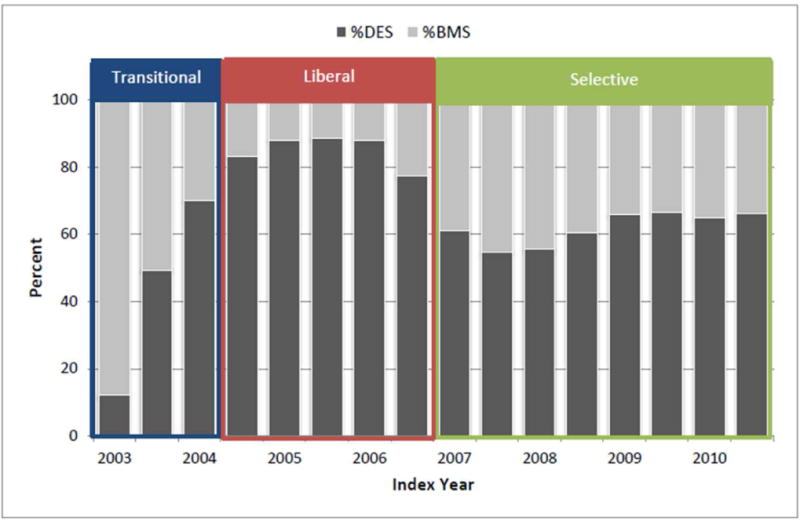
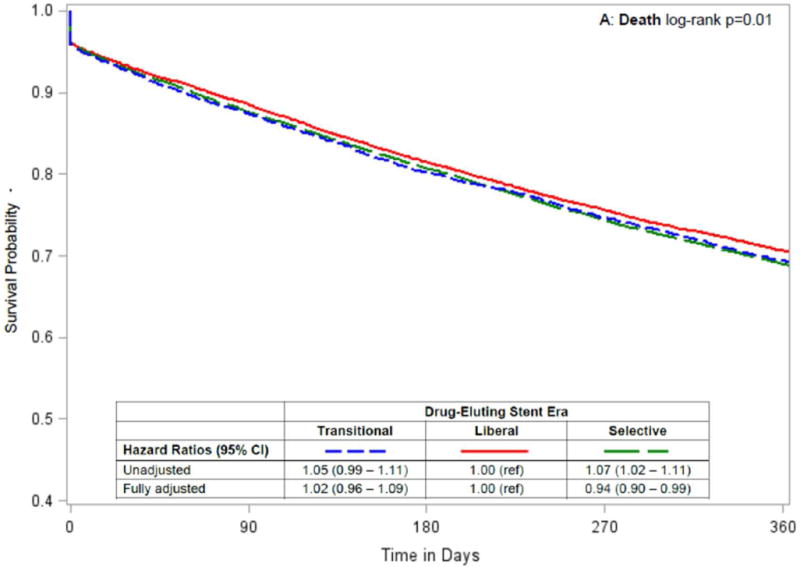
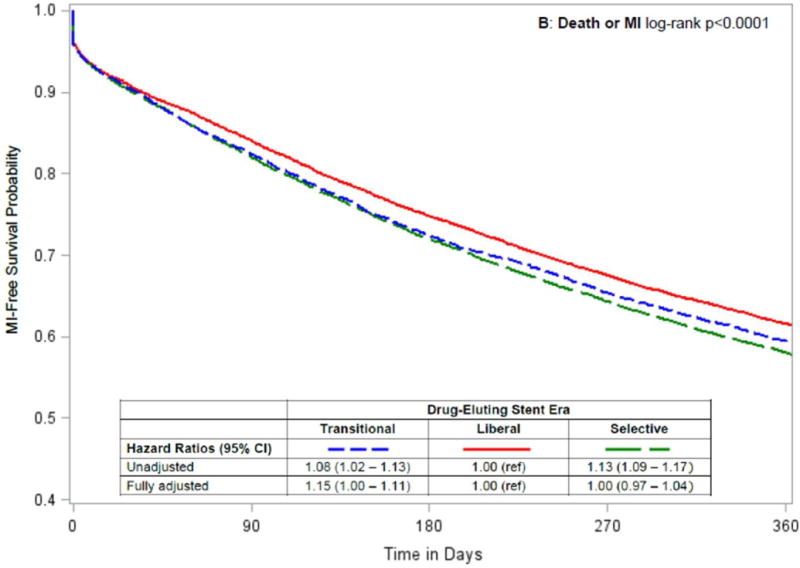
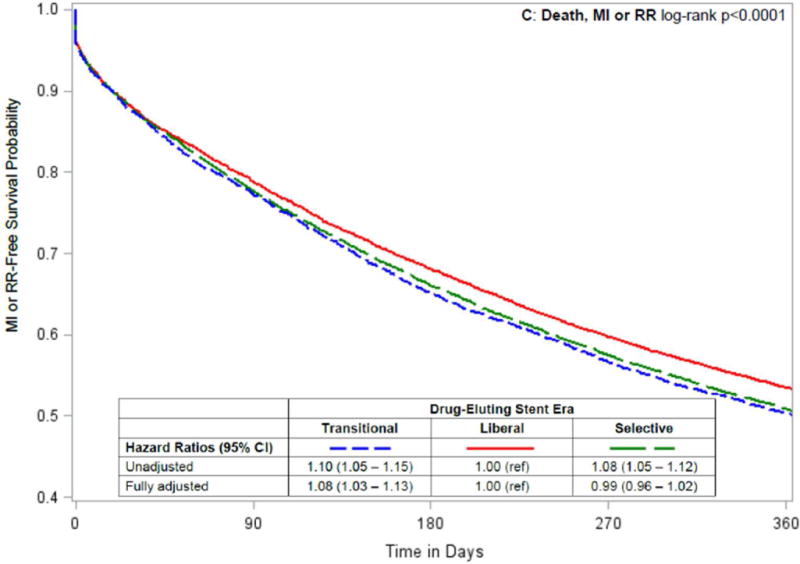
Methods: We identified 36,117 dialysis patients from the USRDS (United States Renal Data System) who had coronary stenting in the United States between April 23, 2003, and December 31, 2010, and examined the association of DES versus BMS with 1-year outcomes: death; death or MI; and death, MI, or repeat revascularization. We also conducted a temporal analysis by dividing the study period into 3 DES eras: Transitional (April 23, 2003, to June 30, 2004); Liberal (July 1, 2004, to December 31, 2006); and Selective (January 1, 2007, to December 31, 2010).
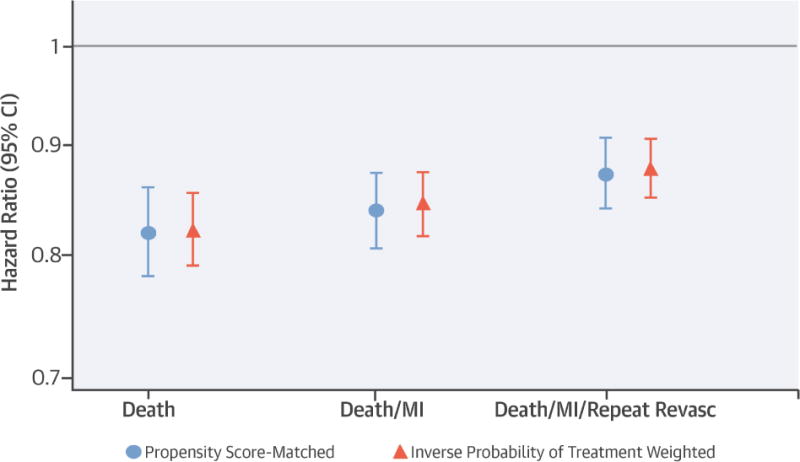
Results: One-year event rates were high, with 38 deaths; 55 death or MI events; and 71 death, MI, or repeat revascularization events per 100 person-years. DES, compared with BMS, were associated with a significant 18% lower risk of death; 16% lower risk of death or MI; and 13% lower risk of death, MI, or repeat revascularization. DES use varied, from 56% in the Transitional era to 85% in the Liberal era and 62% in the Selective era. DES outcomes in the Liberal era were significantly better than in the Transitional Era, but not significantly better than in the Selective Era.
Conclusions: DES for percutaneous coronary intervention appears to be safe for use in U.S. dialysis patients and is associated with lower rates of death, MI, and repeat revascularization.
Keywords: cardiovascular disease; end-stage renal disease; epidemiology; hemodialysis; ischemic heart disease; renal insufficiency.
Copyright © 2016 American College of Cardiology Foundation. Published by Elsevier Inc. All rights reserved.
Figures
Comment in
-
Drug-Eluting Stents: Capable of Saving Lives in Dialysis Patients?J Am Coll Cardiol. 2016 Mar 29;67(12):1470-1471. doi: 10.1016/j.jacc.2015.10.105. J Am Coll Cardiol. 2016. PMID: 27012408 No abstract available.
References
-
- Charytan D, Kuntz RE, Mauri L, DeFilippi C. Distribution of coronary artery disease and relation to mortality in asymptomatic hemodialysis patients. Am J Kidney Dis. 2007;49:409–16. - PubMed
-
- Joki N, Hase H, Takahashi Y, et al. Angiographical severity of coronary atherosclerosis predicts death in the first year of hemodialysis. Int Urol Nephrol. 2003;35:289–97. - PubMed
-
- U.S. Renal Data System. USRDS 2011 Annual Data Report: Atlas of Chronic Kidney Disease and End-Stage Renal Disease in the United States. Bethesda, MD: National Institute of Health, National Institute of Diabetes and Digestive and Kidney Diseases; 2011.
-
- Bangalore S, Kumar S, Fusaro M, et al. Short- and long-term outcomes with drug-eluting and bare-metal coronary stents: a mixed-treatment comparison analysis of 117 762 patient-years of follow-up from randomized trials. Circulation. 2012;125:2873–91. - PubMed
Publication types
MeSH terms
Grants and funding
LinkOut - more resources
Full Text Sources
Other Literature Sources
Medical
Miscellaneous
