


Preclinical Alzheimer's disease: Definition, natural history, and diagnostic criteria
- PMID: 27012484
- PMCID: PMC6417794
- DOI: 10.1016/j.jalz.2016.02.002
Preclinical Alzheimer's disease: Definition, natural history, and diagnostic criteria
Abstract
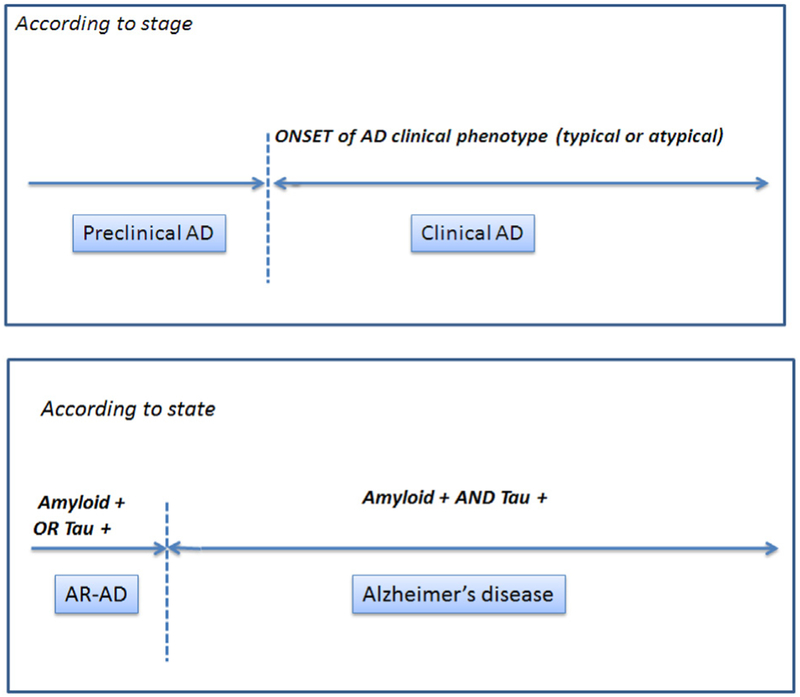
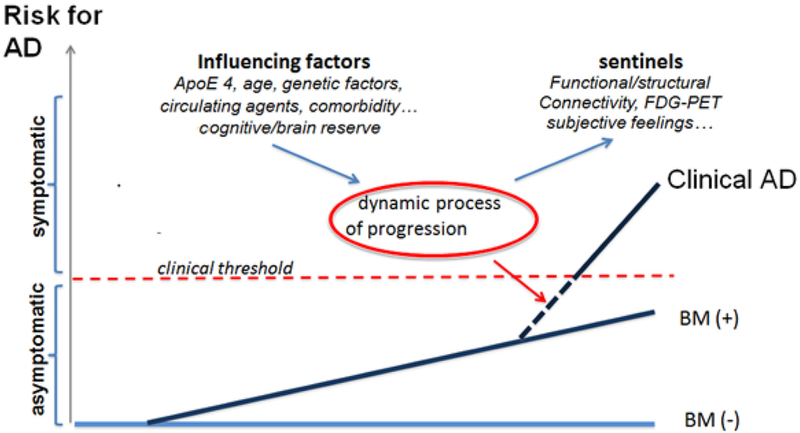
During the past decade, a conceptual shift occurred in the field of Alzheimer's disease (AD) considering the disease as a continuum. Thanks to evolving biomarker research and substantial discoveries, it is now possible to identify the disease even at the preclinical stage before the occurrence of the first clinical symptoms. This preclinical stage of AD has become a major research focus as the field postulates that early intervention may offer the best chance of therapeutic success. To date, very little evidence is established on this "silent" stage of the disease. A clarification is needed about the definitions and lexicon, the limits, the natural history, the markers of progression, and the ethical consequence of detecting the disease at this asymptomatic stage. This article is aimed at addressing all the different issues by providing for each of them an updated review of the literature and evidence, with practical recommendations.
Keywords: Alzheimer's disease; Amyloid PET; Asymptomatic; Biomarkers; Blood biomarkers; CSF biomarkers; Diagnostic criteria; Genetics; MRI; Pathophysiology; Preclinical; Tau PET.
Copyright © 2016 The Alzheimer's Association. Published by Elsevier Inc. All rights reserved.
Figures
Comment in
-
Toward a consensus recommendation for defining the asymptomatic-preclinical phases of putative Alzheimer's disease?Alzheimers Dement. 2016 Mar;12(3):213-5. doi: 10.1016/j.jalz.2016.02.003. Alzheimers Dement. 2016. PMID: 27012483 No abstract available.
References
-
- Hubbard BM, Fenton GW, Anderson JM. A quantitative histological study of early clinical and preclinical Alzheimer’s disease. Neuropathol Appl Neurobiol 1990;16:111–21. - PubMed
-
- Hampel H, Frank R, Broich K, Teipel SJ, Katz RG, Hardy J, et al. Biomarkers for Alzheimer’s disease: academic, industry and regulatory perspectives. Nat Rev Drug Discov 2010;9:560–74. - PubMed
-
- Buchhave P, Minthon L, Zetterberg H, Wallin AK, Blennow K, Hansson O. Cerebrospinal fluid levels of beta-amyloid 1–42, but not of tau, are fully changed already 5 to 10 years before the onset of Alzheimer dementia. Arch Gen Psychiatry 2012;69:98–106. - PubMed
Publication types
MeSH terms
Grants and funding
LinkOut - more resources
Full Text Sources
Other Literature Sources
Medical
Miscellaneous
