


Persistent Plasmodium falciparum and Plasmodium vivax infections in a western Cambodian population: implications for prevention, treatment and elimination strategies
- PMID: 27013512
- PMCID: PMC4806483
- DOI: 10.1186/s12936-016-1224-7
Persistent Plasmodium falciparum and Plasmodium vivax infections in a western Cambodian population: implications for prevention, treatment and elimination strategies
Abstract
Background: Subclinical Plasmodium parasitaemia is an important reservoir for the transmission and persistence of malaria, particularly in low transmission areas.
Methods: Using ultrasensitive quantitative PCR (uPCR) for the detection of parasitaemia, the entire population of three Cambodian villages in Pailin province were followed for 1 year at three-monthly intervals. A cohort of adult participants found initially to have asymptomatic malaria parasitaemia was followed monthly over the same period.
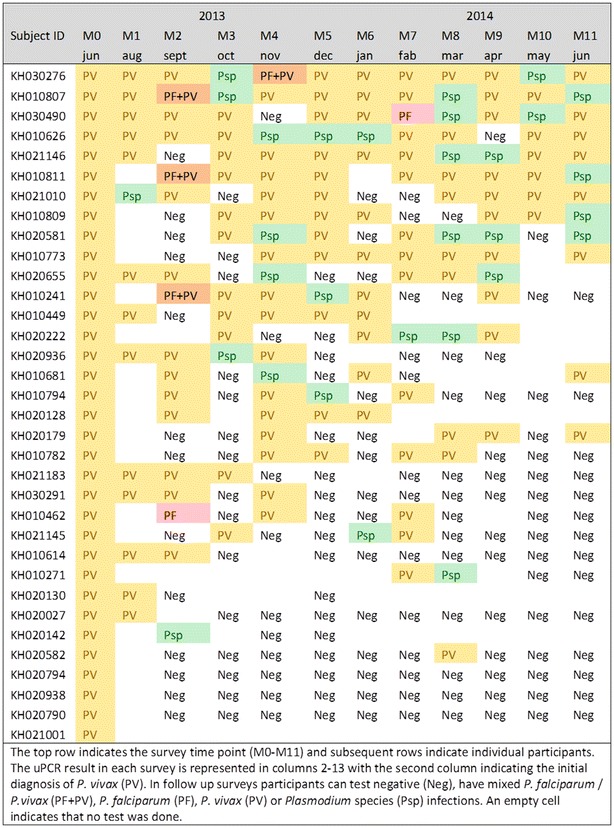
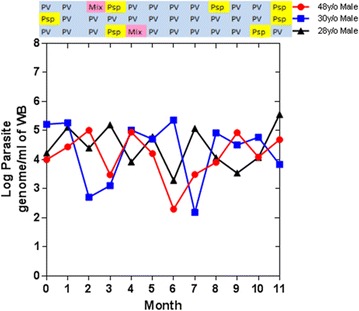
Results: The initial cross sectional survey in June 2013 (M0) of 1447 asymptomatic residents found that 32 (2.2%) had Plasmodium falciparum, 48 (3.3%) had P. vivax, 4 (0.3%) had mixed infections and in 142/1447 (9.8%) malaria was detected but there was insufficient DNA to identify the species (Plasmodium. species). Polymorphisms in the 'K13-propeller' associated with reduced susceptibility to artemisinin derivatives (C580Y) were found in 17/32 (51%) P. falciparum strains. Monthly follow-up without treatment of 24 adult participants with asymptomatic mono or mixed P. falciparum infections found that 3/24 (13%) remained parasitaemic for 2-4 months, whereas the remaining 21/24 (87%) participants had cleared their parasitaemia after 1 month. In contrast, 12/34 (35%) adult participants with P. vivax mono-infection at M0 had malaria parasites (P. vivax or P. sp.) during four or more of the following 11 monthly surveys.
Conclusions: This longitudinal survey in a low transmission setting shows limited duration of P. falciparum carriage, but prolonged carriage of P. vivax infections. Radical treatment of P. vivax infections by 8-aminoquinoline regimens may be required to eliminate all malaria from Cambodia. Trial registration ClinicalTrials.gov NCT01872702.
Keywords: Artemisinins; Cambodia; Clearance; Cohort; Falciparum; Malaria; PCR; Pailin; Persistence; Plasmodium; Resistance; Vivax.
Figures


References
-
- Warrell DA, Gilles HM. Essential malariology. 4. Abingdon: Taylor & Francis; 2002.
Publication types
MeSH terms
Associated data
Grants and funding
LinkOut - more resources
Full Text Sources
Other Literature Sources
Medical
Research Materials
