. 2016 Mar 14:10:49.
doi: 10.3389/fnbeh.2016.00049. eCollection 2016.

Effects of Propranolol, a β-noradrenergic Antagonist, on Memory Consolidation and Reconsolidation in Mice

Affiliations

Effects of Propranolol, a β-noradrenergic Antagonist, on Memory Consolidation and Reconsolidation in Mice

Hélène Villain et al. Front Behav Neurosci. .

Abstract

Memory reconsolidation impairment using the β-noradrenergic receptor blocker propranolol is a promising novel treatment avenue for patients suffering from pathogenic memories, such as post-traumatic stress disorder (PTSD). However, in order to better inform targeted treatment development, the effects of this compound on memory need to be better characterized via translational research. We examined the effects of systemic propranolol administration in mice undergoing a wide range of behavioral tests to determine more specifically which aspects of the memory consolidation and reconsolidation are impaired by propranolol. We found that propranolol (10 mg/kg) affected memory consolidation in non-aversive tasks (object recognition and object location) but not in moderately (Morris water maze (MWM) to highly (passive avoidance, conditioned taste aversion) aversive tasks. Further, propranolol impaired memory reconsolidation in the most and in the least aversive tasks, but not in the moderately aversive task, suggesting its amnesic effect was not related to task aversion. Moreover, in aquatic object recognition and location tasks in which animals were forced to behave (contrary to the classic versions of the tasks); propranolol did not impair memory reconsolidation. Taken together our results suggest that the memory impairment observed after propranolol administration may result from a modification of the emotional valence of the memory rather than a disruption of the contextual component of the memory trace. This is relevant to the use of propranolol to block memory reconsolidation in individuals with PTSD, as such a treatment would not erase the traumatic memory but only reduce the emotional valence associated with this event.

Keywords: PTSD; aversive memory; consolidation; emotional valence; noradrenergic system; propranolol; reconsolidation.


Figures
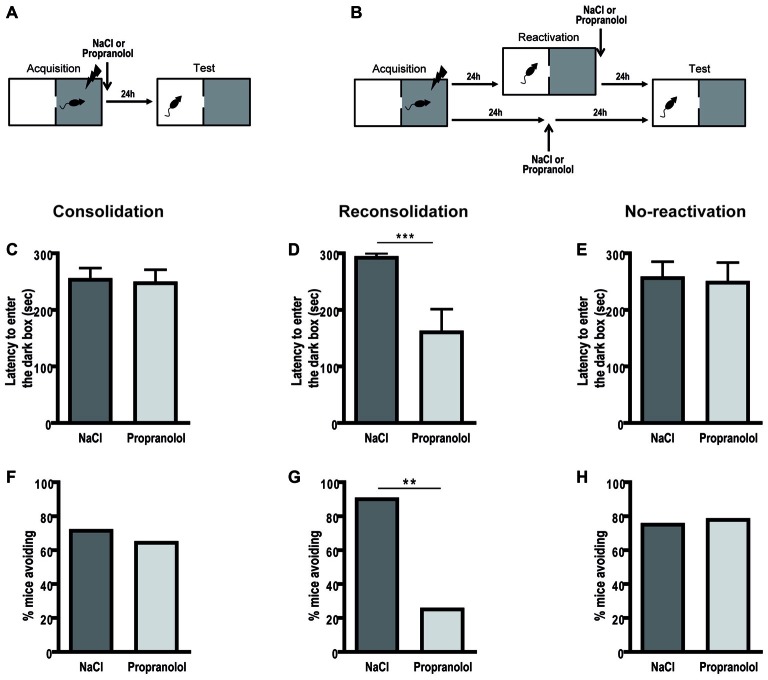
Figure 1
Figure 1
Propranolol disrupts memory reconsolidation in the passive avoidance task. Schematic of the behavioral protocols for the consolidation (A) and reconsolidation and no-reactivation (B) procedures. In the consolidation procedure (n = 14 per group), there was no memory deficit in propranolol-injected mice for the latency (±SEM) to enter the dark box (C), nor for the percentage of avoidance of this aversive box (F). However, for the reconsolidation procedure, propranolol-injected mice (n = 8) exhibited decreased memory performance relative to control mice (n = 10) (D,G). In the no-reactivation procedure, propranolol-injected mice (n = 9) showed the same level of avoidance as control mice (n = 8) (E,H). **p < 0.01; ***p < 0.001 NaCl vs. Propranolol.
Figure 2
Figure 2
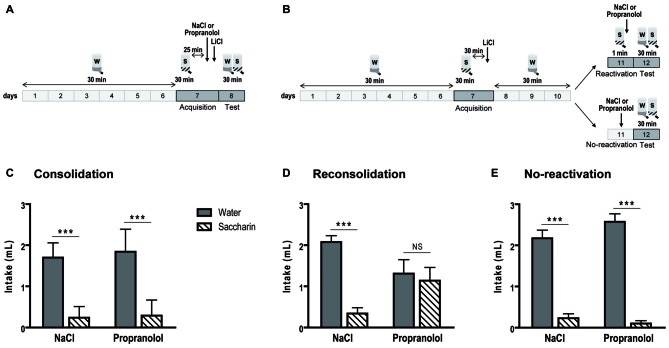
Propranolol disrupts memory reconsolidation in the conditioned taste aversion task. Schematic of the behavioral protocols for the consolidation (A) and reconsolidation and no-reactivation (B) procedures. Mean consumption (±SEM) of water (gray) and saccharin (white hachured) in the choice test is represented. (C) In the consolidation procedure (n = 7 per group), a clear preference for the water was displayed for control but also for propranolol-injected mice. (D) On the contrary, for the reconsolidation procedure (n = 8 per group), control mice avoided saccharin while propranolol-injected mice showed no preference for water or saccharin. (E) In the no-reactivation procedure, there was not any memory deficit in propranolol-injected mice thus a preference for the water was displayed in both group of mice (n = 8 per group). ***p < 0.001 Water vs. Saccharin.
Figure 3
Figure 3
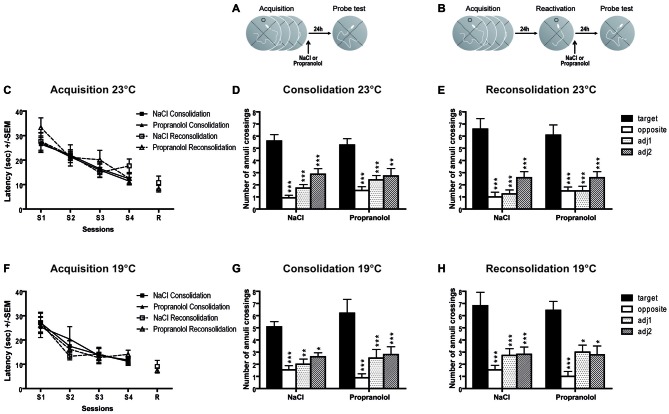
Propranolol has no effect on memory reconsolidation in the Morris water maze (MWM) task. Schematic of the behavioral protocols for the consolidation (A) and reconsolidation (B) procedures. 23°C procedure (C–E). Throughout training sessions (C), mice learned equally well to locate the hidden platform and exhibited decreasing latencies (±SEM) over blocks of trials in the two different behavioral procedures (consolidation and reconsolidation). The number of annuli crossings (±SEM) during probe test (PT) in the consolidation (n = 15 per group; D) and reconsolidation (n = 12 per group; E) procedures are represented. 19°C procedure (F–H). For this more aversive procedure with cold water, we found exactly the same results as in the 23°C procedure i.e., mice learned equally well to locate the hidden platform during training sessions (F), and all groups of mice showed similar preference for the target zone in the consolidation (NaCl: n = 10; Propranolol: n = 14; G) and in the reconsolidation (NaCl: n = 9; Propranolol: n = 11; H) procedures. target vs. others, *p < 0.05; **p < 0.01; ***p < 0.001.
Figure 4
Figure 4
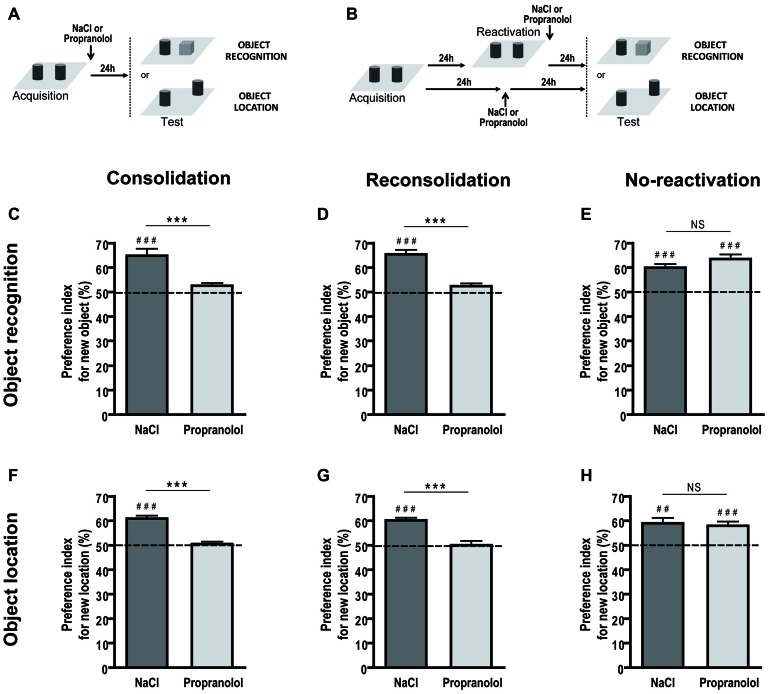
Propranolol impairs the memory reconsolidation in the object recognition and object location tasks. Schematics of the behavioral protocols of the object recognition and object location tasks for the consolidation (A) and reconsolidation and no-reactivation (B) procedures. Performances are expressed as the group mean (±SEM) preference index. The horizontal line represents equal exploration of the two objects. For the consolidation (n = 9 per group; C) and reconsolidation (NaCl: n = 10; Propranolol: n = 9; D) procedures of the object recognition task, control mice spent significantly more time exploring the new object than the familiar one. For the consolidation (NaCl: n = 13; Propranolol: n = 14; F) and reconsolidation (NaCl: n = 14; Propranolol: n = 13; G) procedures of the object location task, NaCl-injected mice spent significantly more time exploring the displaced object than the non displaced one. Mice with propranolol injection during consolidation or reconsolidation presented severe deficits in these two spatial tasks and were not able to distinguish the new or displaced object. For the no-reactivation procedures, NaCl- but also propranolol-injected mice showed similar preference for the familiar or non-displaced object as compared to the new or displaced object in the object recognition (NaCl: n = 7; Propranolol: n = 8; E) and object location (NaCl: n = 8; Propranolol: n = 9; H) tasks respectively. ##p < 0.01; ###p < 0.001 index vs. chance level; 50%. ***p < 0.001 NaCl vs. Propranolol; NS, non significant.
Figure 5
Figure 5
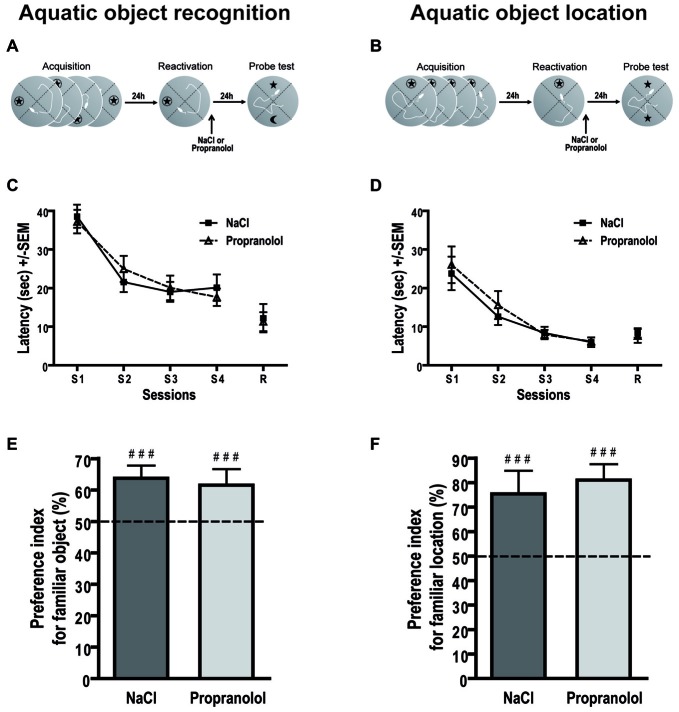
Propranolol does not impair memory reconsolidation in the aquatic object recognition and object location tasks. Schematics of the behavioral protocols of the aquatic object recognition (A) and object location (B) tasks. Throughout training sessions, mice learned equally well to find the hidden platform and exhibited decreasing latencies (±SEM) over blocks of trials in the aquatic object recognition (C) and location (D) tasks. Performances during PT are expressed as the group mean (±SEM) preference index. The horizontal line represents equal exploration of the two objects. (E) For reactivation procedure of the aquatic version of the object recognition task, NaCl- but also propranolol-injected mice showed similar preference for the familiar object as compared to the new object (n = 11 per group). (F) For reactivation procedure of the aquatic version of the object location task, we obtained the same behavioral profile i.e., the two groups of mice spent significantly more time below the object that had remained in a familiar location than the object that had been introduced to a new location (n = 8 per group). ###p < 0.001 index vs. chance level; 50%.

References

    1. Abrari K., Rashidy-Pour A., Semnanian S., Fathollahi Y. (2008). Administration of corticosterone after memory reactivation disrupts subsequent retrieval of a contextual conditioned fear memory: dependence upon training intensity. Neurobiol. Learn. Mem. 89, 178–184. 10.1016/j.nlm.2007.07.005 - DOI - PubMed
    1. Alfei J. M., Ferrer Monti R. I., Molina V. A., Bueno A. M., Urcelay G. P. (2015). Prediction error and trace dominance determine the fate of fear memories after post-training manipulations. Learn. Mem. 22, 385–400. 10.1101/lm.038513.115 - DOI - PMC - PubMed
    1. Artinian J., De Jaeger X., Fellini L., de Saint Blanquat P., Roullet P. (2007). Reactivation with a simple exposure to the experimental environment is sufficient to induce reconsolidation requiring protein synthesis in the hippocampal CA3 region in mice. Hippocampus 17, 181–191. 10.1002/hipo.20256 - DOI - PubMed
    1. Artinian J., McGauran A.-M. T., De Jaeger X., Mouledous L., Frances B., Roullet P. (2008). Protein degradation, as with protein synthesis, is required during not only long-term spatial memory consolidation but also reconsolidation. Eur. J. Neurosci. 27, 3009–3019. 10.1111/j.1460-9568.2008.06262.x - DOI - PubMed
    1. Bahar A., Dorfman N., Dudai Y. (2004). Amygdalar circuits required for either consolidation or extinction of taste aversion memory are not required for reconsolidation. Eur. J. Neurosci. 19, 1115–1118. 10.1111/j.0953-816x.2004.03215.x - DOI - PubMed

LinkOut - more resources