


The Programming Power of the Placenta
- PMID: 27014074
- PMCID: PMC4789467
- DOI: 10.3389/fphys.2016.00033
The Programming Power of the Placenta
Abstract
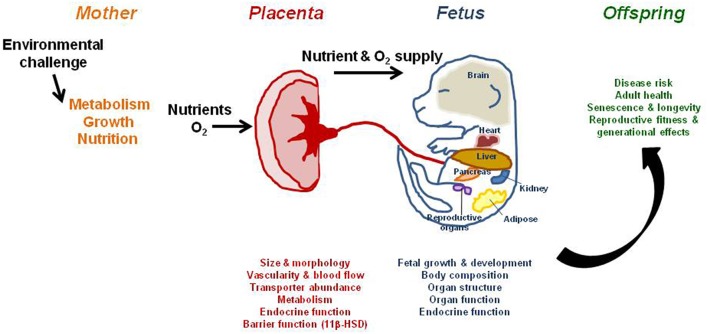
Size at birth is a critical determinant of life expectancy, and is dependent primarily on the placental supply of nutrients. However, the placenta is not just a passive organ for the materno-fetal transfer of nutrients and oxygen. Studies show that the placenta can adapt morphologically and functionally to optimize substrate supply, and thus fetal growth, under adverse intrauterine conditions. These adaptations help meet the fetal drive for growth, and their effectiveness will determine the amount and relative proportions of specific metabolic substrates supplied to the fetus at different stages of development. This flow of nutrients will ultimately program physiological systems at the gene, cell, tissue, organ, and system levels, and inadequacies can cause permanent structural and functional changes that lead to overt disease, particularly with increasing age. This review examines the environmental regulation of the placental phenotype with particular emphasis on the impact of maternal nutritional challenges and oxygen scarcity in mice, rats and guinea pigs. It also focuses on the effects of such conditions on fetal growth and the developmental programming of disease postnatally. A challenge for future research is to link placental structure and function with clinical phenotypes in the offspring.
Keywords: fetus; maternal environment; nutrient transport; placenta; pregnancy; programming.
Figures
References
-
- Ahokas R. A., Anderson G. D., Lipshitz J. (1983). Effect of dietary restriction, during the last week only or throughout gestation, on cardiac output and uteroplacental blood flow in pregnant rats. J. Nutr. 113, 1766–1776. - PubMed
-
- Ahokas R. A., Lahaye E. B., Anderson G. D., Lipshitz J. (1981). Effect of maternal dietary restriction on fetal growth and placental transfer of alpha-amino isobutyric acid in rats. J. Nutr. 111, 2052–2058. - PubMed
-
- Alexander B. T., Kassab S. E., Miller M. T., Abram S. R., Reckelhoff J. F., Bennett W. A., et al. (2001). Reduced uterine perfusion pressure during pregnancy in the rat is associated with increases in arterial pressure and changes in renal nitric oxide. Hypertension 37, 1191–1195. 10.1161/01.HYP.37.4.1191 - DOI - PubMed
Publication types
LinkOut - more resources
Full Text Sources
Other Literature Sources
