Review
. 2016 Mar 7:7:58.
doi: 10.3389/fphys.2016.00058. eCollection 2016.

Pulp Regeneration: Current Approaches and Future Challenges

Affiliations
Review

Pulp Regeneration: Current Approaches and Future Challenges

Jingwen Yang et al. Front Physiol. .

Abstract

Regenerative endodontics aims to replace inflamed/necrotic pulp tissues with regenerated pulp-like tissues to revitalize teeth and improve life quality. Pulp revascularization case reports, which showed successful clinical and radiographic outcomes, indicated the possible clinical application of pulp regeneration via cell homing strategy. From a clinical point of view, functional pulp-like tissues should be regenerated with the characterization of vascularization, re-innervation, and dentin deposition with a regulated rate similar to that of normal pulp. Efficient root canal disinfection and proper size of the apical foramen are the two requisite preconditions for pulp regeneration. Progress has been made on pulp regeneration via cell homing strategies. This review focused on the requisite preconditions and cell homing strategies for pulp regeneration. In addition to the traditionally used mechanical preparation and irrigation, antibiotics, irrigation assisted with EndoVac apical negative-pressure system, and ultrasonic and laser irradiation are now being used in root canal disinfection. In addition, pulp-like tissues could be formed with the apical foramen less than 1 mm, although more studies are needed to determine the appropriate size. Moreover, signaling molecules including stromal cell derived factor (SDF-1α), basic Fibroblast Growth Factor (bFGF), Platelet Derived Growth Factor (PDGF), stem cell factor (SCF), and Granulocyte Colony-Stimulating Factor (G-CSF) were used to achieve pulp-like tissue formation via a cell homing strategy. Studies on the cell sources of pulp regeneration might give some indications on the signaling molecular selection. The active recruitment of endogenous cells into root canals to regenerate pulp-like tissues is a novel concept that may offer an unprecedented opportunity for the near-term clinical translation of current biology-based therapies for dental pulp regeneration.

Keywords: cell homing; regenerative endodontics; root canal disinfection; signaling molecules; stem cells.


Figures
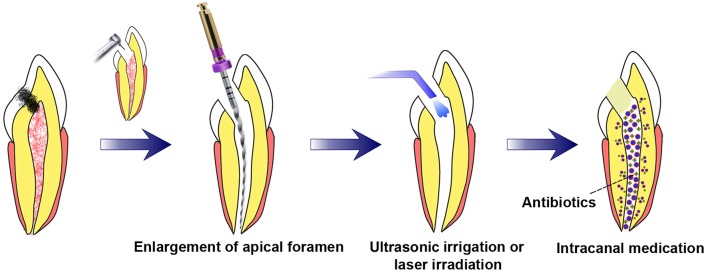
Figure 1
Figure 1
Requisite preconditions for pulp regeneration (root canal disinfection and enlargement of the apical foramen). After mechanical preparation of the root canal combined with irrigation, the apical foramen should be enlarged to a proper size. Root canal disinfection could be achieved through intracanal medication combined with irrigation assisted with EndoVac apical negative-pressure system or ultrasonic and/or laser irradiation.
Figure 2
Figure 2
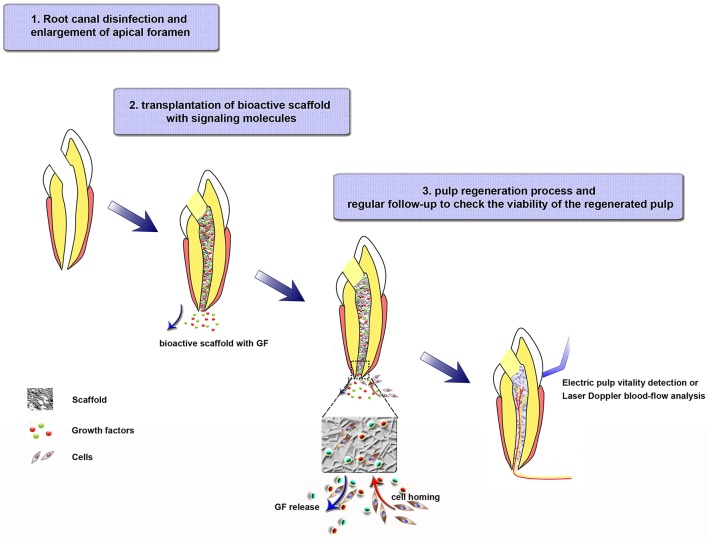
Tissue-engineering strategies for regenerative endodontics through a cell homing strategy. Step 1. Root canal disinfection and enlargement of apical foramen. Step 2. Bioactive scaffold transplantation and tooth restoration. Load bioactive scaffold in the canal after cleaning the antibiotics effectively. The growth factors, which are released from the scaffold to the surrounding tissues, will recruit cells into the scaffold. Step 3. Pulp-formation process. Recruited cells migrate, proliferate, differentiate in the scaffold, and participate in the formation of blood vessels, nerves, and regulated dentin deposition. During this step, regular follow-up to check the viability of the regenerated pulp are needed.

References

    1. Albuquerque M. T., Valera M. C., Moreira C. S., Bresciani E., de Melo R. M., Bottino M. C. (2015). Effects of ciprofloxacin-containing scaffolds on enterococcus faecalis biofilms. J. Endod. 41, 710–714. 10.1016/j.joen.2014.12.025 - DOI - PubMed
    1. Alongi D. J., Yamaza T., Song Y., Fouad A. F., Romberg E. E., Shi S., et al. (2010). Stem/progenitor cells from inflamed human dental pulp retain tissue regeneration potential. Regen. Med. 5, 617–631. 10.2217/rme.10.30 - DOI - PMC - PubMed
    1. Andreasen J. O., Borum M. K., Jacobsen H. L., Andreasen F. M. (1995). Replantation of 400 avulsed permanent incisors. 4. Factors related to periodontal ligament healing. Endod. Dent. Traumatol. 11, 76–89. 10.1111/j.1600-9657.1995.tb00464.x - DOI - PubMed
    1. Becerra P., Ricucci D., Loghin S., Gibbs J. L., Lin L. M. (2014). Histologic study of a human immature permanent premolar with chronic apical abscess after revascularization/revitalization. J. Endod. 40, 133–139. 10.1016/j.joen.2013.07.017 - DOI - PubMed
    1. Bottino M. C., Kamocki K., Yassen G. H., Platt J. A., Vail M. M., Ehrlich Y., et al. (2013). Bioactive nanofibrous scaffolds for regenerative endodontics. J. Dent. Res. 92, 963–969. 10.1177/0022034513505770 - DOI - PMC - PubMed