


Effect of Different Agrobacterium rhizogenes Strains on Hairy Root Induction and Phenylpropanoid Biosynthesis in Tartary Buckwheat (Fagopyrum tataricum Gaertn)
- PMID: 27014239
- PMCID: PMC4789558
- DOI: 10.3389/fmicb.2016.00318
Effect of Different Agrobacterium rhizogenes Strains on Hairy Root Induction and Phenylpropanoid Biosynthesis in Tartary Buckwheat (Fagopyrum tataricum Gaertn)
Abstract
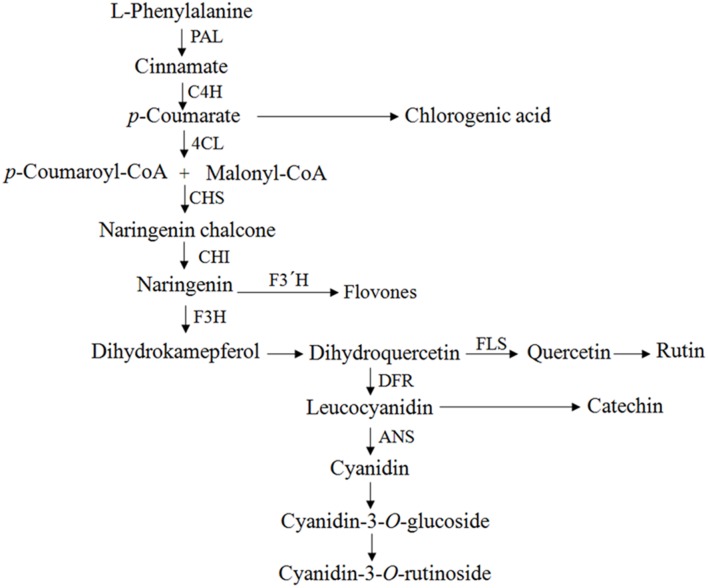
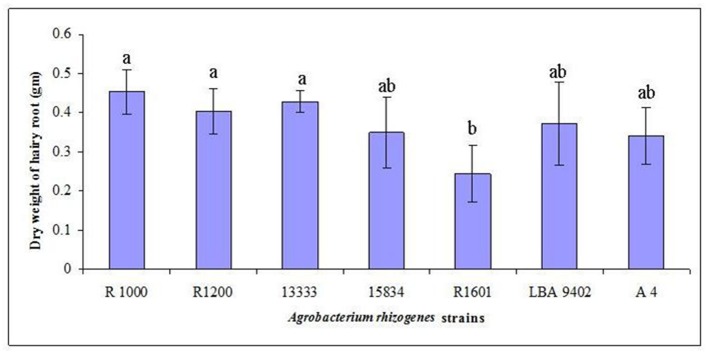
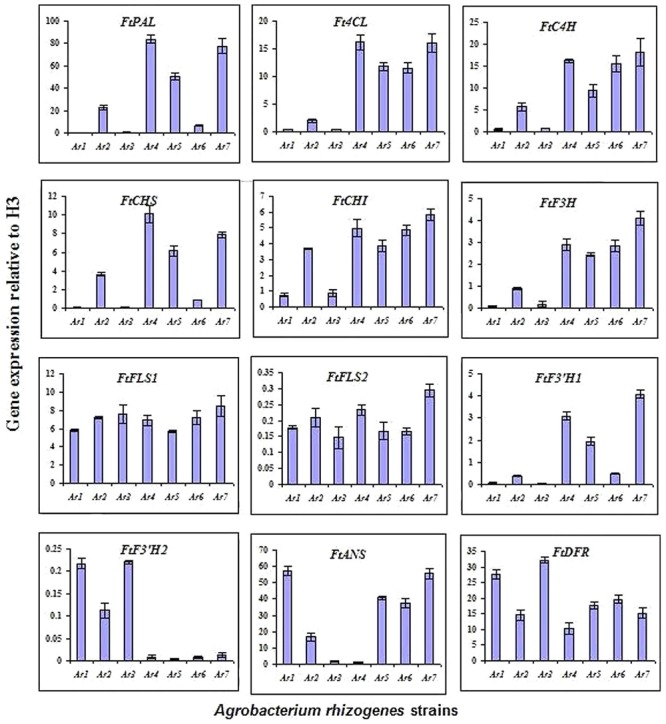
The development of an efficient protocol for successful hairy root induction by Agrobacterium rhizogenes is the key step toward an in vitro culturing method for the mass production of secondary metabolites. The selection of an effective Agrobacterium strain for the production of hairy roots is highly plant species dependent and must be determined empirically. Therefore, our goal was to investigate the transformation efficiency of different A. rhizogenes strains for the induction of transgenic hairy roots in Fagopyrum tataricum 'Hokkai T10' cultivar; to determine the expression levels of the polypropanoid biosynthetic pathway genes, such as ftpAL, FtC4H, Ft4CL, FrCHS, FrCH1, FrF3H, FtFLS1, FtFLS2, FtF3(,) H1, FtF3'H2, FtANS, and FtDFR; and to quantify the in vitro synthesis of phenolic compounds and anthocyanins. Among different strains, R1000 was the most promising candidate for hairy root stimulation because it induced the highest growth rate, root number, root length, transformation efficiency, and total anthocyanin and rutin content. The R1000, 15834, and A4 strains provided higher transcript levels for most metabolic pathway genes for the synthesis of rutin (22.31, 15.48, and 13.04 μg/mg DW, respectively), cyanidin 3-O-glucoside (800, 750, and 650 μg/g DW, respectively), and cyanidin 3-O-rutinoside (2410, 1530, and 1170 μg/g DW, respectively). A suitable A. rhizogenes strain could play a vital role in the fast growth of the bulk amount of hairy roots and secondary metabolites. Overall, R1000 was the most promising strain for hairy root induction in buckwheat.
Keywords: Agrobacterium rhizogenes; HPLC; anthocyanin; polypropanoid biosynthetic genes; rutin; tartary buckwheat.
Figures
References
-
- Ali S. S., Kasoju N., Luthra A., Singh A., Sharanabasava H., Sahu A., et al. (2008). Indian medicinal herbs as sources of antioxidants. Food Res. Int. 41 1–15. 10.1016/j.foodres.2007.10.001 - DOI
-
- Alvarez-Jubete L., Wijngaard H., Arendt E. K., Gallagher E. (2010). Polyphenol composition and in vitro antioxidant activity of amaranth, quinoa buckwheat, and wheat as affected by sprouting and baking. Food Chem. 119 770–778. 10.1016/j.foodchem.2009.07.032 - DOI
LinkOut - more resources
Full Text Sources
Other Literature Sources
Molecular Biology Databases
Research Materials
