Review
. 2016 Mar 17:7:345.
doi: 10.3389/fmicb.2016.00345. eCollection 2016.

Gut Microbiota: The Brain Peacekeeper

Affiliations
Review

Gut Microbiota: The Brain Peacekeeper

Chunlong Mu et al. Front Microbiol. .

Abstract

Gut microbiota regulates intestinal and extraintestinal homeostasis. Accumulating evidence suggests that the gut microbiota may also regulate brain function and behavior. Results from animal models indicate that disturbances in the composition and functionality of some microbiota members are associated with neurophysiological disorders, strengthening the idea of a microbiota-gut-brain axis and the role of microbiota as a "peacekeeper" in the brain health. Here, we review recent discoveries on the role of the gut microbiota in central nervous system-related diseases. We also discuss the emerging concept of the bidirectional regulation by the circadian rhythm and gut microbiota, and the potential role of the epigenetic regulation in neuronal cell function. Microbiome studies are also highlighted as crucial in the development of targeted therapies for neurodevelopmental disorders.

Keywords: anxiety; circadian rhythm; gut microbiota; gut–brain axis; nervous system; pattern recognition receptors.


Figures
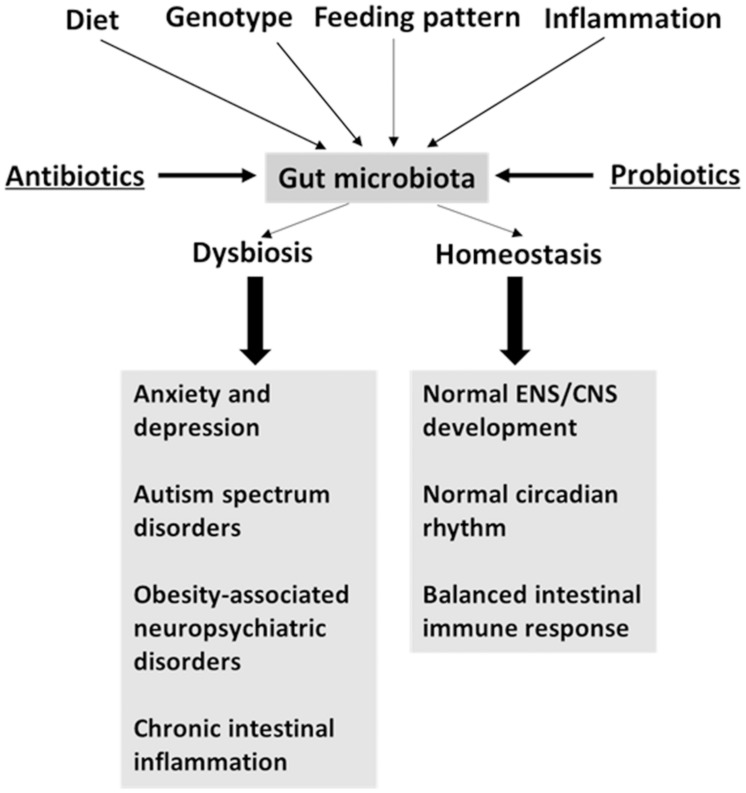
FIGURE 1
FIGURE 1
Factors driving the variation of gut microbiota may affect brain function. Antibiotics and probiotics treatment are microbiota-targeted interventions.
FIGURE 2
FIGURE 2
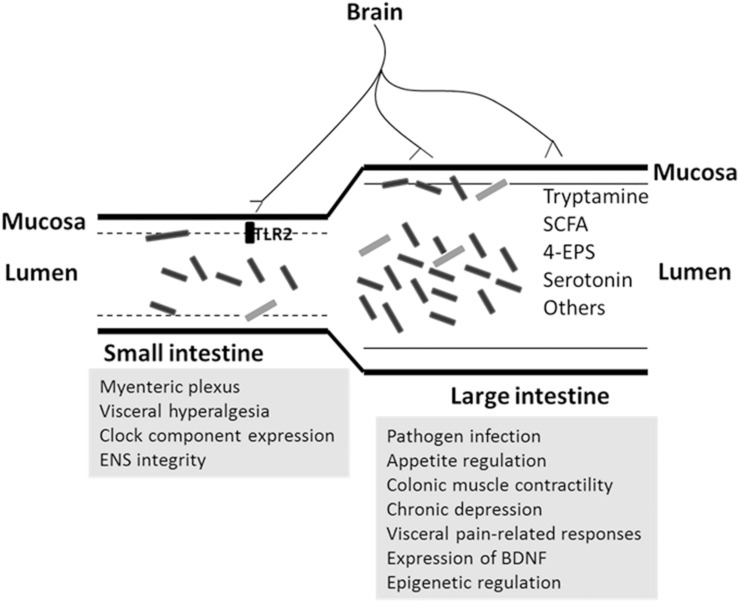
Potential regulation of microbiota on brain function in small and large intestine. The microbiota composition differs between small and large intestine, or mucosa and lumen. The rectangle objects are represented as bacteria. The site-related pathways (in gray background) are proposed according to the related discovery in this review.

References

    1. Abizaid A., Gao Q., Horvath T. L. (2006). Thoughts for food: brain mechanisms and peripheral energy balance. Neuron 51 691–702. 10.1016/j.neuron.2006.08.025 - DOI - PubMed
    1. Adams J. B., Johansen L. J., Powell L. D., Quig D., Rubin R. A. (2011). Gastrointestinal flora and gastrointestinal status in children with autism-comparisons to typical children and correlation with autism severity. BMC Gastroenterol. 11:22 10.1186/1471-230X-11-22 - DOI - PMC - PubMed
    1. Aguilera M., Vergara P., Martinez V. (2013). Stress and antibiotics alter luminal and wall-adhered microbiota and enhance the local expression of visceral sensory-related systems in mice. Neurogastroenterol. Motil. 25 e515–e529. 10.1111/nmo.12154 - DOI - PubMed
    1. Alenghat T., Osborne L. C., Saenz S. A., Kobuley D., Ziegler C. G. K., Mullican S. E., et al. (2013). Histone deacetylase 3 coordinates commensal-bacteria-dependent intestinal homeostasis. Nature 504 153–157. 10.1038/nature12687 - DOI - PMC - PubMed
    1. Anitha M., Vijay-Kumar M., Sitaraman S. V., Gewirtz A. T., Srinivasan S. (2012). Gut microbial products regulate murine gastrointestinal motility via toll-like receptor 4 signaling. Gastroenterology 143 10006.e4–1016.e4. 10.1053/j.gastro.2012.06.034 - DOI - PMC - PubMed