. 2016 Mar 9:7:282.
doi: 10.3389/fpls.2016.00282. eCollection 2016.

Comprehensive Analysis of the Soybean (Glycine max) GmLAX Auxin Transporter Gene Family

Affiliations

Comprehensive Analysis of the Soybean (Glycine max) GmLAX Auxin Transporter Gene Family

Chenglin Chai et al. Front Plant Sci. .

Abstract

The phytohormone auxin plays a critical role in regulation of plant growth and development as well as plant responses to abiotic stresses. This is mainly achieved through its uneven distribution in plant via a polar auxin transport process. Auxin transporters are major players in polar auxin transport. The AUXIN RESISTENT 1/LIKE AUX1 (AUX/LAX) auxin influx carriers belong to the amino acid permease family of proton-driven transporters and function in the uptake of indole-3-acetic acid (IAA). In this study, genome-wide comprehensive analysis of the soybean AUX/LAX (GmLAX) gene family, including phylogenic relationships, chromosome localization, and gene structure, was carried out. A total of 15 GmLAX genes, including seven duplicated gene pairs, were identified in the soybean genome. They were distributed on 10 chromosomes. Despite their higher percentage identities at the protein level, GmLAXs exhibited versatile tissue-specific expression patterns, indicating coordinated functioning during plant growth and development. Most GmLAXs were responsive to drought and dehydration stresses and auxin and abscisic acid (ABA) stimuli, in a tissue- and/or time point- sensitive mode. Several GmLAX members were involved in responding to salt stress. Sequence analysis revealed that promoters of GmLAXs contained different combinations of stress-related cis-regulatory elements. These studies suggest that the soybean GmLAXs were under control of a very complex regulatory network, responding to various internal and external signals. This study helps to identity candidate GmLAXs for further analysis of their roles in soybean development and adaption to adverse environments.

Keywords: GmLAX; abiotic stress; abscisic acid; auxin transporter; dehydration; drought; salinity; soybean.


Figures
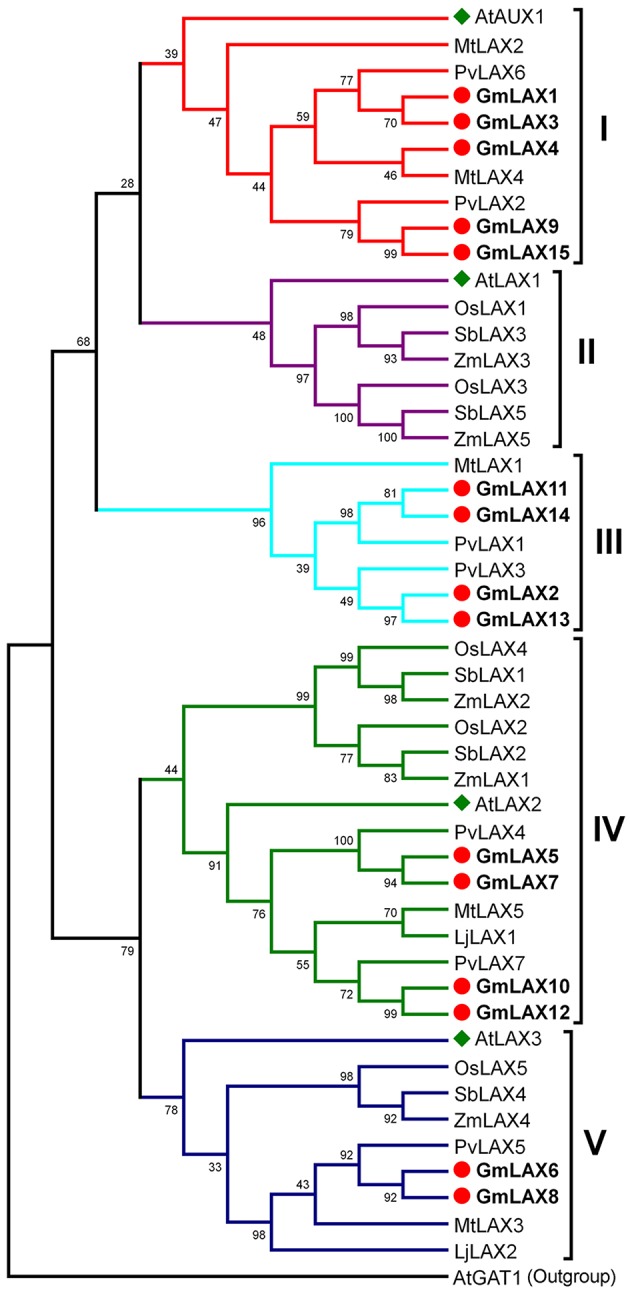
Figure 1
Figure 1
Phylogenetic relationships of the AUX/LAX auxin influx carriers from eight plant species. Protein sequences of 48 AUX/LAX auxin influx carriers from soybean, common bean, Medicago truncatula, Lotus japonicus, rice, maize, sorghum, and Arabidopsis (Supplementary Table S1) were used to construct the phylogenetic tree by the Maximum Likelihood method through MEGA 5.2 (Tamura et al., 2011). They were classified into five groups (I–V). The Arabidopsis AtGAT1 (AT1G08230.2), an H+-driven, high affinity gamma-aminobutyric acid transporter, was used as outgroup. The soybean GmLAXs were shown in bold font.
Figure 2
Figure 2
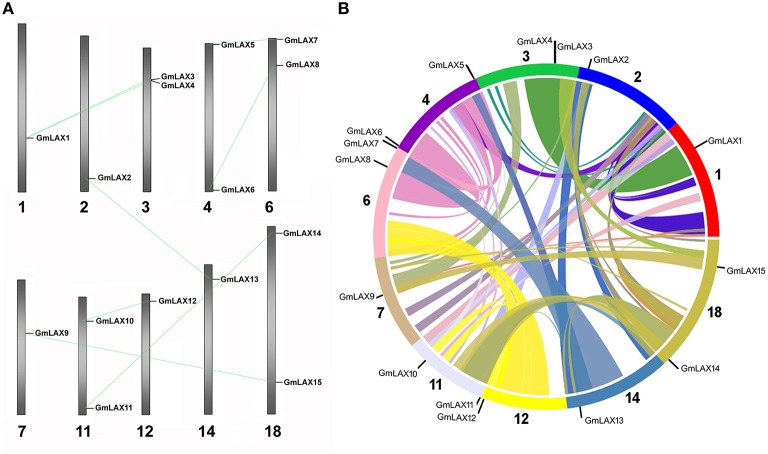
Chromosomal distribution of the soybean GmLAXs. (A) Chromosomal locations of GmLAXs were shown from top to bottom on corresponding chromosomes (Glycine max Wm82.a2.v1). Duplicated genes are linked by gray lines. (B) A circular map of soybean chromosomes was drawn by SyMAP (http://www.symapdb.org/), showing the soybean AUX/LAXs localization in synteny blocks.
Figure 3
Figure 3
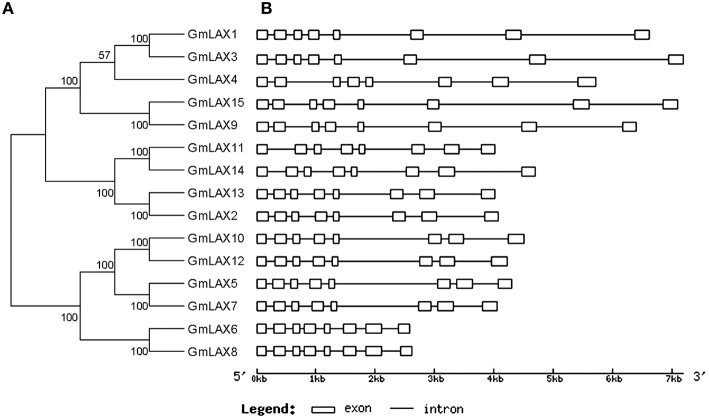
Phylogenetic relationships (A) and gene structures (B) of GmLAXs. The phylogenetic analysis was carried out using MEGA 5.2 (Tamura et al., 2011). Gene exon-intron structures were made using the Gene Structure Display Server (Guo et al., 2007).
Figure 4
Figure 4
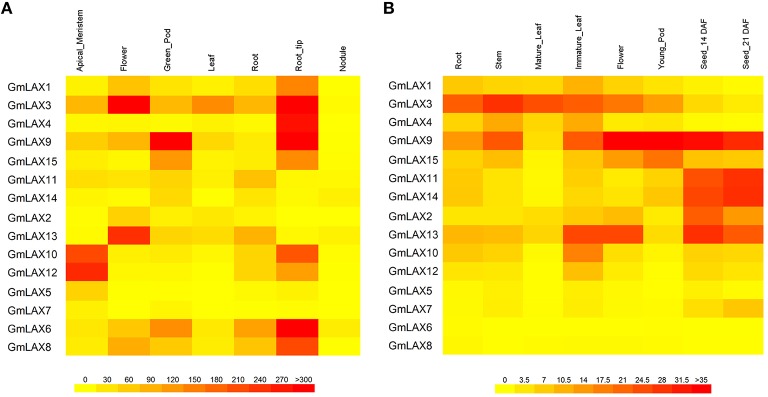
Tissue/organ expression profiles of GmLAXs. (A) Expression of 15 GmLAXs in shoot apical meristem, flower, green pod, leaf, root, root tip, and nodule. RNA-Seq data (Libault et al., 2010) are shown as a heat map. (B) GmLAXs gene expression in root, stem, mature leaf, immature leaf, flower, pod, and seed at 14 and 21 days after flowering was analyzed by qRT-PCR. Relative expression values of GmLAXs were multiplied by 1000 and visualized as a heat map. All heat maps in this study were made by using the BAR Heatmapper (http://bar.utoronto.ca/ntools/cgi-bin/ntools_heatmapper.cgi).
Figure 5
Figure 5
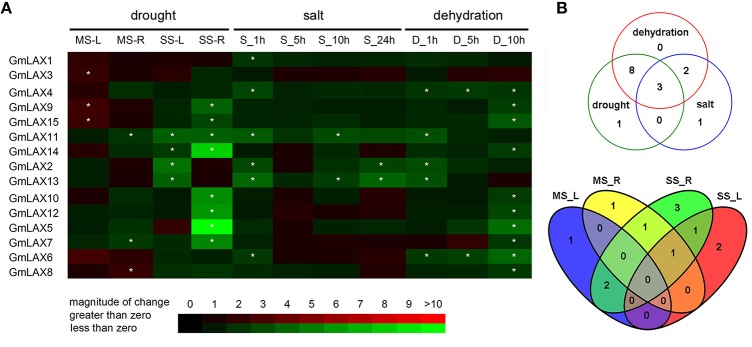
Differential expression of GmLAXs in response to drought, salt, and dehydration. (A) Fold changes of GmLAXs gene expressions in shoots and roots under mild drought stress (−7 bar) and moderate drought stress (−13 bar) treatments, and in whole seedlings under salt (250 mM NaCl) and dehydration stress treatments. Data showed the means of three biological repeats in qRT-PCR analysis. Asterisks indicated fold changes (absolute value) ≥2 and P < 0.05 (Student's t-test). (B) Venn diagram analysis of data in (A). MS-L, mild drought stress-shoots; MS-R, mild drought stress-roots; SS-L, moderate drought stress-shoots; SS-R, moderate drought stress-roots; S-1 h, salt 1 h; S-5 h, salt 5 h; S-10 h, salt 10 h; S-24 h, salt 24 h; D-1 h, dehydration 1 h; D-5 h, dehydration 5 h; D-10 h, dehydration 10 h.
Figure 6
Figure 6
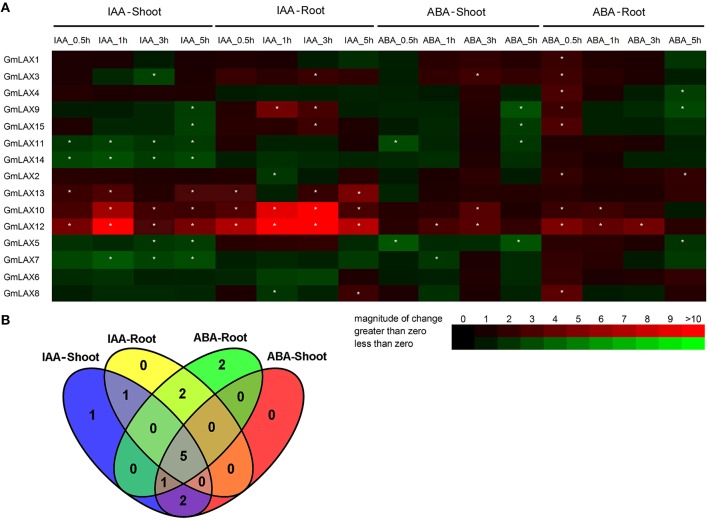
Expression profiles of GmLAXs upon auxin and ABA treatments. (A) Fold changes of GmLAXs gene expression in shoots and roots under ABA (150 μM) and IAA (50 μM) treatments. Data showed the means of biological triplicates in qRT-PCR analysis. Asterisks indicated absolute fold changes (absolute value) ≥2 and P < 0.05 (Student's t-test). (B) Venn diagram analysis of data in (A). Summary of GmLAXs gene expression in shoots and roots under IAA and ABA treatments at all four time points.

References

    1. Anderson J. V., Dogramaci M., Horvath D. P., Foley M. E., Chao W. S., Suttle J. C., et al. (2012). Auxin and ABA act as central regulators of developmental networks associated with paradormancy in Canada thistle (Cirsium arvense). Funct. Integr. Genomics. 12, 515–531. 10.1007/s10142-012-0280-5 - DOI - PubMed
    1. Bainbridge K., Guyomarc'h S., Bayer E., Swarup R., Bennett M., Mandel T., et al. (2008). Auxin influx carriers stabilize phyllotactic patterning. Genes. Dev. 22, 810–823. 10.1101/gad.462608 - DOI - PMC - PubMed
    1. Chai C., Wang Y., Joshi T., Valliyodan B., Prince S., Michel L., et al. (2015). Soybean transcription factor ORFeome associated with drought resistance: a valuable resource to accelerate research on abiotic stress resistance. BMC Genomics 16:596. 10.1186/s12864-015-1743-6 - DOI - PMC - PubMed
    1. Chen C., Twito S., Miller G. (2014). New cross talk between ROS, ABA and auxin controlling seed maturation and germination unraveled in APX6 deficient Arabidopsis seeds. Plant Signal. Behav. 9:e976489. 10.4161/15592324.2014.976489 - DOI - PMC - PubMed
    1. Cho M., Cho H. (2013). The function of ABCB transporters in auxin transport. Plant Signal Behav. 8:e22990. 10.4161/psb.22990 - DOI - PMC - PubMed

LinkOut - more resources