


Floral Volatiles in Parasitic Plants of the Orobanchaceae. Ecological and Taxonomic Implications
- PMID: 27014329
- PMCID: PMC4791402
- DOI: 10.3389/fpls.2016.00312
Floral Volatiles in Parasitic Plants of the Orobanchaceae. Ecological and Taxonomic Implications
Abstract
The holoparasitic broomrapes, Orobanche spp. and Phelipanche spp. (Orobanchaceae), are root parasites that completely depend on a host plant for survival and reproduction. There is considerable controversy on the taxonomy of this biologically and agronomically important family. Flowers of over 25 parasitic Orobanchaceae and a number of close, parasitic and non-parasitic, relatives emitted a complex blend of volatile organic compounds (VOCs), consisting of over 130 VOCs per species. Floral VOC blend-based phylogeny supported the known taxonomy in internal taxonomic grouping of genus and eliminated the uncertainty in some taxonomical groups. Moreover, phylogenetic analysis suggested separation of the broomrapes into two main groups parasitizing annual and perennial hosts, and for the annual hosts, into weedy and non-weedy broomrapes. We conclude that floral VOCs are a significant tool in species identification and possibly even in defining new species and can help to improve controversial taxonomy in the Orobanchaceae.
Keywords: Orobanche; Phelipanche; broomrapes; floral scents; phylogenetic patterns; taxonomy; volatile organic compounds; weeds.
Figures
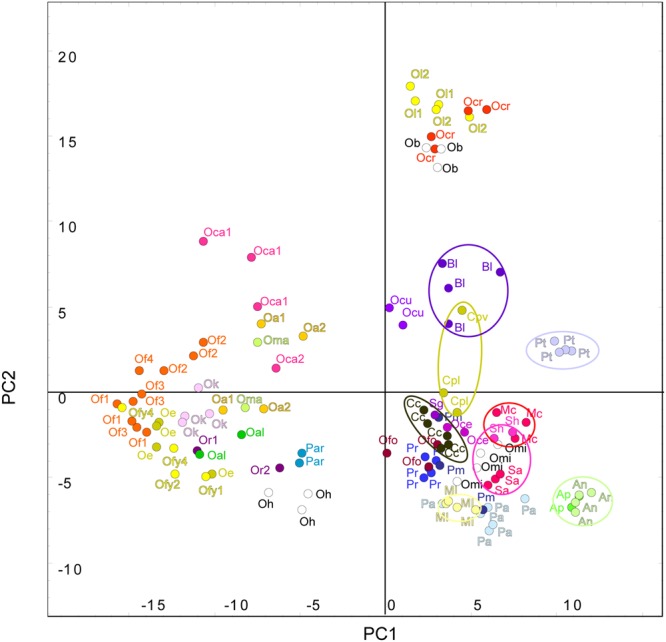
 , Antirrhinum majus nanum;
  , A. majus pumilum;
  , Boulardia latisquama;
  , Cistanche phelypea (lutea);
  , Ci. phelypea (violacea); Cc, Cynomorium coccineum;
  , Mimulus cardinalis;
  , M. luteus;
  Orobanche alba (location 1, 2);
  , O. alsatica; Ob, O. ballotae (white color);
 , O. caryophylacea (location 1, 2);
  , O. cernua;
  , O. crenata;
  , O. cumana;
  , O. elatior;
  , O. flava (location 1,2,3,4),
  , O. flava yellow morph (location 1,2,4);
  , O. foetida; Oh, O. hederae (white color);
  , O. kochii;
  , lutea (year 1,2);
  , O. mayeri; Omi, O. minor (white color);
  , O. reticulata (location 1,2);
  , Phelipanche aegyptiaca;
  , Ph. arenaria;
  , Ph. mutelii;
  , Ph. ramosa;
  , Paulownia tomentosa;
  , Striga asiatica;
  , S. gesnerioides;
  , S. hermonthica.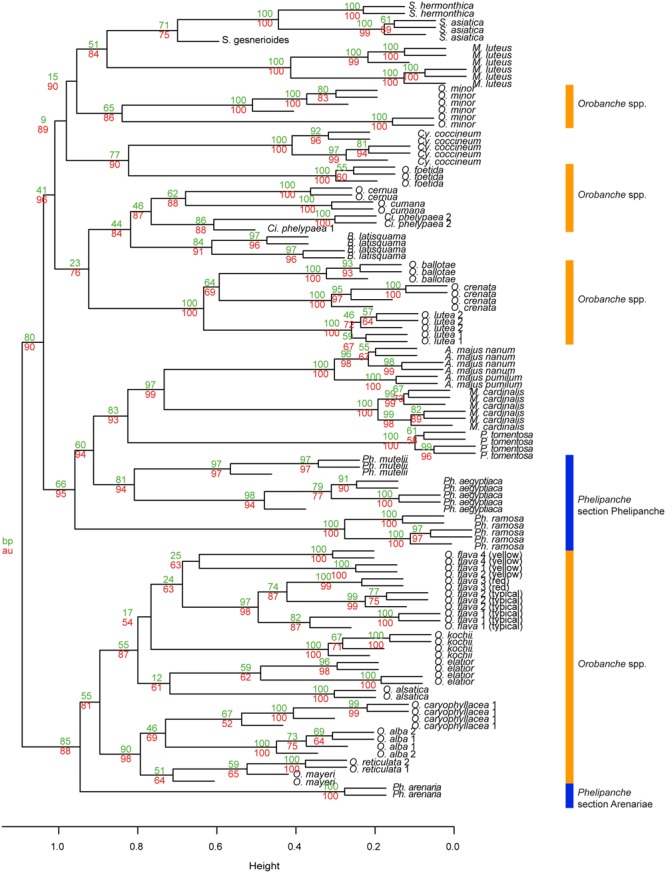
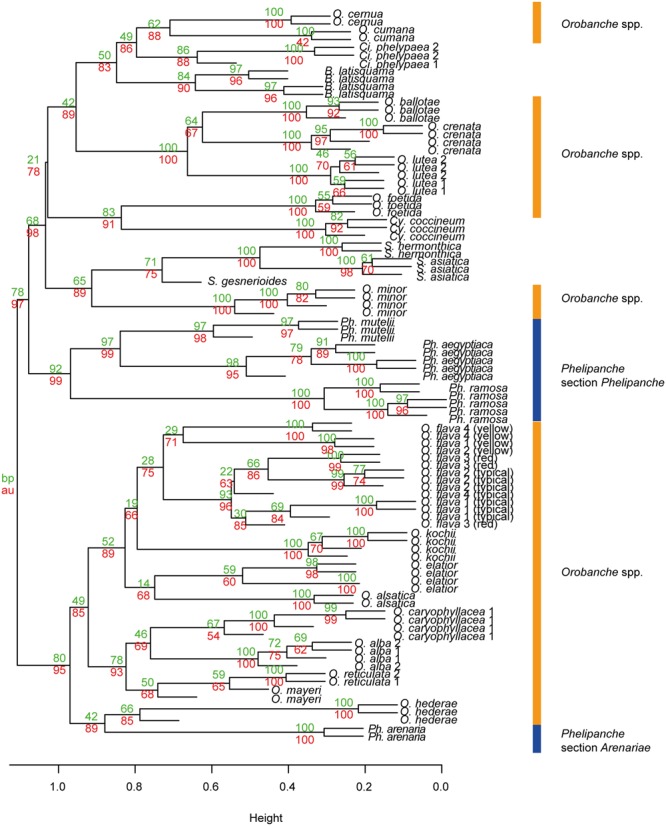
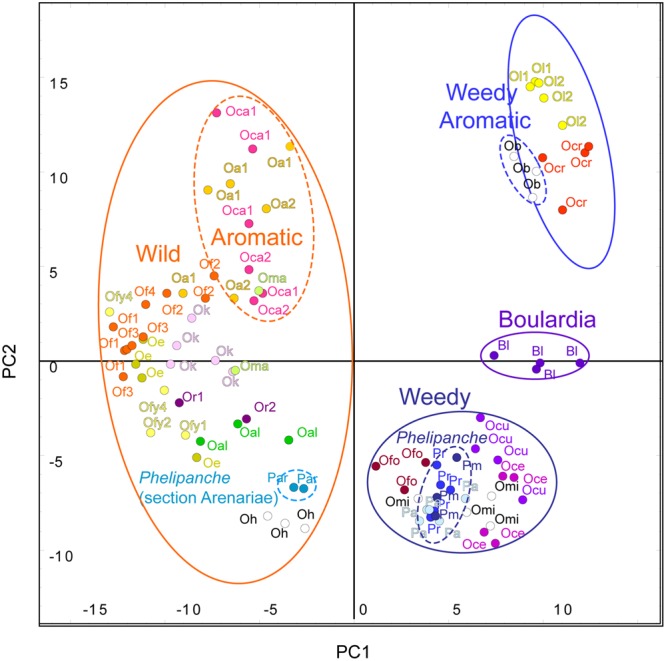 Orobanche alba (location 1, 2), , O. alsatica;
, O. caryophylacea (location 1, 2); , O. elatior; , O. flava (location 1,2,3,4); , O. flava yellow morph (location 1,2,4); Oh, O. hederae (White color); , O. kochii; , O. mayeri;
Orobanche alba (location 1, 2), , O. alsatica;
, O. caryophylacea (location 1, 2); , O. elatior; , O. flava (location 1,2,3,4); , O. flava yellow morph (location 1,2,4); Oh, O. hederae (White color); , O. kochii; , O. mayeri;  , O. reticulata (location 1,2); , Phelipanche arenaria. Group of weedy broomrapes: Ob, O. ballotae (White color); , O. cernua; , O. crenata; , O. cumana; , O. foetida; , O. lutea (year 1,2); Omi, O. minor (White color); , Ph. aegyptiaca; , Ph. mutelii; , Ph. ramosa. Other broomrapes: , Boulardia latisquama.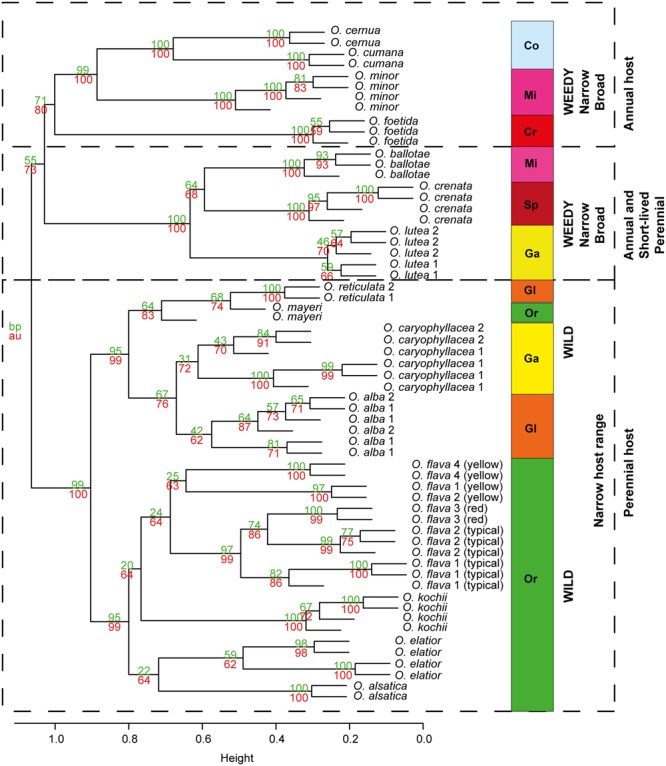
References
-
- Adams R. P. (2007). Identification of Essential oil Components by Gas Chromatography/Mass Spectroscopy. Carol Stream, IL: Allured Publishing Corporation.
-
- Beck-Mannagetta G. (1930). “IV. 261. Orobanchaceae,” in Das Pflanzenreich. Regni Vegetabilis Conspectus ed. Engler A. (Leipzig: Wilhelm Engelmann; ) 1–348.
-
- Cakir A., Kordali S., Kilic H., Kaya E. (2005). Antifungal properties of essential oil and crude extracts of Hypericum linarioides Bosse Source. Biochem. Syst. Ecol. 33 245–256. 10.1016/j.bse.2004.08.006 - DOI
LinkOut - more resources
Full Text Sources
Other Literature Sources
Miscellaneous
