Review
. 2016 Mar 16:7:327.
doi: 10.3389/fpls.2016.00327. eCollection 2016.

Calcium Sensors as Key Hubs in Plant Responses to Biotic and Abiotic Stresses

Affiliations
Review

Calcium Sensors as Key Hubs in Plant Responses to Biotic and Abiotic Stresses

Benoît Ranty et al. Front Plant Sci. .

Abstract

The Ca(2+) ion is recognized as a crucial second messenger in signaling pathways coupling the perception of environmental stimuli to plant adaptive responses. Indeed, one of the earliest events following the perception of environmental changes (temperature, salt stress, drought, pathogen, or herbivore attack) is intracellular variation of free calcium concentrations. These calcium variations differ in their spatio-temporal characteristics (subcellular location, amplitude, kinetics) with the nature and strength of the stimulus and, for this reason, they are considered as signatures encrypting information from the initial stimulus. This information is believed to drive a specific response by decoding via calcium-binding proteins. Based on recent examples, we illustrate how individual calcium sensors from the calcium-dependent protein kinase and calmodulin-like protein families can integrate inputs from various environmental changes. Focusing on members of these two families, shown to be involved in plant responses to both abiotic and biotic stimuli, we discuss their role as key hubs and we put forward hypotheses explaining how they can drive the signaling pathways toward the appropriate plant responses.

Keywords: CML; CPK; biotic and abiotic stress; calcium sensor; calcium signaling; decoding; plant; specificity.


Figures
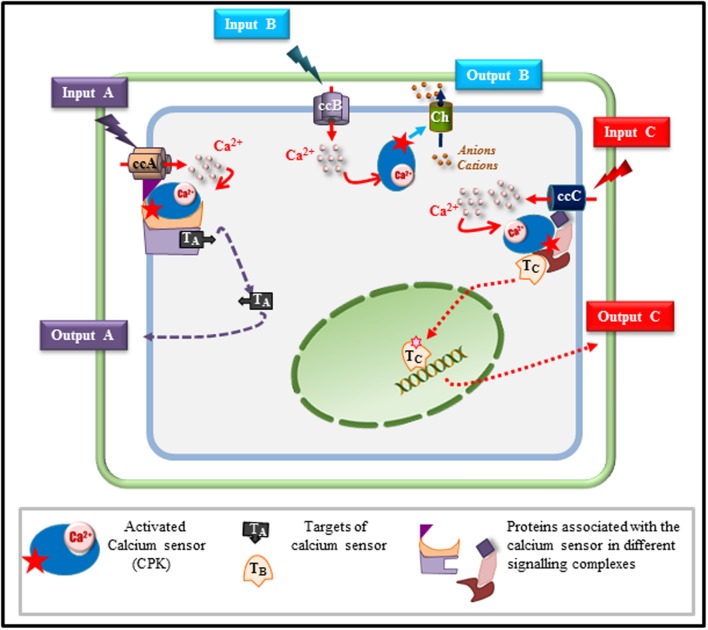
FIGURE 1
FIGURE 1
Model depicting how a single calcium sensor can handle various cell signaling inputs and outputs. Based on the results described in this mini-review, we depict various possible scenarios explaining how a single calcium sensor such as a calcium-dependent protein kinase (CPK), can drive signaling pathways toward specific responses in a single cell exposed to different stimuli. In response to a stimulus A (input A), a specific calcium channel (ccA) is activated and generates a calcium flux that will activate the CPK that will phosphorylate target A (TA) involved in output A. In response to a second stimulus (input B), a specific calcium channel is activated (ccB) and calcium released into the cytosol will activate the CPK that can directly regulate an effector (Ch) such as an ion transporter (channel, pump, exchanger) leading, according to the charge of the transported ions, to membrane depolarisation or hyperpolarisation contributing to the final response (output B). The same calcium sensor can be associated, in the same cell, with a different scaffold tethered to a different calcium channel (ccC) that is activated only by stimulus C (input C). Upon ccC activation, the calcium sensor is activated and can lead, through this specific signaling module, to the activation of a different target (TC) migrating to the nucleus in order to control the adaptive response C through gene reprogramming for instance (output C).

References

    1. Allen G. J., Chu S. P., Harrington C. L., Schumacher K., Hoffmann T., Tang Y. Y., et al. (2001). A defined range of guard cell calcium oscillation parameters encodes stomatal movements. Nature 411 1053–1057. 10.1038/35082575 - DOI - PubMed
    1. Asano T., Hayashi N., Kikuchi S., Ohsugi R. (2012a). CDPK-mediated abiotic stress signalling. Plant Signal. Behav. 7 817–821. 10.4161/psb.20351 - DOI - PMC - PubMed
    1. Asano T., Hayashi N., Kobayashi M., Aoki N., Miyao A., Mitsuhara I., et al. (2012b). A rice calcium-dependent protein kinase OsCPK12 oppositely modulates salt-stress tolerance and blast disease resistance. Plant J. 69 26–36. 10.1111/j.1365-313X.2011.04766.x - DOI - PubMed
    1. Bender K. W., Dobney S., Ogunrinde A., Chiasson D., Mullen R. T., Teresinski H. J., et al. (2014). The calmodulin-like protein CML43 functions as a salicylic-acid-inducible root-specific Ca(2+) sensor in Arabidopsis. Biochem. J. 457 127–136. 10.1042/bj20131080 - DOI - PubMed
    1. Bender K. W., Snedden W. A. (2013). Calmodulin-related proteins step out from the shadow of their namesake. Plant Physiol. 163 486–495. 10.1104/pp.113.221069 - DOI - PMC - PubMed

LinkOut - more resources
