


Evidence that the adenosine triphosphate-binding cassette G5/G8-independent pathway plays a determinant role in cholesterol gallstone formation in mice
- PMID: 27014967
- PMCID: PMC6037420
- DOI: 10.1002/hep.28570
Evidence that the adenosine triphosphate-binding cassette G5/G8-independent pathway plays a determinant role in cholesterol gallstone formation in mice
Abstract
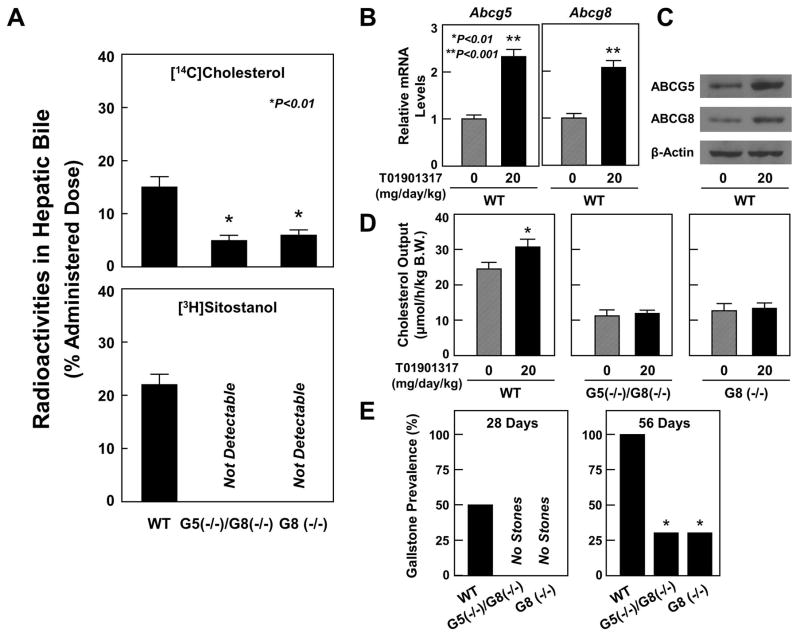
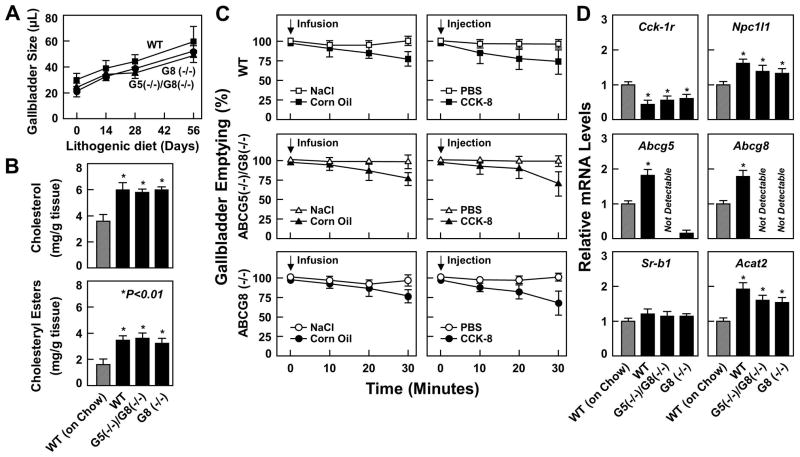
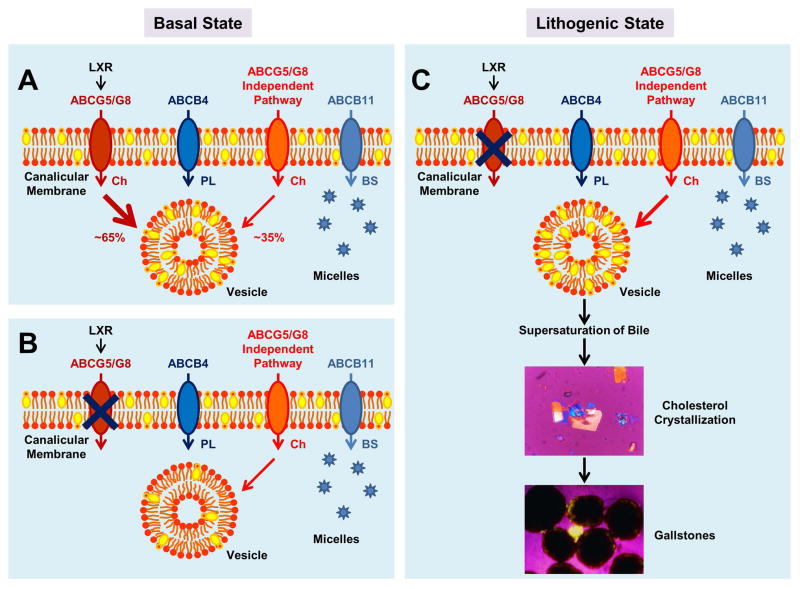
The adenosine triphosphate-binding cassette (ABC) sterol transporter, Abcg5/g8, is Lith9 in mice, and two gallstone-associated variants in ABCG5/G8 have been identified in humans. Although ABCG5/G8 plays a critical role in determining hepatic sterol secretion, cholesterol is still secreted to bile in sitosterolemic patients with a defect in either ABCG5 or ABCG8 and in either Abcg5/g8 double- or single-knockout mice. We hypothesize that in the defect of ABCG5/G8, an ABCG5/G8-independent pathway is essential for regulating hepatic secretion of biliary sterols, which is independent of the lithogenic mechanism of the ABCG5/G8 pathway. To elucidate the effect of the ABCG5/G8-independent pathway on cholelithogenesis, we investigated the biliary and gallstone characteristics in male wild-type (WT), ABCG5(-/-)/G8(-/-), and ABCG8 (-/-) mice fed a lithogenic diet or varying amounts of cholesterol, treated with a liver X receptor (LXR) agonist, or injected intravenously with [(3) H]sitostanol- and [(14) C]cholesterol-labeled high-density lipoprotein (HDL). We found that ABCG5(-/-)/G8(-/-) and ABCG8 (-/-) mice displayed the same biliary and gallstone phenotypes. Although both groups of knockout mice showed a significant reduction in hepatic cholesterol output compared to WT mice, they still formed gallstones. The LXR agonist significantly increased biliary cholesterol secretion and gallstones in WT, but not ABCG5(-/-)/G8(-/-) or ABCG8 (-/-), mice. The 6-hour recovery of [(14) C]cholesterol in hepatic bile was significantly lower in both groups of knockout mice than in WT mice and [(3) H]sitostanol was detected in WT, but not ABCG5(-/-)/G8(-/-) or ABCG8 (-/-), mice.
Conclusions: The ABCG5/G8-independent pathway plays an important role in regulating biliary cholesterol secretion, the transport of HDL-derived cholesterol from plasma to bile, and gallstone formation, which works independently of the ABCG5/G8 pathway. Further studies are needed to observe whether this pathway is also operational in humans. (Hepatology 2016;64:853-864).
© 2016 by the American Association for the Study of Liver Diseases.
Conflict of interest statement
There is no conflict of interest to disclose for all authors.
Figures
Comment in
-
Unexpected cholesterol gallstones.Hepatology. 2016 Sep;64(3):711-3. doi: 10.1002/hep.28646. Epub 2016 Jun 23. Hepatology. 2016. PMID: 27184022 No abstract available.
References
-
- Wang DQ, Afdhal NH. Gallstone Disease. In: Feldman M, Friedman LS, Brandt L, editors. Sleisenger and Fordtran’s Gastrointestinal and Liver Disease. 10. Philadelphia: Elsevier Saunders; 2014. pp. 1100–1133.
MeSH terms
Substances
Grants and funding
LinkOut - more resources
Full Text Sources
Other Literature Sources
Medical
Molecular Biology Databases
