


Missed opportunities of inclusion in a cohort of HIV-infected children to initiate antiretroviral treatment before the age of two in West Africa, 2011 to 2013
- PMID: 27015798
- PMCID: PMC4808141
- DOI: 10.7448/IAS.19.1.20601
Missed opportunities of inclusion in a cohort of HIV-infected children to initiate antiretroviral treatment before the age of two in West Africa, 2011 to 2013
Abstract
Introduction: The World Health Organization (WHO) 2010 guidelines recommended to treat all HIV-infected children less than two years of age. We described the inclusion process and its correlates of HIV-infected children initiated on early antiretroviral therapy (EART) at less than two years of age in Abidjan, Côte d'Ivoire, and Ouagadougou, Burkina Faso.
Methods: All children with HIV-1 infection confirmed with a DNA PCR test of a blood sample, aged less than two years, living at a distance less than two hours from the centres and whose parents (or mother if she was the only legal guardian or the legal caregiver if parents were not alive) agreed to participate in the MONOD ANRS 12206 project were included in a cohort to receive EART based on lopinavir/r. We used logistic regression to identify correlates of inclusion.
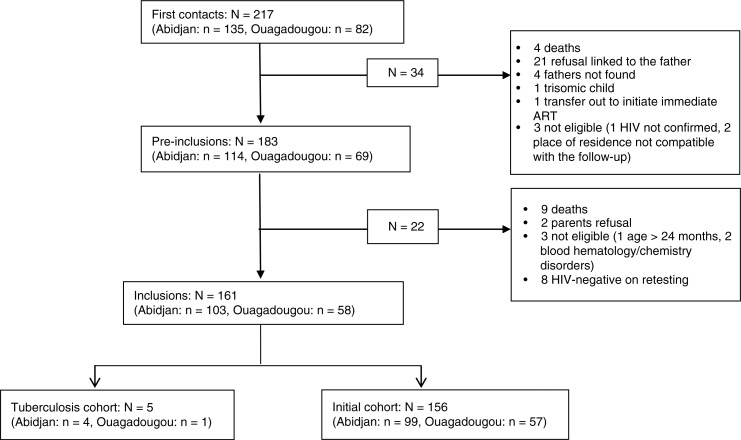
Results: Among the 217 children screened and referred to the MONOD centres, 161 (74%) were included and initiated on EART. The main reasons of non-inclusion were fear of father's refusal (48%), mortality (24%), false-positive HIV infection test (16%) and other ineligibility reasons (12%). Having previously disclosed the child's and mother's HIV status to the father (adjusted odds ratio (aOR): 3.20; 95% confidence interval (95% CI): 1.55 to 6.69) and being older than 12 months (aOR: 2.05; 95% CI: 1.02 to 4.12) were correlates of EART initiation. At EART initiation, the median age was 13.5 months, 70% had reached WHO Stage 3/4 and 57% had a severe immune deficiency.
Conclusions: Fear of stigmatization by the father and early competing mortality were the major reasons for missed opportunities of EART initiation. There is an urgent need to involve fathers in the care of their HIV-exposed children and to promote early infant diagnosis to improve their future access to EART and survival.
Trial registration: ClinicalTrials.gov NCT01127204.
Keywords: HIV; West Africa; acceptability; access to care; children; early antiretroviral therapy; linkage to care.
Figures
References
-
- UNAIDS. Report on the global AIDS epidemic 2013 [Internet] [cited 2014 Aug 21]. Available from: http://www.unaids.org/en/resources/documents/2013/name,85053,en.asp.
-
- SP/CNLS-IST, ONUSIDA. Rapport d'activité sur la riposte au SIDA du Burkina Faso 2012 [Internet] [cited 2013 Dec 20]. Available from: http://www.unaids.org/en/dataanalysis/knowyourresponse/countryprogressre....
-
- Conseil national de lutte contre le SIDA. Rapport national 2012 : suivi de La déclaration de politique sur le sida de Juin 2011 [Internet] [cited 2014 Aug 21]. Available from: http://www.unaids.org/en/regionscountries/countries/ctedivoire/
-
- Conseil national de lutte contre le SIDA. Rapport national de la Côte d'Ivoire 2014: suvi de la declaration de politique sur le SIDA de Juin 2011 [Internet] [cited 2015 Feb 26]. Available from: http://www.unaids.org/en/regionscountries/countries/ctedivoire/
-
- Newell M-L, Coovadia H, Cortina-Borja M, Rollins N, Gaillard P, Dabis F, et al. Mortality of infected and uninfected infants born to HIV-infected mothers in Africa: a pooled analysis. Lancet. 2004;364(9441):1236–43. - PubMed
Publication types
MeSH terms
Substances
Associated data
LinkOut - more resources
Full Text Sources
Other Literature Sources
Medical
