. 2016 May;203(1):433-50.
doi: 10.1534/genetics.115.181594. Epub 2016 Mar 26.

Uncovering Adaptation from Sequence Data: Lessons from Genome Resequencing of Four Cattle Breeds

Affiliations

Uncovering Adaptation from Sequence Data: Lessons from Genome Resequencing of Four Cattle Breeds

Simon Boitard et al. Genetics. 2016 May.

Abstract

Detecting the molecular basis of adaptation is one of the major questions in population genetics. With the advance in sequencing technologies, nearly complete interrogation of genome-wide polymorphisms in multiple populations is becoming feasible in some species, with the expectation that it will extend quickly to new ones. Here, we investigate the advantages of sequencing for the detection of adaptive loci in multiple populations, exploiting a recently published data set in cattle (Bos taurus). We used two different approaches to detect statistically significant signals of positive selection: a within-population approach aimed at identifying hard selective sweeps and a population-differentiation approach that can capture other selection events such as soft or incomplete sweeps. We show that the two methods are complementary in that they indeed capture different kinds of selection signatures. Our study confirmed some of the well-known adaptive loci in cattle (e.g., MC1R, KIT, GHR, PLAG1, NCAPG/LCORL) and detected some new ones (e.g., ARL15, PRLR, CYP19A1, PPM1L). Compared to genome scans based on medium- or high-density SNP data, we found that sequencing offered an increased detection power and a higher resolution in the localization of selection signatures. In several cases, we could even pinpoint the underlying causal adaptive mutation or at least a very small number of possible candidates (e.g., MC1R, PLAG1). Our results on these candidates suggest that a vast majority of adaptive mutations are likely to be regulatory rather than protein-coding variants.

Keywords: FST; domestication; linkage disequilibrium; next-generation sequencing; selective sweeps.


Figures

Figure 1
Figure 1
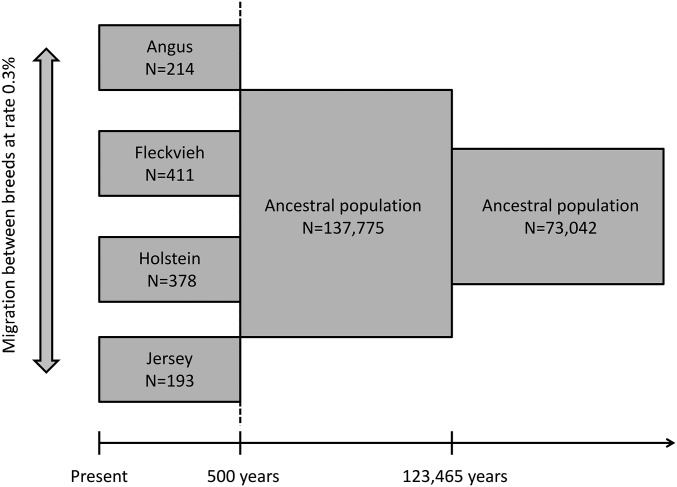
Joint demography of the four cattle breeds, estimated from our data using the approach of Excoffier et al. (2013). Population sizes correspond to the number of haploid individuals. Parameter values correspond to the EM iteration with the highest likelihood, but similar values were obtained from the second- and third-best EM iterations.
Figure 2
Figure 2
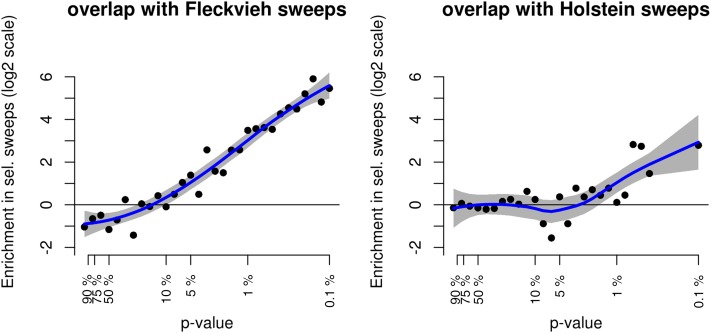
Comparison between HMM and CLR results. Shown is the proportion of Fleckvieh CLR P-values (obtained from Qanbari et al. 2014) in sweep windows vs. other windows in the genome. On the left, the sweep windows considered were those detected in Fleckvieh, independently of what happened in other breeds. On the right, the sweep windows considered were those detected only in Holstein.
Figure 3
Figure 3
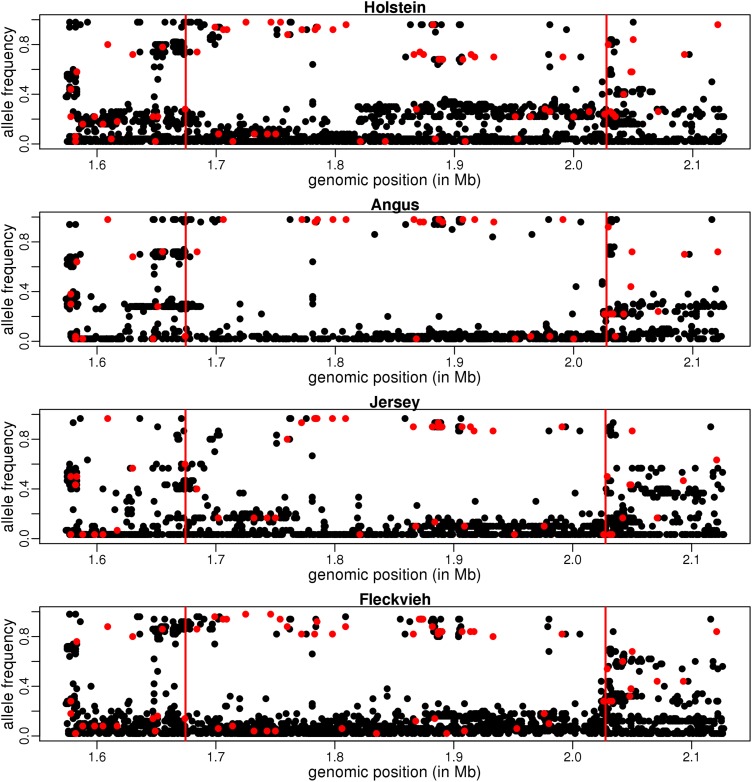
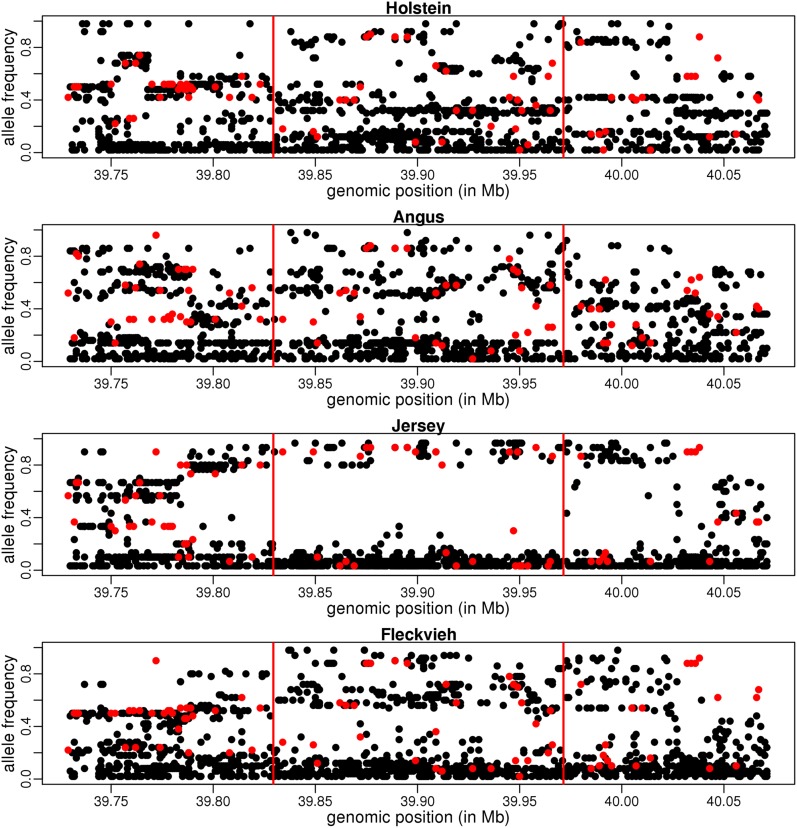
Allele frequencies in the sweep region at the polled locus. For SNPs where the ancestral allele is known (in red), the frequency is that of the derived allele. For other SNPs (in black) the frequency is that of the minor allele (among all breeds). Vertical red bars delimit the union of detected regions among the four breeds.
Figure 4
Figure 4
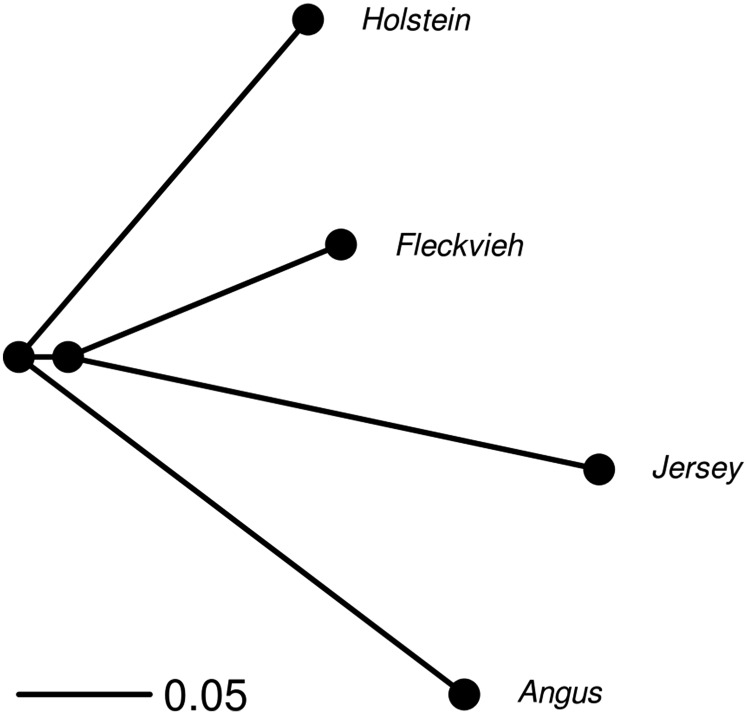
Population tree estimated from the 1000 bull genomes data. Branch length is measured in units of drift (t/2N, where t is the time in generations and N the effective population size).
Figure 5
Figure 5
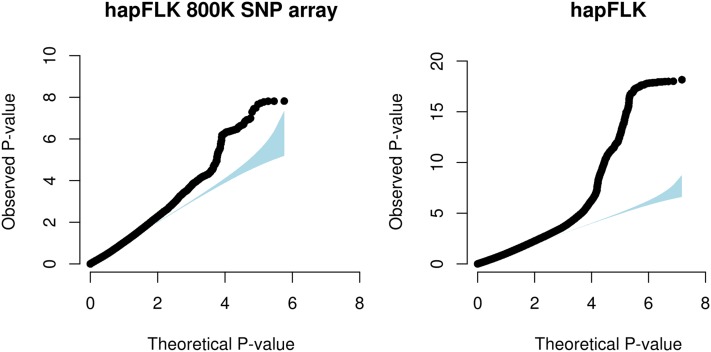
Influence of NGS on hapFLK detection power. Shown is a probabiliy probability (PP) plot of the hapFLK test applied to SNPs of the Illumina BovineHD SNP chip (left) or to all sites of the 1000 bull genomes project (right).
Figure 6
Figure 6
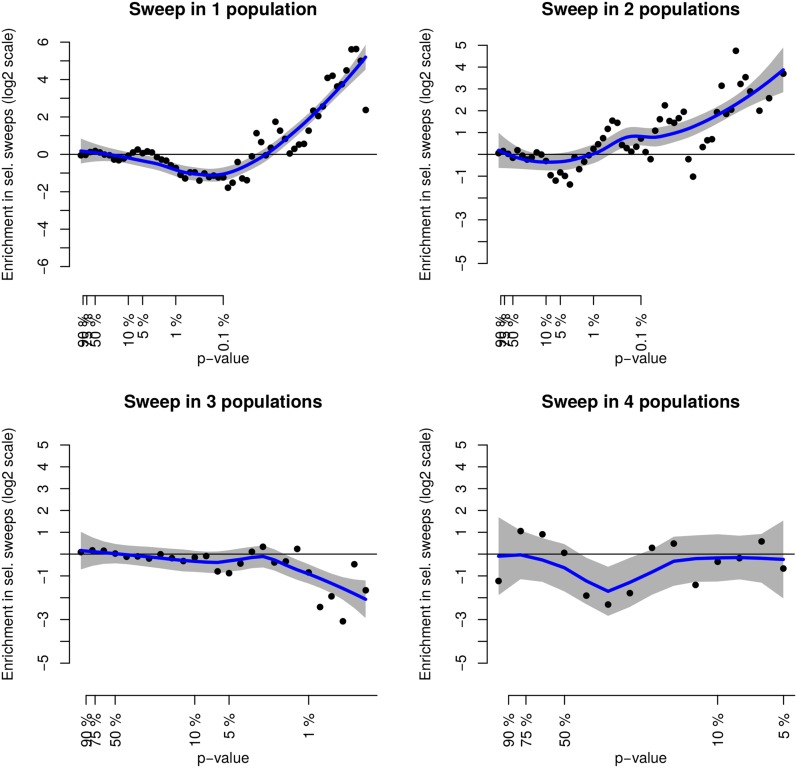
Distribution of hapFLK within hard-sweep regions. Shown is a comparison of the distribution of hapFLK P-values in hard-sweep regions identified within populations and in the rest of the genome. The plot shows the ratio of the P-values distribution in hard sweeps detected in one to four populations to their distribution on the part of the genome where no hard sweep is detected. y-axis is on a log2 scale and x-axis is on a log10 scale.
Figure 7
Figure 7
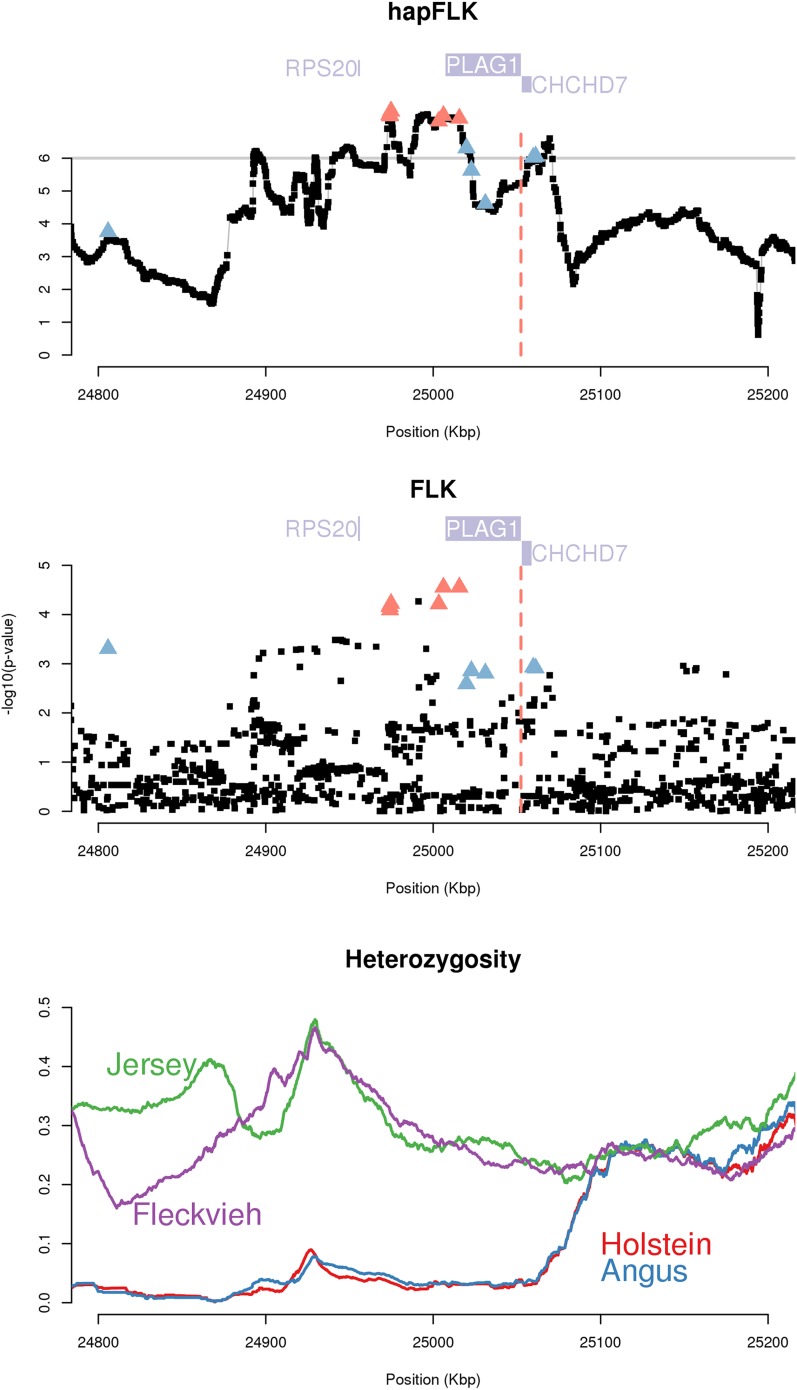
Selection signature around PLAG1. Shown are hapFLK (top) and FLK (middle) P-values (log10 scale) for the selection signature around PLAG1 and local heterozygosity in the four breeds (bottom) for the same region. In the top and middle panels, genes are indicated by purple solid rectangles, and red solid triangles correspond to the candidate QTNs of Karim et al. (2011).
Figure 8
Figure 8
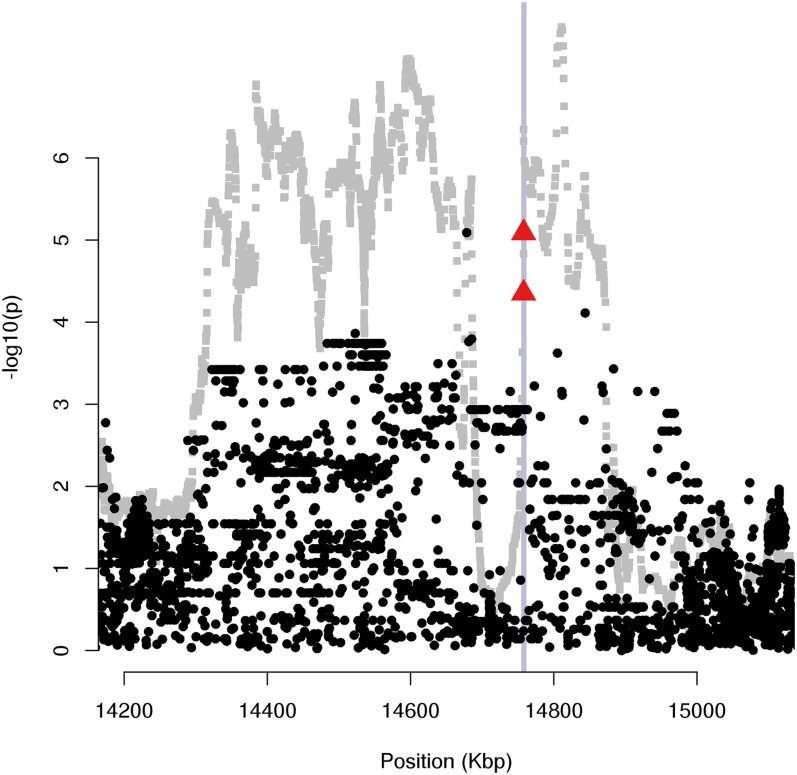
Selection signature around MC1R. Shown are hapFLK (gray) and FLK (black) P-values (log10 scale) for the selection signature around MC1R (purple vertical line). Red triangles highlight the two known causal mutations for red and black coat color in cattle.
Figure 9
Figure 9
Allele frequencies in the sweep region including SLC45A2 and RXFP3. For SNPs where the ancestral allele is known (in red), the frequency is that of the derived allele. For other SNPs (in black) the frequency is that of the minor allele (among all breeds).

References

    1. Albrecht E., Komolka K., Kuzinski J., Maak S., 2012. Agouti revisited: transcript quantification of the asip gene in bovine tissues related to protein expression and localization. PLoS One 7: e35282. - PMC - PubMed
    1. Allais-Bonnet A., Grohs C., Medugorac I., Krebs S., Djari A., et al. , 2013. Novel insights into the bovine polled phenotype and horn ontogenesis in bovidae. PLoS One 8: e63512. - PMC - PubMed
    1. Bionaz M., Loor J. J., 2008. Acsl1, agpat6, fabp3, lpin1, and slc27a6 are the most abundant isoforms in bovine mammary tissue and their expression is affected by stage of lactation. J. Nutr. 138: 1019–1024. - PubMed
    1. Biswas S., Akey J. M., 2006. Genomic insights into positive selection. Trends Genet. 22: 437–446. - PubMed
    1. Boitard S., Schlotterer C., Futschik A., 2009. Detecting selective sweeps: a new approach based on hidden Markov models. Genetics 181: 1567–1578. - PMC - PubMed