


Bat Accelerated Regions Identify a Bat Forelimb Specific Enhancer in the HoxD Locus
- PMID: 27019019
- PMCID: PMC4809552
- DOI: 10.1371/journal.pgen.1005738
Bat Accelerated Regions Identify a Bat Forelimb Specific Enhancer in the HoxD Locus
Abstract
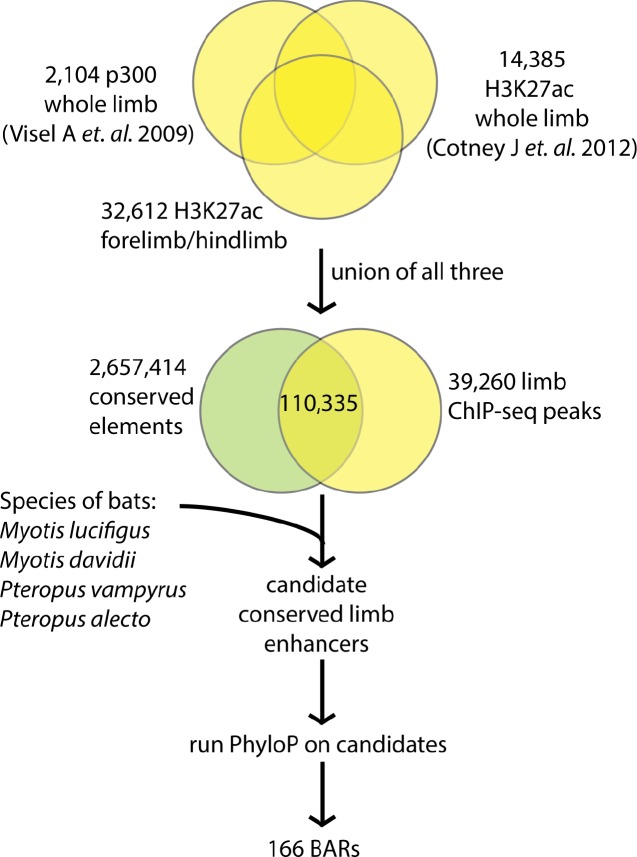
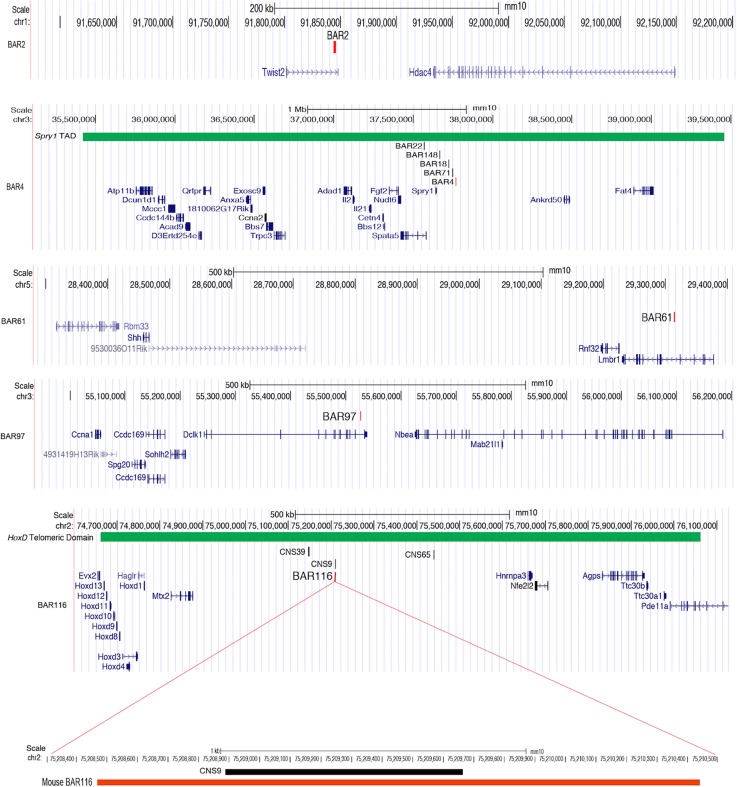
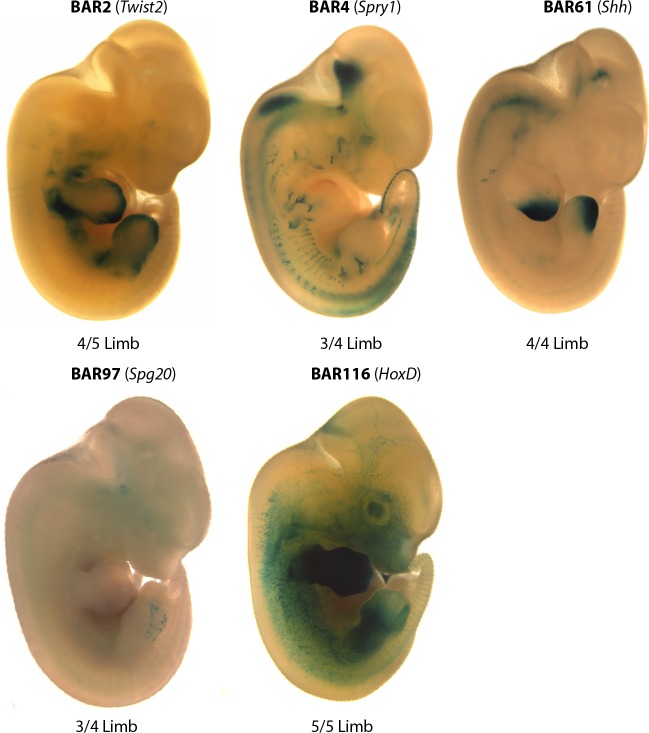
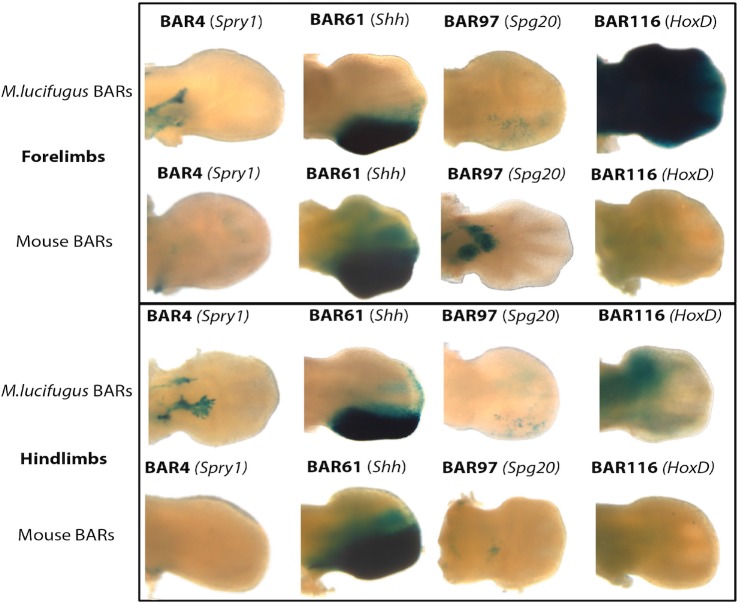
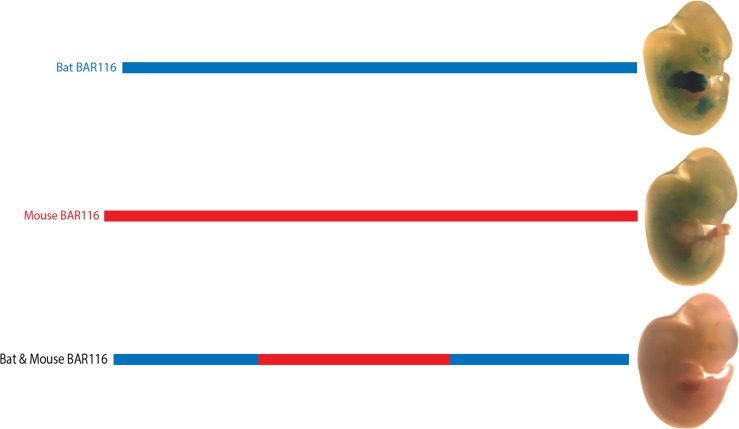
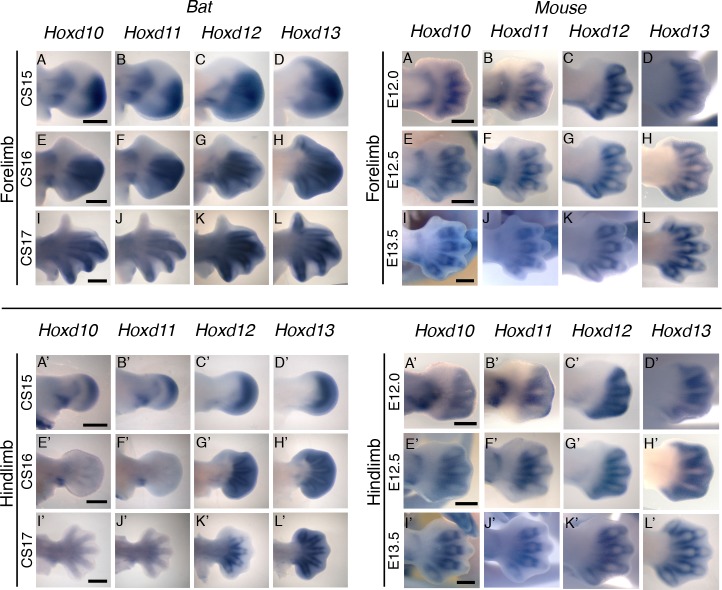
The molecular events leading to the development of the bat wing remain largely unknown, and are thought to be caused, in part, by changes in gene expression during limb development. These expression changes could be instigated by variations in gene regulatory enhancers. Here, we used a comparative genomics approach to identify regions that evolved rapidly in the bat ancestor, but are highly conserved in other vertebrates. We discovered 166 bat accelerated regions (BARs) that overlap H3K27ac and p300 ChIP-seq peaks in developing mouse limbs. Using a mouse enhancer assay, we show that five Myotis lucifugus BARs drive gene expression in the developing mouse limb, with the majority showing differential enhancer activity compared to the mouse orthologous BAR sequences. These include BAR116, which is located telomeric to the HoxD cluster and had robust forelimb expression for the M. lucifugus sequence and no activity for the mouse sequence at embryonic day 12.5. Developing limb expression analysis of Hoxd10-Hoxd13 in Miniopterus natalensis bats showed a high-forelimb weak-hindlimb expression for Hoxd10-Hoxd11, similar to the expression trend observed for M. lucifugus BAR116 in mice, suggesting that it could be involved in the regulation of the bat HoxD complex. Combined, our results highlight novel regulatory regions that could be instrumental for the morphological differences leading to the development of the bat wing.
Conflict of interest statement
The authors have declared that no competing interests exist.
Figures
References
-
- Casanova JC, Sanz-ezquerro JJ (2007) Digit morphogenesis: Is the tip different? Develop Growth Differ 49: 479–491. - PubMed
-
- Cooper LN, Sears KE (2013) How to grow a bat wing In: Adams RA, Pedersen SC, editors. Bat evolution, ecology, and conservation. New York: Springer Science; pp. 3–20.
-
- Sears KE, Behringer RR, Rasweiler JJ, Niswander LA (2007) The evolutionary and developmental basis of parallel reduction in mammalian zeugopod elements. Am Nat 169: 105–117. - PubMed
Publication types
MeSH terms
Substances
Grants and funding
- 1R01NS079231/NS/NINDS NIH HHS/United States
- R01 CA197139/CA/NCI NIH HHS/United States
- R01 HD059862/HD/NICHD NIH HHS/United States
- 1R01CA197139/CA/NCI NIH HHS/United States
- R01HD059862/HD/NICHD NIH HHS/United States
- R01 DK090382/DK/NIDDK NIH HHS/United States
- MC_PC_13052/MRC_/Medical Research Council/United Kingdom
- S10 OD021596/OD/NIH HHS/United States
- T32 GM008284/GM/NIGMS NIH HHS/United States
- T32 GM067547/GM/NIGMS NIH HHS/United States
- 1R01DK090382/DK/NIDDK NIH HHS/United States
- R01 NS079231/NS/NINDS NIH HHS/United States
LinkOut - more resources
Full Text Sources
Other Literature Sources
Molecular Biology Databases
Miscellaneous
