


Effect of 5-HT2A and 5-HT2C receptors on temporal discrimination by mice
- PMID: 27020041
- PMCID: PMC5403251
- DOI: 10.1016/j.neuropharm.2016.03.038
Effect of 5-HT2A and 5-HT2C receptors on temporal discrimination by mice
Abstract
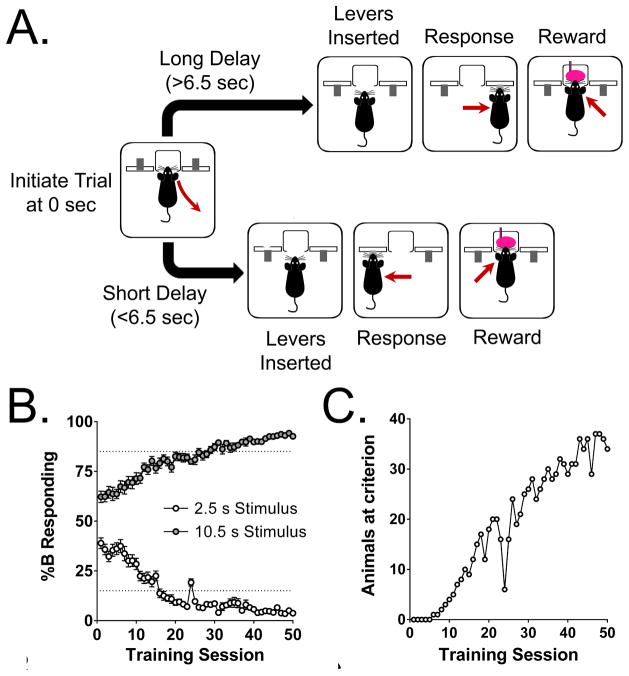
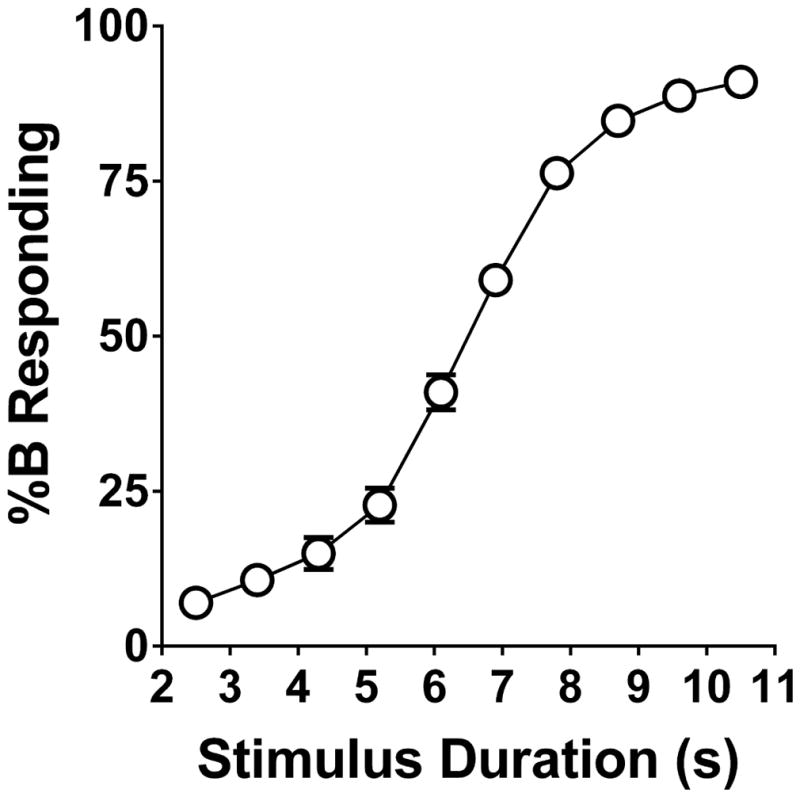
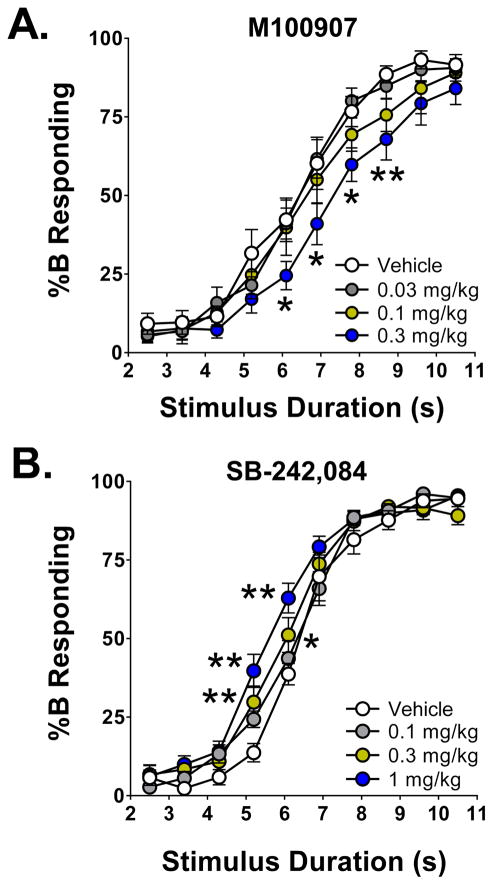
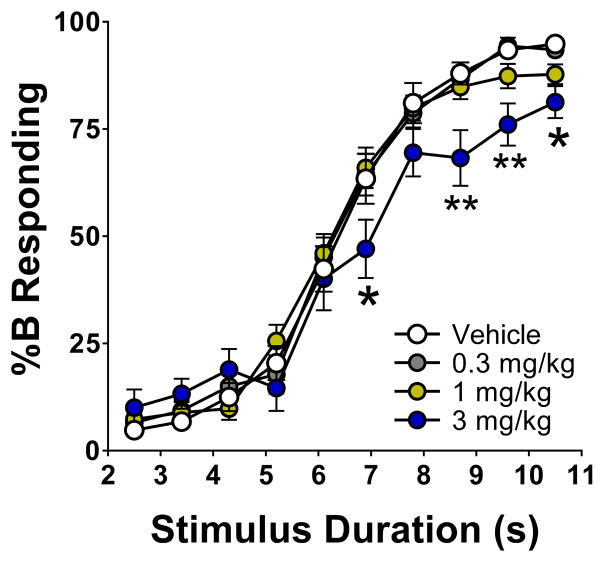
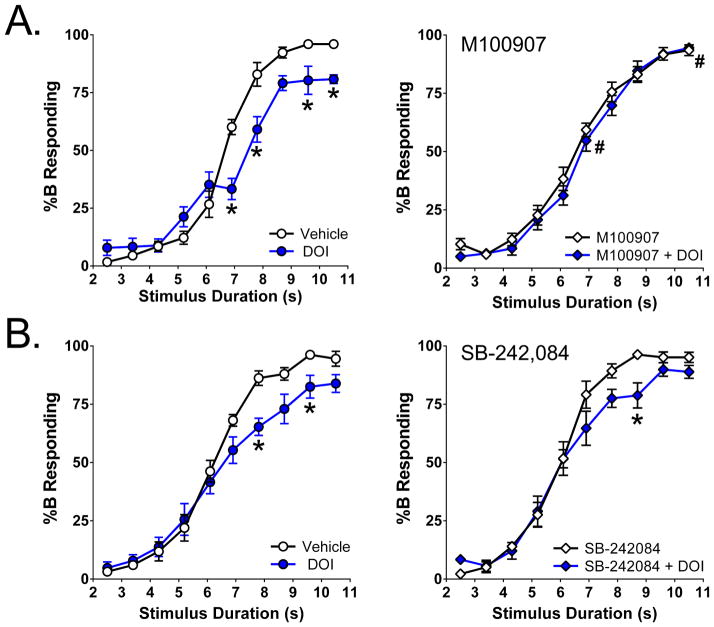
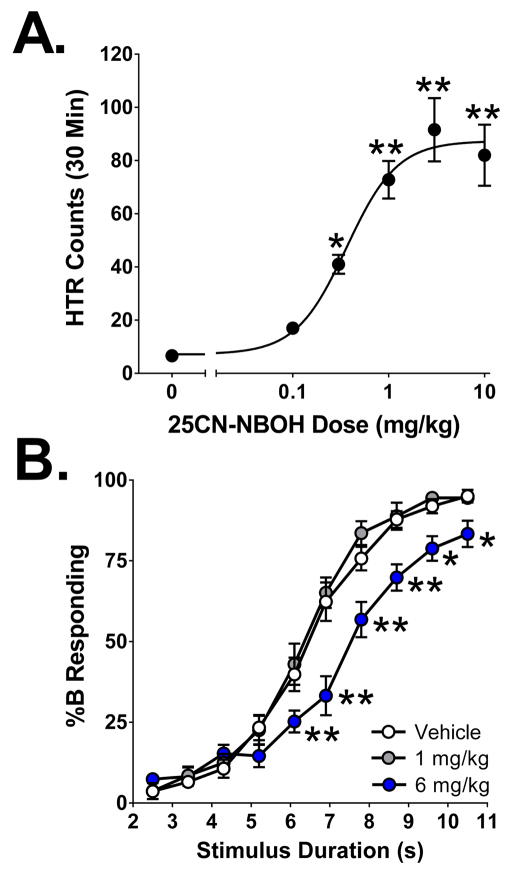
Timing deficits are observed in patients with schizophrenia. Serotonergic hallucinogens can also alter the subjective experience of time. Characterizing the mechanism through which the serotonergic system regulates timing will increase our understanding of the linkage between serotonin (5-HT) and schizophrenia, and will provide insight into the mechanism of action of hallucinogens. We investigated whether interval timing in mice is altered by hallucinogens and other 5-HT2 receptor ligands. C57BL/6J mice were trained to perform a discrete-trials temporal discrimination task. In the discrete-trials task, mice were presented with two levers after a variable interval. Responding on lever A was reinforced if the interval was <6.5 s, and responding on lever B was reinforced if the interval was >6.5 s. A 2-parameter logistic function was fitted to the proportional choice for lever B (%B responding), yielding estimates of the indifference point (T50) and the Weber fraction (a measure of timing precision). The 5-HT2A antagonist M100907 increased T50, whereas the 5-HT2C antagonist SB-242,084 reduced T50. The results indicate that 5-HT2A and 5-HT2C receptors have countervailing effects on the speed of the internal pacemaker. The hallucinogen 2,5-dimethoxy-4-iodoamphetamine (DOI; 3 mg/kg IP), a 5-HT2 agonist, flattened the response curve at long stimulus intervals and shifted it to the right, causing both T50 and the Weber fraction to increase. The effect of DOI was antagonized by M100907 (0.03 mg/kg SC) but was unaffected by SB-242,084 (0.1 mg/kg SC). Similar to DOI, the selective 5-HT2A agonist 25CN-NBOH (6 mg/kg SC) reduced %B responding at long stimulus intervals, and increased T50 and the Weber fraction. These results demonstrate that hallucinogens alter temporal perception in mice, effects that are mediated by the 5-HT2A receptor. It appears that 5-HT regulates temporal perception, suggesting that altered serotonergic signaling may contribute to the timing deficits observed in schizophrenia and other psychiatric disorders.
Keywords: Discrete-trials; Hallucinogen; Interval timing; Mice; Psychedelic.
Copyright © 2016 Elsevier Ltd. All rights reserved.
Figures
References
-
- Almaula N, Ebersole BJ, Ballesteros JA, Weinstein H, Sealfon SC. Contribution of a helix 5 locus to selectivity of hallucinogenic and nonhallucinogenic ligands for the human 5-hydroxytryptamine2A and 5-hydroxytryptamine2C receptors: direct and indirect effects on ligand affinity mediated by the same locus. Mol Pharmacol. 1996;50:34–42. - PubMed
-
- Asgari K, Body S, Bak VK, Zhang ZQ, Rickard JF, Glennon JC, Fone KC, Bradshaw CM, Szabadi E. Effects of 5-HT2A receptor stimulation on the discrimination of durations by rats. Behav Pharmacol. 2006;17:51–59. - PubMed
-
- Asgari K, Body S, Rickard JF, Zhang Z, Fone KC, Bradshaw CM, Szabadi E. Effects of quipazine and m-chlorophenylbiguanide (m-CPBG) on the discrimination of durations: evidence for the involvement of 5-HT2A but not 5-HT3 receptors. Behav Pharmacol. 2005;16:43–51. - PubMed
-
- Beringer K. Seine Geschiehte und Erseheinungsweise. Berlin: Springer; 1927. Der Meskalinrausch.
Publication types
MeSH terms
Substances
Grants and funding
LinkOut - more resources
Full Text Sources
Other Literature Sources
