


Review
doi: 10.1007/s00335-016-9628-9.
Epub 2016 Mar 28.
Old cells, new tricks: chromatin structure in senescence
Affiliations
- PMID: 27021489
- PMCID: PMC4935760
- DOI: 10.1007/s00335-016-9628-9
Item in Clipboard
Review
Old cells, new tricks: chromatin structure in senescence
Mamm Genome.
2016 Aug.
Abstract
Cellular senescence is a stable form of cell cycle arrest with roles in many pathophysiological processes including development, tissue repair, cancer, and aging. Senescence does not represent a single entity but rather a heterogeneous phenotype that depends on the trigger and cell type of origin. Such heterogeneous features include alterations to chromatin structure and epigenetic states. New technologies are beginning to unravel the distinct mechanisms regulating chromatin structure during senescence. Here, we describe the multiple levels of chromatin organization associated with senescence: global and focal, linear, and higher order.
Figures
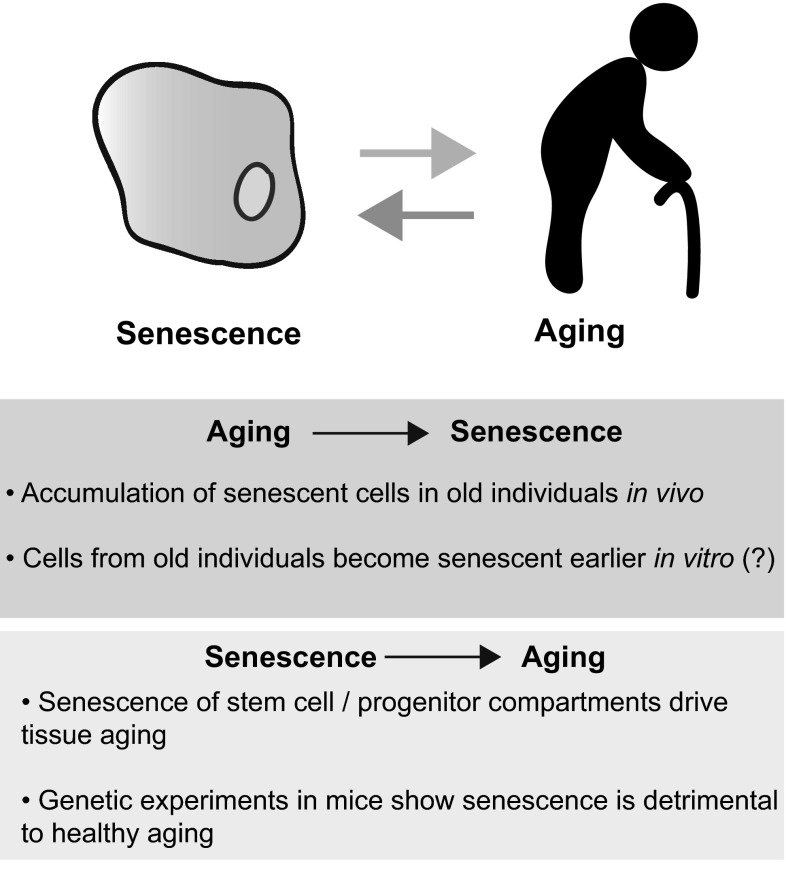
Cellular senescence and organismal aging. Although these processes involve different levels of complexity, evidence linking senescence and aging has been accumulating. Correlation between aging and senescence (Aging >Senescence), and some functional relevance of senescence for the aging process (Senescence >Aging) are shown. (Question mark) represents that the statement appears to be controversial (see text)
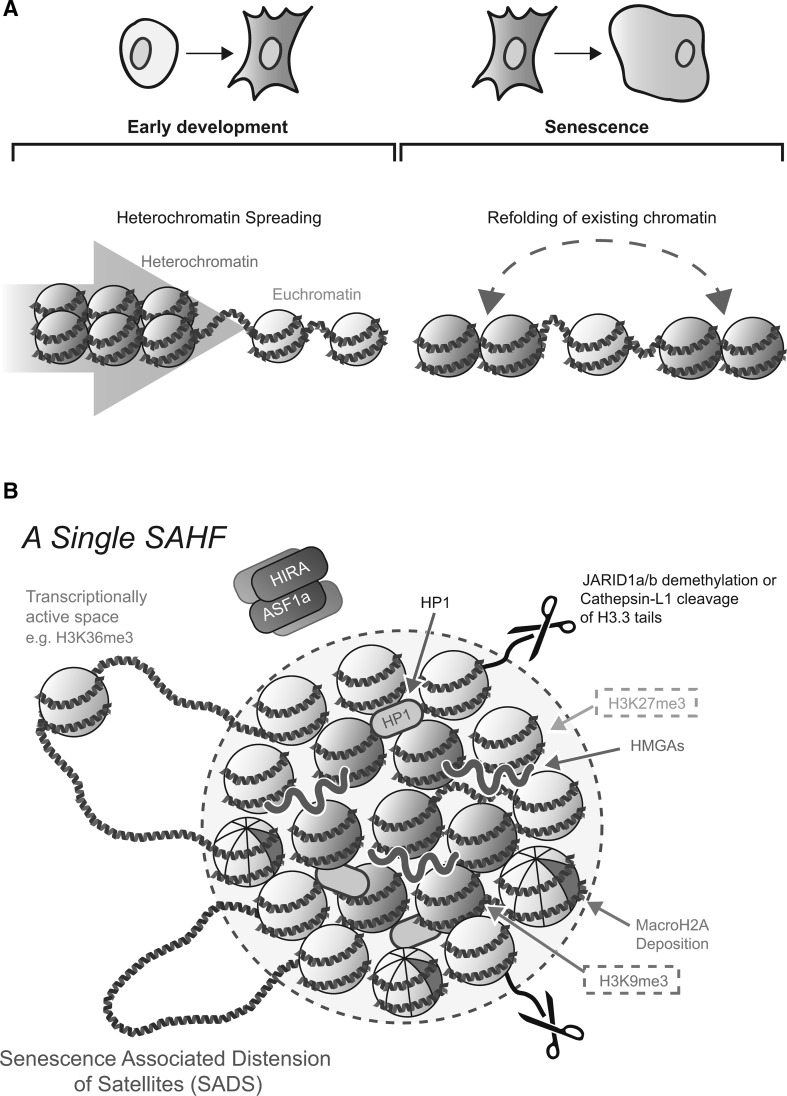
Heterochromatin assembly through spreading and spatial reorganization. a The primary model of heterochromatin establishment involves ‘spreading’ across the linear genome. This has largely been demonstrated in models of early development (left). In contrast, recent data suggest that during senescence there is a refolding of existing heterochromatin rather than an expansion (right). b Characterization of single SAHF. Chromatin is reorganized into a layered structure composing of a core enriched for the histone mark H3K9me3 (red nucleosomes) and an outer ring of H3K27me3 (green nucleosomes). Various effectors and structural components of SAHF have been identified, including HIRA/ASF1a, JARID1a/b, Cathepsin-L1, HP1 proteins, HMGA proteins, and others. Transcriptionally active genes and SADS may loop out from the SAHF core (Color figure online)
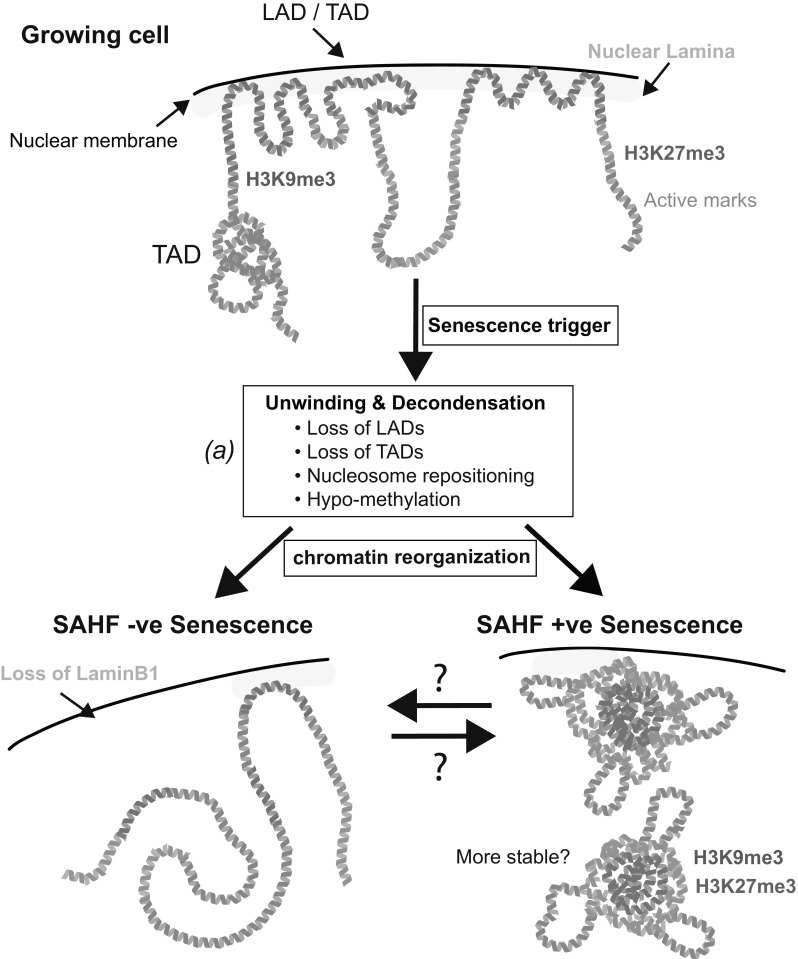
A speculative model of high-order chromatin structure alterations during senescence. Recent data suggest a ‘modular’ rearrangement of chromatin during senescence—an unwinding of chromatin and a de-condensation of canonical heterochromatin, its spatial reorganization and a refolding of chromatin. (a) It is unknown how general the features of unwinding are (i.e., loss of LADs, TADs etc.) and the extent of these may vary between types of senescence. Here, we illustrate two possible states following refolding (SAHF −ve and +ve), although a spectrum of states is likely. Although we have depicted chromatin as linear in the SAHF −ve state, various higher-order structures may exist
References
Publication types
MeSH terms
Substances
Grants and funding
LinkOut - more resources
Full Text Sources
Other Literature Sources
Medical
